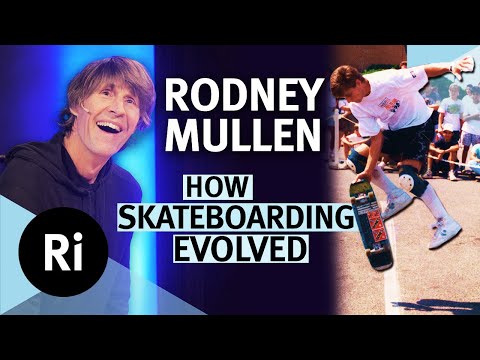
From impossible to iconic: Rodney Mullen's evolution of skateboarding
 Watch on YouTube →
Overview
Rodney Mullen explains how the flatland ollie helped move skateboarding from vert parks into streets, and how shared tricks, skate culture, and engineering shaped its evolution. He connects skating to embodied cognition, structured language, IBM Watson, and the ways practice, failure, intuition, and community support learning and creative progress.
Key takeaways
- The flatland ollie became transformative when skate-park closures pushed skaters into streets, where it enabled access to stairs, rails, and ledges.
- Skate tricks form a compact descriptive language: stance, rotation, and terrain details let skaters communicate complex movements across language barriers.
- In Mullen’s project with an IBM CTO, structured trick names let Watson generate plausible trick variations, and terrain data extended suggestions into city spots and learning routes.
- Repeated practice embeds environmental physics in the body; Mullen describes elite skaters as developing an inner calculus of forces such as friction, speed, and ramp flex.
- For difficult tricks, analytical iteration and belief work together: Tony Hawk adjusted his body position to preserve angular momentum, while a first successful 900 made the feat seem possible to others.
- Skateboarding’s transferable strengths include managing failure, maintaining subtle motor awareness, and relying on community—qualities Mullen applied while guiding students at MIT Media Lab.
Chapters
0:00
The Flatland Ollie and Skateboarding’s Move into the Streets
- Rodney Mullen says movements from tricks he had practiced for years came together into the flatland ollie after he saw them in a new way.
- By the mid-1980s, injuries and rising insurance costs closed skate parks, making ollies useful for getting onto stairs, handrails, and ledges.
- Mullen describes innovation as old ideas finding new uses when the surrounding culture and terrain change.
2:40
Skate Culture, Punk, and an Open-Source Trick Community
- As skating shifted from surf-inspired competition toward street skating, new generations focused on what they could do with a board and four wheels.
- Mullen links skateboarding’s outsider identity to punk and hip-hop, highlighting photographer Glen E. Friedman and the documentary All the Streets Are Silent.
- Skaters share tricks across places such as London’s Southbank, while individuals develop distinctive ways to perform them; Mullen likens this to an open-source community.
6:25
Creativity, Engineering, and the Mechanics of Skate Tricks
- Drawing on John Seely Brown of Xerox PARC, Mullen frames creativity as making the familiar strange and imagination as making the strange familiar.
- Skaters repurpose spaces and objects for unauthorized uses, while skateboard product design must fit how the adopting culture actually skates.
- Mullen analyzes tricks as combinations of smaller movements, comparing the hours of refinement to drawing the pages of a flip book until motion becomes automatic.
9:40
Skate Trick Grammar, Labanotation, and IBM Watson
- Skate trick names use a compact prefix-root-suffix structure to describe stance, direction, board rotation, and terrain.
- Mullen contrasts skate terminology with Labanotation, a detailed movement notation developed in the 1920s and adopted by dancers by 1940.
- In a project with an IBM CTO, structured trick names helped Watson generate plausible variations without being taught the underlying physics.
- Adding terrain information let a chatbot suggest London and Barcelona spots, transit routes, and a progression from ledges to hubbas and small handrails.
14:35
Shaun White, Danny Way, and Embodied Physics
- Mullen argues that repeated practice embeds an environment’s physics into movement, shaping how skaters learn and imagine new tricks.
- Shaun White’s snowboarding and vert experience influenced his skating, while Danny Way’s motocross and ramp background helped inspire the MegaRamp.
- For Danny Way’s Great Wall of China jump, Mullen recounts how Way identified that the takeoff needed more height, fractured an ankle, then completed the jump and a backside 360.
- Mullen calls elite skating an inner calculus: sensitivity to forces such as wheel friction, ramp flex, and wind that supports fast learning and safer decisions.
22:15
Tony Hawk’s Iteration, Belief, and the Limits of Practice
- Mullen analyzes Tony Hawk adjusting a front-foot impossible and backside air by changing how much he opened his body to preserve angular velocity for landing.
- Learning an unprecedented trick means projecting toward a landing and working backward through the movements needed to reach it.
- Mullen says the first successful 900 helped make the trick seem possible to others, showing how belief can break through a barrier that technique alone does not remove.
- He compares skill-building to machine learning research on forgetting: targeted overwriting of less-important information matters because ingrained movements can be difficult to unlearn.
30:30
Failure, Somatic Awareness, and the Skateboarding Community
- Skaters build pattern recognition by managing repeated falls; Mullen describes other skaters recognizing Milton’s promising kickflip attempt as soon as he flicked the board.
- Injury breaks practice and can dull the fine-tuned awareness of where a skater and board will be at commitment, increasing the risk of reinjury.
- Mullen argues that deliberate practice must maintain subtle skills, and that experienced peers help skaters endure injuries and the pressure to return.
- He compares skating intuition with chess, citing Magnus Carlsen’s ability to sense the potential of moves beyond straightforward calculation.
36:15
Mullen’s Surgery, MIT Media Lab, and Lessons Beyond Skating
- After spinal surgery, Mullen had to relearn how his feet related to the board, describing the change as altered physical infrastructure beneath decades of practiced movement.
- He uses computer networking layers as an analogy for how bodily changes can disrupt learned motor routines and require rebuilding them.
- Mullen recalls landing a trick with Lance Mountain after four tries despite not having attempted it for ten years.
- At MIT Media Lab, he found that skateboarding’s habits of experimentation, learning from failure, and community collaboration helped him guide researchers; he argues these transferable skills support resilience in any field.
Summary, takeaways, and chapters were generated by AI from the video's transcript and may contain errors. The video belongs to its creator, The Royal Institution.