Fri Sep 4, 2026 Lecture (L06) Stewart Sect. 2.1 Derivatives and Rates of Change
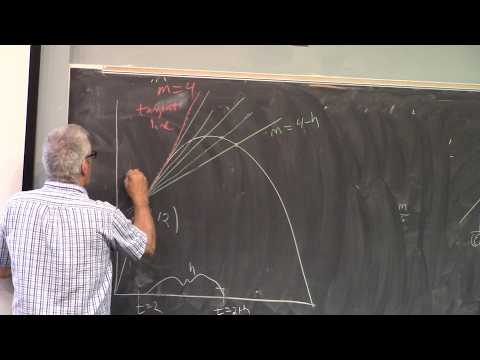 Watch on YouTube →
Overview
Barsamian's Math Videos develops the ideas in Stewart Section 2.1, “Derivatives and Rates of Change,” through a ball-height model, y(t) = 8t − t². The lecture connects average velocity to secant-line slopes, derives instantaneous velocity as a limit (4 m/s at t = 2), and uses that slope and the point (2, 12) to find the tangent line y = 4t + 4.
Key takeaways
- For the height model y(t) = 8t − t², the initial height is y(0) = 0, the ball returns to ground level at t = 8, and the peak occurs at t = 4.
- Average velocity over an interval is the slope of the secant line between the corresponding points on the graph; from t = 2 to t = 4, that slope is 2 m/s.
- For the interval from t = 2 to t = 2 + h, the difference quotient simplifies to 4 − h, provided h ≠ 0.
- Taking the limit of 4 − h as h approaches zero gives the instantaneous velocity y′(2) = 4 m/s and the tangent slope at (2, 12).
- Using the point (2, 12) and slope 4 gives the tangent-line equation y − 12 = 4(t − 2), or y = 4t + 4.
Chapters
0:00
Stewart Section 2.1 and the Lecture Handout
- Barsamian's Math Videos introduces Lecture 6 on Stewart Section 2.1, “Derivatives and Rates of Change.”
- The handout is available in class and as a PDF through the course website's calendar entry.
- The lecture introduces defined terms through an extended example rather than beginning with formal definitions.
2:55
Modeling a Thrown Ball with y(t) = 8t − t²
- The example models a ball thrown upward at 8 m/s on a fictional planet with height y(t) = 8t − t².
- Here, t is time in seconds after release and y(t) is height in meters above the ground.
- Since y(0) = 0, the ball starts at ground level; a nonzero constant term would represent an initial height, such as a tower.
7:12
Graphing the Parabola from Its Standard and Factored Forms
- The negative coefficient of t² shows that y(t) = 8t − t² is a downward-opening parabola.
- Factoring as y(t) = t(8 − t) reveals the time-axis intercepts t = 0 and t = 8.
- The graph passes through (0, 0), and its symmetry places the peak at t = 4.
11:38
Average Velocity from t = 2 to t = 4
- Average velocity is calculated as [y(4) − y(2)]/(4 − 2), using the change in height over the elapsed time.
- The model gives y(4) = 16 and y(2) = 12, so the average velocity is (16 − 12)/2 = 2 m/s.
- Graphically, the value 2 is the slope of the secant line through (2, 12) and (4, 16).
17:54
Building the Secant Slope from t = 2 to t = 2 + h
- The average velocity over the interval from 2 to 2 + h is [y(2 + h) − y(2)]/h.
- Substituting y(t) = 8t − t² and expanding (2 + h)² gives a numerator that simplifies to 4h − h².
- For h ≠ 0, canceling h yields the secant slope 4 − h; the second point is (2 + h, y(2 + h)).
29:12
Instantaneous Velocity as a Limit of Secant Slopes
- Instantaneous velocity at t = 2 is defined by the limit as h approaches 0 of [y(2 + h) − y(2)]/h.
- Because the difference quotient simplifies to 4 − h, direct substitution gives a limit of 4 m/s.
- The limit exists even though h itself cannot equal zero in the original difference quotient.
33:20
Secant Lines Converge to the Tangent at (2, 12)
- As h approaches zero, the secant line's second point moves toward the fixed point (2, 12).
- The secant slopes 4 − h approach 4, so the limiting line through (2, 12) has slope 4.
- That limiting line is the tangent line, and its slope is the instantaneous velocity y′(2) = 4.
37:19
Finding the Tangent-Line Equation at t = 2
- The tangent line is determined by the point (2, 12) and slope 4, so point-slope form gives y − 12 = 4(t − 2).
- Rearranging gives y = 4t + 4, with slope 4 and y-intercept 4.
- For tangent-line problems, identify the point (a, f(a)) and derivative slope f′(a) before inserting values into the line equation.
42:51
Maximum-Height Question Deferred; Tangent-Line Practice Assigned
- The question of the ball's maximum height is left for later, when a simpler method for computing velocities is introduced.
- A related recitation problem asks for the tangent-line equation to y = √x at x = 1.
- That problem requires finding the point of tangency and calculating the tangent slope before writing the line equation.
Summary, takeaways, and chapters were generated by AI from the video's transcript and may contain errors. The video belongs to its creator, Barsamian's Math Videos.