Fri Sep 25, 2026 Lecture (L13) Stewart Sections 2.6 Implicit Differentiation and 2.7 Related Rates
 Watch on YouTube →
Overview
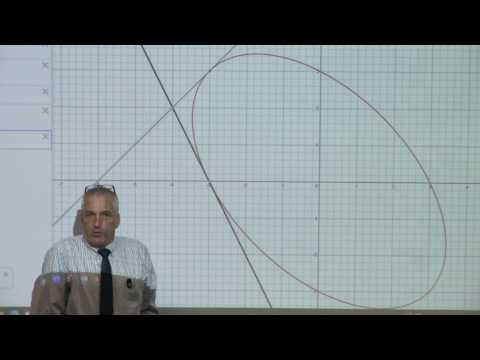
Barsamian's Math Videos introduces implicit differentiation as a way to find dy/dx from an equation relating x and y without solving explicitly for y, then applies it to tangent lines on the ellipse x² + xy + y² = 9. The lecture begins related rates with a cylindrical tank: differentiating V = πd²h/4 and using diameter 4 m and dh/dt = 0.2 m/min gives an inflow rate of 0.8π m³/min.
Key takeaways
- Implicit differentiation handles curves that are not globally functions of x by differentiating their defining equations and solving for y′.
- When differentiating with respect to x, y must be treated as a function of x: for example, d(y²)/dx = 2yy′.
- For x² + xy + y² = 9, the derivative is y′ = −(2x + y)/(x + 2y), so tangent slopes depend on the specific point, not only its x-coordinate.
- A related-rates solution requires a geometric equation connecting quantities before substituting the known instantaneous values and rates.
- For a cylinder of fixed diameter d, dV/dt = (πd²/4)(dh/dt); with d = 4 m and dh/dt = 0.2 m/min, inflow is 0.8π m³/min.
Chapters
0:00
Implicit Equations Versus Explicit Functions
- An equation such as x³ + y³ = 7 relates x and y implicitly, even when it can also be rearranged to express y explicitly.
- The relation x² + y² = 49 describes a circle, not one global function y(x), because some x-values correspond to two y-values.
- Implicit differentiation finds dy/dx without first solving the original equation for y.
5:00
Local Circle Branches Explain Why Implicit Differentiation Works
- The upper semicircle can be written y = √(49 − x²), while the lower semicircle is y = −√(49 − x²).
- Although a curve may fail the vertical line test globally, portions of it can behave as functions locally.
- Implicit differentiation avoids identifying and solving for each local branch before finding a slope.
8:20
Differentiate Both Sides and Solve for y′
- Treat y as a function of x when differentiating an equation involving x and y.
- The derivative of x with respect to x is 1, while differentiating y produces y′.
- After differentiating both sides, collect terms involving y′ and solve to obtain a derivative formula that can depend on both x and y.
15:50
Product and Chain Rules for y cos x = x² + y²
- For y cos x = x² + y², the product rule gives y′ cos x − y sin x on the left.
- The chain rule gives 2yy′ for the derivative of y²; the right side becomes 2x + 2yy′.
- Collecting y′ terms yields y′ = (2x + y sin x)/(cos x − 2y).
21:40
Find a Tangent to x² + xy + y² = 9 at (−3, 3)
- Implicit differentiation of x² + xy + y² = 9 gives 2x + y + xy′ + 2yy′ = 0.
- Solving gives y′ = −(2x + y)/(x + 2y); at (−3, 3), the tangent slope is 1.
- Using point-slope form at (−3, 3) gives the tangent line y − 3 = x + 3, or y = x + 6.
28:30
The Same Ellipse Has Different Tangents at x = −3
- The ellipse also passes through (−3, 0), demonstrating that specifying x = −3 alone does not identify a unique point.
- Substituting (−3, 0) into y′ = −(2x + y)/(x + 2y) gives slope −2.
- The tangent line at (−3, 0) is y = −2x − 6; implicit tangent-line problems require both coordinates of the point.
31:10
Related Rates Connect Quantities That Change Together
- Related-rates problems begin with an equation connecting quantities, then use known values and rates to determine an unknown rate.
- Rates are derivatives with respect to time, such as dh/dt or dV/dt.
- The lecture shifts from implicit differentiation to Section 2.7, emphasizing that differentiating a shared equation creates a relationship between rates.
34:40
Model the Cylindrical Tank with Variables and Known Values
- The tank is a cylinder 6 m tall with diameter 4 m; at the instant of interest, the water depth is 2 m.
- The water level rises at 20 cm/min, which must be converted to dh/dt = 0.2 m/min.
- The target is the inflow rate, equivalent to the rate of change of water volume, dV/dt.
41:30
Relate Water Volume to Diameter and Depth
- For a cylindrical volume, V = πr²h; using diameter d instead of radius gives V = πd²h/4.
- The tank’s full height of 6 m and the current water depth of 2 m do not affect the volume-rate formula for a cylinder with fixed diameter.
- Differentiating with respect to time while d is constant gives dV/dt = (πd²/4)(dh/dt).
46:40
Compute the Inflow Rate and Review Quiz Coverage
- Substituting d = 4 m and dh/dt = 0.2 m/min gives dV/dt = π(4²)(0.2)/4 = 0.8π m³/min.
- The lecture corrects an initial arithmetic slip: the final rate is 0.8π, not 3.2π, cubic meters per minute.
- The announced Monday quiz covers Stewart Sections 2.4, 2.5, and 2.6.
Summary, takeaways, and chapters were generated by AI from the video's transcript and may contain errors. The video belongs to its creator, Barsamian's Math Videos.