Fri Sep 11, 2026 Lecture (L08) Stewart Sect. 2.2 The Derivative as a Function, Part 2
 Watch on YouTube →
Overview
Section 2.2 develops the derivative as a function by finding the derivative of f(t) = 1/√t directly from the limit definition, using a common denominator and conjugate to obtain f′(t) = −1/(2t^(3/2)). It then establishes that differentiability implies continuity and uses graph behavior to identify three failures of differentiability: discontinuities, a cusp, and a vertical tangent.
Key takeaways
- Using the limit definition for f(t) = 1/√t requires combining fractions, multiplying by the conjugate, canceling h for h ≠ 0, and then evaluating the limit to get −1/(2t^(3/2)).
- If f′(x) exists, the numerator f(x+h) − f(x) must approach zero as h→0; this gives lim(h→0) f(x+h) = f(x) and proves continuity at x.
- The contrapositive of “differentiability implies continuity” is “discontinuity implies no derivative,” making discontinuity a sufficient test for failure of differentiability.
- Continuity alone does not guarantee differentiability: a cusp can prevent a unique tangent line even when the function itself is continuous.
- A vertical tangent also prevents a finite derivative because its slope is undefined, despite the tangent line itself being present.
Chapters
0:00
Section 2.2 Recap and a Definition-Based Derivative
- Lecture 8 continues Stewart Section 2.2, following an earlier graphical and formula-based example involving a quadratic.
- The class sets out to differentiate f(t) = 1/√t using the definition rather than shortcut rules.
- The limit definition is emphasized as the required method when a problem explicitly requests it; faster derivative rules are introduced later.
2:05
Differentiate 1/√t by Rationalizing the Difference Quotient
- The difference quotient is [1/√(t+h) − 1/√t]/h, which gives the indeterminate form 0/0 when h approaches zero.
- Combining the two fractions over a common denominator prepares the numerator for multiplication by its conjugate.
- The difference-of-squares identity reduces the numerator to −h; canceling h is valid because the limit takes h toward zero through nonzero values.
- Substituting h = 0 after cancellation gives f′(t) = −1/(2t^(3/2)).
16:22
The Derivative Limit and Conditions for Differentiability
- The derivative at x is defined as lim(h→0) [f(x+h) − f(x)]/h.
- Because the denominator h approaches zero, a finite derivative limit requires the numerator to approach zero as well.
- This requirement leads to lim(h→0) f(x+h) = f(x), the defining limit condition for continuity at x.
17:24
Why Differentiability at x Guarantees Continuity at x
- If f′(x) exists, then the difference quotient has a limit, forcing f(x+h) − f(x) to approach zero.
- Consequently, lim(h→0) f(x+h) = f(x), so f must be continuous at that x-value.
- The implication is one-way: continuity is necessary for differentiability, but this result does not establish that every continuous function is differentiable.
24:59
Contrapositives: Turning the Continuity Result into a Test
- For a conditional statement “if A, then B,” the converse “if B, then A” is not logically equivalent; the Cavaliers and Ferrari examples illustrate the distinction.
- The contrapositive, “if not B, then not A,” is logically equivalent to the original conditional.
- Applying that rule to differentiability yields: if f is not continuous at x, then f′(x) does not exist there.
30:11
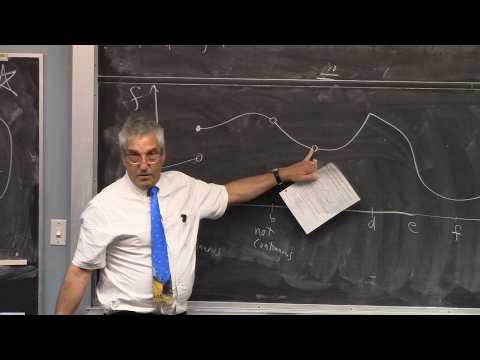
Graph Examples: Three Discontinuities Prevent Derivatives
- At graph location A, the left- and right-hand limits disagree, so the limit does not exist and the function is discontinuous.
- At B, the limit exists but the function’s y-value is missing; at C, both exist but the limit and y-value differ.
- Since the function is discontinuous at A, B, and C, the contrapositive guarantees that its derivative does not exist at those points.
32:36
Cusps and Vertical Tangents Also Block Differentiability
- At D, the graph is continuous but has a cusp, so no single tangent line matches the graph’s direction from both sides.
- At E, the tangent line is vertical; although a tangent line exists, its slope is undefined, so there is no derivative value.
- The lecture identifies three general failure modes: discontinuity, no unique tangent line (as at a cusp), or a vertical tangent with undefined slope.
Summary, takeaways, and chapters were generated by AI from the video's transcript and may contain errors. The video belongs to its creator, Barsamian's Math Videos.