Fri Oct 9, 2026 Lecture (L18) Stewart Sections 3.5 derivatives of Inverse Trig Functions
 Watch on YouTube →
Overview
The lecture covers Stewart Section 3.5, first defining inverse sine, cosine, and tangent through restricted domains so each trig function is one-to-one, then showing how principal-value ranges affect inverse-function cancellation. It derives the three inverse-trig derivative formulas from the inverse-function rule and applies the chain rule to distinguish derivatives such as (arctan x)^3 and arctan(x^3).
Key takeaways
- Inverse sine, cosine, and tangent require restricted domains: [-π/2, π/2] for sine, [0, π] for cosine, and (-π/2, π/2) for tangent.
- Inverse-trig cancellation returns the original angle only when that angle lies in the inverse function’s principal-value range; for example, arcsin(sin(2π/3)) = π/3.
- For θ = arccos(x), a right triangle gives tan(arccos x) = √(1 - x²)/x, with signs and allowable inputs governed by arccos’s range.
- The derivative formulas are arcsin′(x) = 1/√(1 - x²), arccos′(x) = -1/√(1 - x²), and arctan′(x) = 1/(1 + x²).
- Chain-rule structure changes the result: d/dx[(arctan x)³] = 3(arctan x)²/(1 + x²), whereas d/dx[arctan(x³)] = 3x²/(1 + x⁶).
Chapters
0:00
Restricted Domains Make Sine, Cosine, and Tangent Invertible
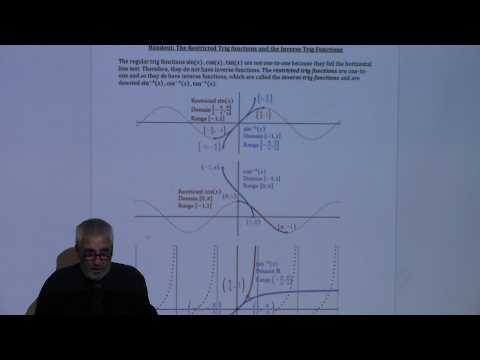
- The ordinary sine, cosine, and tangent functions fail the horizontal line test, so none has an inverse function over its full domain.
- Restrict sine to [-π/2, π/2], giving an inverse with domain [-1, 1] and range [-π/2, π/2].
- Restrict cosine to [0, π], giving arccos domain [-1, 1] and range [0, π].
- Restrict tangent to (-π/2, π/2), giving arctan domain all real numbers and range (-π/2, π/2).
5:30
Principal Values Determine When Inverse-Trig Cancellation Works
- The identities arcsin(sin x) = x and similar cancellation rules apply only when x lies in the restricted function’s domain.
- Since 2π/3 is outside arcsin’s range, arcsin(sin(2π/3)) = arcsin(√3/2) = π/3, not 2π/3.
- Because 2π/3 lies in arccos’s range [0, π], arccos(cos(2π/3)) = 2π/3.
- For tangent, tan(2π/3) = -√3, so arctan(tan(2π/3)) = arctan(-√3) = -π/3.
13:24
Right-Triangle Methods Simplify Mixed Inverse-Trig Expressions
- For θ = arccos(x), cosine gives adjacent/hypotenuse = x/1; the Pythagorean theorem gives the opposite side √(1 - x²).
- Using that triangle, tan(arccos x) = √(1 - x²)/x, with the expression’s domain and sign constrained by the principal arccos range.
- For θ = arctan(x), tangent gives opposite/adjacent = x/1, so the hypotenuse is √(1 + x²).
- The second triangle yields cos(arctan x) = 1/√(1 + x²); drawing the triangle makes the relevant side ratios explicit.
18:28
Inverse-Function Rule Produces the Inverse-Trig Derivatives
- Apply (f⁻¹)'(x) = 1 / f'(f⁻¹(x)) to the restricted trig functions.
- For arcsin, use cos(arcsin x) = √(1 - x²) to obtain d/dx[arcsin x] = 1/√(1 - x²).
- The corresponding formulas are d/dx[arccos x] = -1/√(1 - x²) and d/dx[arctan x] = 1/(1 + x²).
- The inverse sine and cosine derivatives share the same denominator, but arccos has a negative sign.
25:07
Chain Rule Distinguishes Cubed Arctangent from Arctangent of a Cube
- For (arctan x)³, treat arctan x as the inner function and the cube as the outer function: the derivative is 3(arctan x)²/(1 + x²).
- For arctan(x³), the inner function is x³ and the outer function is arctan, giving 3x²/(1 + x⁶).
- The two expressions differ because the cube is outside arctan in the first case and inside it in the second.
- The lecture ends by transitioning to a quiz after emphasizing careful use of nested functions and the chain rule.
Summary, takeaways, and chapters were generated by AI from the video's transcript and may contain errors. The video belongs to its creator, Barsamian's Math Videos.