Fractals (zₙ₊₁= zₙ² + c)
 Watch on YouTube →
Overview
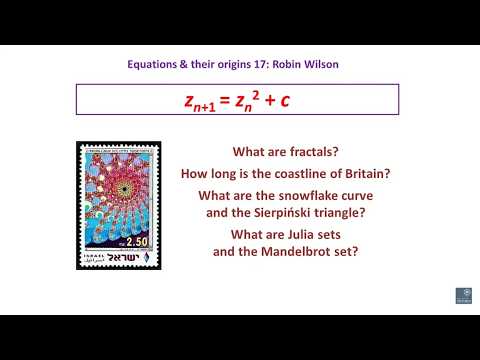
Oxford Mathematics explores the geometry of fractals, introducing concepts like the coastline paradox and self-similarity through examples such as the Koch snowflake and Sierpinski triangle. The discussion culminates in an explanation of Julia sets and the Mandelbrot set, defined by the recurrence relation zₙ₊₁ = zₙ² + c, highlighting their intricate beauty and complexity.
Key takeaways
- The length of natural coastlines, like Britain's, can be infinite due to their jagged, self-similar nature, a key characteristic of fractals.
- The Koch snowflake, constructed iteratively, possesses infinite length and encloses a finite area, demonstrating fractal properties.
- The Sierpinski triangle, formed by removing central triangles, exhibits self-similarity and can be visualized using Pascal's triangle.
- Julia sets are defined by the boundary of points that remain finite under repeated application of a complex transformation (zₙ₊₁ = Az + B).
- The Mandelbrot set comprises all complex numbers C for which the corresponding Julia set (derived from zₙ₊₁ = zₙ² + C with Z₀ = 0) is connected.
- Fractals, like the Mandelbrot set, exhibit profound complexity and self-similarity at all scales, bridging mathematics and art.
Chapters
0:00
Introduction to Fractals and the Coastline Paradox
- Introduces fractals through the question of measuring the length of Britain's coastline.
- Explains how zooming in reveals more detail, leading to an infinite length for a finite area.
- Compares this to an infinitely long alphorn with a finite volume, illustrating fractal properties.
4:19
Koch Snowflake and Sierpinski Triangle Construction
- Details the construction of the Koch snowflake by iteratively adding triangular peaks to each side of an equilateral triangle.
- Explains the Koch snowflake has infinite length and encloses a finite area, exhibiting self-similarity.
- Describes the Sierpinski triangle construction by repeatedly removing the central inverted triangle from smaller triangles.
- Notes the Sierpinski pattern can also be derived from Pascal's triangle by coloring odd numbers gray.
11:39
Julia Sets and the Mandelbrot Set
- Introduces Benoit Mandelbrot, who coined the term 'fractal' for self-similar, fragmented shapes.
- Explains Julia sets as the boundary between points that remain finite and those that diverge under iteration of zₙ₊₁ = Az + B.
- Defines the Mandelbrot set as the set of complex numbers C for which the Julia set of zₙ₊₁ = zₙ² + C remains connected, with Z₀ = 0.
Summary, takeaways, and chapters were generated by AI from the video's transcript and may contain errors. The video belongs to its creator, Oxford Mathematics.