Formal Charges, Lewis Structures, and Resonance Forms
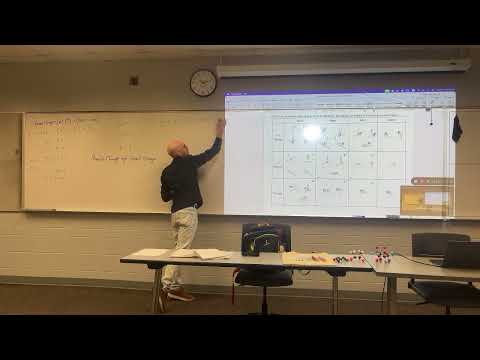 Watch on YouTube →
Overview
John Flood teaches how to calculate formal charge, draw Lewis structures, and compare resonance forms using electron counts, octet patterns, and electronegativity. Worked examples include CH₂Cl₂, CO₂, HCN, NH₄⁺, SF₆, PH₃O, hypochlorite, bromite, iodate, sulfate, and oxy acids; the central lesson is to conserve the correct number of electrons, satisfy duet or octet preferences where applicable, and favor structures with fewer, appropriately placed formal charges.
Key takeaways
- Formal charge is an atom-by-atom accounting tool: subtract the atom’s nonbonding electrons and bond lines from its valence-electron count.
- Lewis structures must use the exact total electron count, adjusted for ionic charge; maximizing octets without counting electrons can produce an invalid structure.
- For atoms capable of expanded-octet Lewis structures, sharing a lone pair into an additional bond can reduce formal charges, as in PH₃O and sulfate.
- When alternative valid structures place a negative charge on different atoms, the contributor placing it on the more electronegative atom—such as oxygen rather than chlorine—is generally preferred.
- Resonance contributors are alternative electron arrangements for one delocalized structure; sulfate has six equivalent major contributors with two S=O bonds in each drawing.
- A resonance hybrid represents sulfate’s S–O bonds as intermediate between single and double bonds, highlighting why no single Lewis structure fully describes the molecule.
Chapters
0:00
Formal Charge: Count Valence Electrons, Dots, and Bonds
- Calculate formal charge for one atom at a time: valence electrons minus nonbonding dots minus bond lines.
- A carbon with three bonds and no lone-pair dots has a +1 formal charge; with three bonds and one lone pair, it is −1.
- Neutral carbon commonly has four bonds and no lone pairs, giving 4 − 4 = 0.
8:09
Neutral Bonding Patterns and Formal Versus Partial Charge
- Common neutral patterns are nitrogen with three bonds and one lone pair, oxygen with two bonds and two lone pairs, and halogens with one bond and three lone pairs.
- Formal charge depends on valence electrons, dots, and bond lines—not on the identity or electronegativity of the bonded partner.
- Partial charge reflects unequal sharing caused by electronegativity differences; it is distinct from formal charge.
15:12
Duet and Octet Rules for Hydrogen and Second-Row Atoms
- Hydrogen follows the duet rule: it has one electron and typically forms one covalent bond to reach two electrons.
- Carbon, nitrogen, oxygen, and fluorine generally follow the octet rule, with characteristic neutral bond counts of four, three, two, and one.
- Helium already has a duet and typically forms no bonds.
18:07
Boron’s Electron Deficiency and Competing Lewis Structures
- Boron and aluminum commonly form three bonds without completing an octet; BH₃ is a neutral example with three bonds and no lone pairs on boron.
- In BH₄⁻, boron has four bonds and a formal charge of −1, illustrating that an octet can come with a charge.
- For boron trihalides, a structure with neutral, electron-deficient boron can be preferable to a full-octet alternative with opposing formal charges.
23:59
Hypervalent Atoms and Assigning Lone Pairs
- The lecture introduces hypervalent atoms—especially period-three and heavier elements such as phosphorus, sulfur, chlorine, bromine, and iodine—as capable of exceeding an octet in Lewis structures.
- A lone-pair exercise asks students to assign electrons to neutral bonding patterns for boron, phosphorus, sulfur, and the halogens.
- John Flood presents available d orbitals as the traditional explanation for expanded octets in the course’s Lewis-structure model.
33:32
Expanded Bonding Patterns, Formal Charge, and Radicals
- Phosphorus and sulfur can have neutral expanded bonding patterns that differ from nitrogen and oxygen, their lighter group analogues.
- An expanded octet can be preferred when it reduces formal charge, as in structures where phosphorus or sulfur avoids an unnecessary positive charge.
- A radical is an unpaired electron; nitrogen radicals are common examples, and hydrogen peroxide can form reactive oxygen-centered radicals.
39:29
A Six-Step Workflow for Drawing Lewis Structures
- Count all valence electrons first, adjust for the molecule’s charge, and place the least electronegative suitable atom at the center; hydrogen is never central.
- Connect atoms to the center with single bonds, then place remaining electrons as lone pairs on outer atoms before adding them to the center.
- Check duet and octet requirements, then convert lone pairs into multiple bonds when that improves octets or minimizes formal charge.
42:31
CH₂Cl₂: Count Electrons Before Completing Octets
- Dichloromethane, CH₂Cl₂, has 20 valence electrons: four from carbon, two from hydrogen, and fourteen from two chlorine atoms.
- Four single bonds from carbon use eight electrons; the remaining twelve form three lone pairs on each chlorine.
- The resulting structure gives carbon and both chlorines octets and each hydrogen a duet, with neutral formal-charge patterns.
48:39
CO₂: Use Double Bonds to Reduce Formal Charges
- CO₂ has 16 valence electrons; a single-bond framework with completed oxygen octets leaves carbon short of an octet and places negative charges on oxygen.
- Moving one lone pair from each oxygen into a C–O bond creates O=C=O, satisfying the octets while giving all atoms neutral formal charges.
- A Lewis structure can show connectivity and electron accounting even when its two-dimensional layout does not depict the molecule’s three-dimensional geometry.
53:00
HCN: Build a Carbon–Nitrogen Triple Bond
- The HCN structure uses a single H–C bond and a C≡N triple bond.
- Carbon has four bonds and no lone pairs; nitrogen has three bonds and one lone pair, matching common neutral bonding patterns.
- A double bond represents four shared electrons and a triple bond represents six.
56:27
NH₄⁺: Adjust the Electron Count for Ionic Charge
- NH₄⁺ starts with five valence electrons from nitrogen and four from hydrogen, then loses one electron for its +1 charge, leaving eight.
- Four N–H single bonds use all eight electrons; nitrogen has four bonds and carries the +1 formal charge.
- Show an ionic Lewis structure in brackets with its net charge, and use an atom-specific formal charge when indicating where the charge is localized.
1:00:09
SF₆ and PH₃O: Expand Octets to Improve Formal Charges
- SF₆ contains 48 valence electrons: sulfur contributes six and six fluorines contribute 42; six S–F bonds and three lone pairs on each fluorine account for all 48.
- For PH₃O, a single-bond framework gives oxygen a −1 formal charge and phosphorus a +1 formal charge.
- Converting an oxygen lone pair into a P=O bond produces a preferred expanded-octet structure with reduced formal charge.
1:07:35
Practice Lewis Structures: Electron Totals and Charge Placement
- Students work through charged and polyatomic examples, including hypochlorite, bromite, iodate, and sulfate.
- For sulfate, the electron total is 32: sulfur contributes six, four oxygens contribute 24, and the 2− charge adds two.
- The practice emphasizes checking both the electron total and each atom’s formal charge rather than relying on octets alone.
1:17:25
Hypochlorite: Choose the Better Charge Location
- A single Cl–O bond with completed octets places the −1 formal charge on oxygen in hypochlorite.
- An alternative structure can place the negative charge on chlorine by forming a Cl=O bond and expanding chlorine’s octet.
- When valid structures place a negative charge on different atoms, the form with the charge on more electronegative oxygen is preferred.
1:23:36
Bromite, Iodate, and Sulfate: Minimize Formal Charge
- For bromite, a single-bond structure can place charges on multiple atoms; expanded bromine bonding can reduce the number of formal charges.
- In iodate, the preferred pattern has two I=O bonds, one I–O bond, and a lone pair on iodine, placing the −1 charge on the singly bonded oxygen.
- For sulfate, two S=O bonds and two S–O⁻ bonds reduce formal charge compared with four single bonds and a +2 sulfur.
1:30:18
Resonance: Electrons Delocalized Across Lewis Structures
- Resonance represents electron delocalization: multiple Lewis structures depict different placements of electrons in the same molecule or ion.
- The structures are connected by a resonance arrow, not treated as separate molecules interconverting between fixed forms.
- The sulfate examples lead into resonance as a way to represent bonding and charge that a single Lewis structure cannot capture.
1:32:14
Three Rules for Ranking Resonance Contributors
- Prefer resonance contributors that maximize octets for atoms that require them.
- Among structures with acceptable octets, prefer those with fewer formal charges.
- When charges remain, a negative charge is generally better placed on a more electronegative atom, such as oxygen rather than sulfur.
1:37:14
Sulfate’s Resonance Hybrid and Equivalent Contributors
- Sulfate has six equivalent major contributors when two of its four sulfur–oxygen bonds are drawn as double bonds; each contributor selects a different pair of oxygens.
- The resonance hybrid represents S–O bonds as intermediate between single and double bonds rather than as permanently distinct bond types.
- Lewis structures are useful models, but the hybrid conveys delocalized bonding more accurately than any one contributor.
1:40:11
Multiple Central Atoms: Building the Oxalate Framework
- Molecules with multiple less-electronegative atoms can have more than one central atom, so the framework must account for several connected centers.
- For oxalate, C₂O₄²⁻, the two carbon atoms form the central framework, with oxygens attached around the carbons.
- Completing carbon octets requires a C=O bond on each carbon in the initial Lewis-structure representation.
1:42:03
Condensed Structural Formulas: Acetic Acid and Acetate
- A condensed formula such as CH₃CO₂H indicates that three hydrogens attach to one carbon and the O–H group belongs to the other carbon’s oxygen-containing unit.
- In acetic acid, one oxygen bonds to both carbon and hydrogen; the other oxygen bonds to the carbon framework.
- Structural connectivity may be supplied by the condensed formula when identifying central atoms from electronegativity alone is ambiguous.
1:44:31
Oxy Acids: Sulfuric Acid Uses Oxygen Bridges
- Oxy acids such as sulfuric acid, sulfurous acid, and chloric acids have hydrogens bonded to oxygen, which accounts for their acidic hydrogen behavior.
- Sulfuric acid is not best represented by attaching both hydrogens directly to sulfur; oxygen atoms connect sulfur to the acidic hydrogens.
- The assigned follow-up practice asks students to draw Lewis structures and resonance forms for additional compounds before the next class.
Summary, takeaways, and chapters were generated by AI from the video's transcript and may contain errors. The video belongs to its creator, John Flood Chemistry.