Finland's Happy Little Economic Crisis
 Watch on YouTube →
Overview
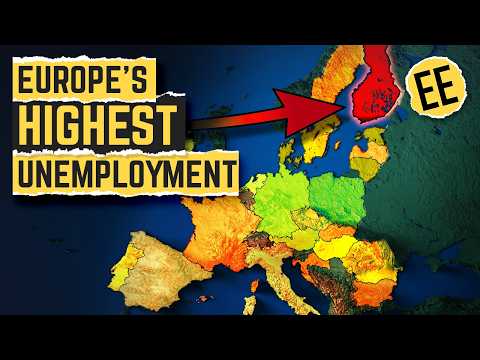
Finland, despite being the world's happiest country, faces a severe economic downturn characterized by a 10.6% unemployment rate, the highest in Europe. This paradox is explained by a confluence of factors including a collapsed construction sector due to rising interest rates, the loss of trade with Russia following its invasion of Ukraine, and a "brain drain" of skilled workers. The high unemployment rate is further complicated by a robust social safety net that can disincentivize work and an expanding labor force due to immigration, leading to rising employment and unemployment figures simultaneously.
Key takeaways
- Finland's high happiness is maintained by a strong social safety net providing universal healthcare, childcare, education, and housing, mitigating the impact of a 10.6% unemployment rate.
- The construction sector's collapse, driven by a rapid increase in interest rates from 0% to 4.5%, is a primary cause of Finland's current unemployment spike.
- The severance of trade relations with Russia following the Ukraine war has significantly impacted Finnish exports and employment, particularly in eastern regions.
- Finland's unemployment rate is rising due to an expanding labor force (driven by immigration and returning retirees) actively seeking work, not just job losses.
- Generous unemployment benefits and progressive taxation in Finland can create disincentives for low-wage employment, contributing to the paradox of rising unemployment and employment.
- The Finnish cultural concept of 'sisu' (stoicism, perseverance) shapes the national response to economic hardship, viewing current issues as temporary shocks rather than permanent failures.
Chapters
- Finland consistently ranks as the happiest country, attributed to high human development, social stability, and work-life balance.
- The nation is experiencing a 10.6% unemployment rate, the highest in Europe, a figure comparable to US rates only during major recessions.
- Despite high unemployment, Finland's employment rate is also rising, creating an economic paradox.
- Key questions revolve around the causes of unemployment, the simultaneous rise in employment, and Finland's seemingly unfazed reaction.
- Decades of urbanization fueled a construction boom, which collapsed after interest rates rose from 0% to 4.5% to combat inflation.
- Housing permits plummeted, leading to bankruptcies in the construction sector and an oversupply of housing.
- The loss of trade with Russia, a major energy and export partner, due to the Ukraine war devastated eastern border towns and Finnish companies.
- Finland's decision to join NATO and close its border with Russia prioritized security over economic ties, contributing to stagnation.
- Skilled Finnish workers are emigrating ('brain drain') due to economic conditions and lack of jobs, seeking opportunities in countries like the US and Switzerland.
- Finland's comprehensive social safety net, while ensuring basic needs and near-elimination of homelessness, can disincentivize low-wage work due to progressive taxation and benefit phase-outs.
- The unemployment rate is rising partly because new job seekers, including immigrants and returning retirees, are entering the labor force and are counted as unemployed if not immediately placed.
- Despite economic hardship, Finns exhibit 'sisu'—stoicism and perseverance—viewing current challenges as cyclical corrections rather than systemic failure.
Summary, takeaways, and chapters were generated by AI from the video's transcript and may contain errors. The video belongs to its creator, Economics Explained.