Fermentation, BIO105 Introductory Biology, David Champlin, USM
 Watch on YouTube →
Overview
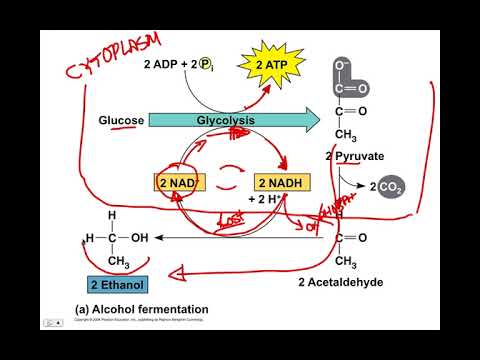
David Champlin explains fermentation as an oxygen-limited pathway in the cytoplasm that recycles NADH to NAD+, allowing glycolysis to continue producing a small amount of ATP when oxidative phosphorylation cannot proceed. He compares yeast alcohol fermentation with lactic acid fermentation in muscles, then connects metabolic pathway choices to enzyme regulation by competitive and non-competitive inhibitors.
Key takeaways
- Fermentation occurs in the cytoplasm and lets glycolysis continue when oxygen limitation prevents pyruvate from entering the usual mitochondrial pathway.
- The central role of fermentation is to recycle NADH into NAD+, a necessary step for sustaining glycolysis when oxidative phosphorylation is unavailable.
- Alcohol fermentation in yeast produces ethanol and carbon dioxide, whereas muscle cells use lactic acid fermentation during oxygen-limited exercise.
- Fermentation yields much less ATP than oxygen-supported cellular respiration because it does not capture as much of the available energy.
- Competitive inhibitors block an enzyme’s active site directly, while non-competitive inhibitors bind at another site and alter the active site’s shape.
Chapters
0:00
Oxygen Shortage Redirects Pyruvate into Fermentation
- With oxygen, pyruvate enters the mitochondria and supports cellular respiration; when oxygen is scarce, it remains in the cytoplasm.
- Fermentation acts as an alternative metabolic pathway, allowing glycolysis to continue despite the blocked route to oxidative phosphorylation.
- Yeast can convert pyruvate through alcohol fermentation to ethanol and carbon dioxide, while muscle cells can produce lactic acid.
2:50
Fermentation Recycles NADH to Sustain Glycolysis
- Cells have a limited supply of NAD+ and NADH; glycolysis requires NAD+ to keep its reactions moving.
- Normally, oxidative phosphorylation helps recycle NADH, but fermentation provides an alternative route to regenerate NAD+ when oxygen is limiting.
- Fermentation captures far less energy as ATP than oxygen-supported respiration; Champlin describes much of the energy as being lost as heat.
6:30
Enzyme Inhibitors Redirect Metabolic Pathways
- Metabolic pathways can be regulated by changing enzyme activity, which controls whether substrates proceed through a particular reaction.
- A competitive inhibitor binds an enzyme’s active site and blocks the substrate from binding.
- A non-competitive inhibitor binds elsewhere on the enzyme, changes the active site’s shape, and reduces substrate affinity.
Summary, takeaways, and chapters were generated by AI from the video's transcript and may contain errors. The video belongs to its creator, The New Evolution for Everyone.