Exploration & Epiphany | Guest video by Paul Dancstep
 Watch on YouTube →
Overview
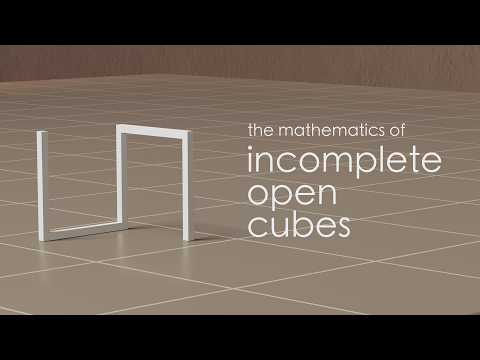
Paul Dancstep explores Sol LeWitt's "Variations of Incomplete Open Cubes" artwork, which enumerates 122 rotationally unique incomplete open cubes. The video details LeWitt's conceptual art approach and his struggle with rotational equivalence, contrasting it with a mathematical solution using group theory and Burnside's Lemma. This mathematical framework, applied to the 4096 possible incomplete open cubes, reveals 218 rotationally unique families, a number later confirmed by computational search to align with LeWitt's 122 after applying all constraints, though the artwork itself contains minor errors.
Key takeaways
- Sol LeWitt's "Variations of Incomplete Open Cubes" is a visual representation of a combinatorial problem solved empirically.
- The core mathematical challenge was identifying rotationally equivalent cubes, which LeWitt tackled through physical models and LeWitt's notebooks detail this struggle.
- Paul Dancstep demonstrates how Burnside's Lemma provides a systematic, formulaic approach to counting symmetrical configurations, yielding 218 families for incomplete open cubes.
- The relationship between a cube's family size and its "lookalikes" (cubes unchanged by a transformation) is inverse: Family Size * Lookalikes = 24.
- LeWitt's discovery of chirality (non-superimposable mirror images) was a critical epiphany that expanded his enumeration.
- Mathematical analysis can offer deeper conceptual and aesthetic appreciation of art, revealing the underlying structure and thought process.
Chapters
- Sol LeWitt's artwork "Variations of Incomplete Open Cubes" displays every rotationally unique incomplete open cube.
- An incomplete open cube is defined by connected edges forming a 3D structure, excluding flat or disconnected forms.
- The artwork presents 122 such unique cubes, representing a solution to a combinatorial problem.
- LeWitt, a conceptual artist, emphasized the idea behind the art over its physical execution.
- His work often involved serial structures and answering "how many ways?" questions.
- Minimalism was key, using simple geometric forms like the cube for its lack of expressiveness.
- LeWitt's notebooks reveal his empirical process of building physical models to identify rotational duplicates.
- Eliminating rotational duplicates was the most challenging constraint for LeWitt.
- He sought a logical, numerical solution but ultimately relied on manual comparison and trial-and-error.
- The problem is first simplified to 2D incomplete open squares to understand rotational equivalence.
- There are 2^4 = 16 possible incomplete open squares.
- Brute-force sorting reveals 6 rotationally equivalent families of squares.
- A cube has 12 edges, each with two states (on/off), leading to 2^12 = 4096 total possible incomplete open cubes.
- Brute-force sorting of 4096 cubes is computationally infeasible.
- A strategy is needed beyond manual comparison and sorting.
- LeWitt broke the problem into smaller parts by considering cubes with a specific number of edges.
- The artwork's layout reflects this strategy, with rows dedicated to different edge counts.
- The focus shifts to understanding the size of each cube's rotational family.
- LeWitt developed an edge numbering system, which facilitated thinking about complementary pairs of cubes.
- A cube and its complement sum to 12 edges (e.g., 4-edge + 8-edge = 12).
- This duality halved LeWitt's search effort by allowing parallel exploration of complementary sets.
- There are 24 distinct rotational transformations of a cube (identity, face axes, corner axes, edge axes).
- Applying all 24 transformations to a cube generates its "family portrait," showing all its rotationally equivalent forms.
- A family portrait of a shape with fewer than 24 members will contain repeated family members.
- The number of times a family repeats in its portrait (its "lookalikes") is related to its size.
- The formula: Family Size * Number of Lookalikes = 24.
- This allows calculating family size by counting lookalikes (e.g., a cube with 2 lookalikes has a family size of 12).
- An epiphany occurs: instead of counting lookalikes per cube, count cubes unchanged by each transformation.
- This re-indexing trick, related to Burnside's Lemma, allows formulaic counting of lookalikes for each transformation.
- Applying this to all 24 transformations yields 5,232 total lookalikes, leading to 218 rotationally unique families (5232 / 24 = 218).
Summary, takeaways, and chapters were generated by AI from the video's transcript and may contain errors. The video belongs to its creator, 3Blue1Brown.