Experiencing America | Dialogue with International Students | 26FA Class #13 Full Lecture
 Watch on YouTube →
Overview
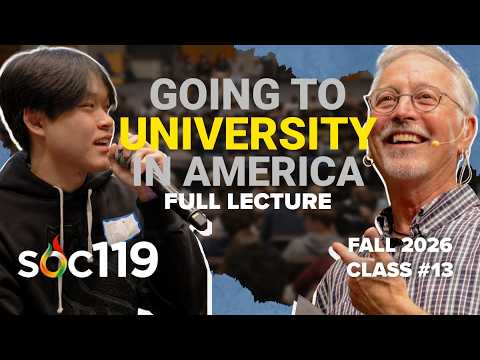
Sam Richards leads a dialogue with four Penn State international students from Saudi Arabia, Cambodia, India, and Ecuador (with Italian family heritage) about how their expectations of the United States compare with daily experience. Their accounts complicate stereotypes about American friendliness, racism, patriotism, consumerism, safety, and college life, while highlighting how cultural diversity, social norms, and time abroad shape belonging and personal growth; Richards notes that about 4,000 of University Park’s 40,000 undergraduates are international students.
Key takeaways
- At Penn State, international students describe American friendliness as real but conditional: outgoing people can build connections quickly, while quieter students may find that others leave them alone.
- Ray’s comparison separates colorism from racism: he reports strong preferences for lighter skin in India and less racism in his U.S. experience than he expected.
- International students’ privacy concerns are shaped by visa screening and possible re-entry barriers; students say social-media histories can be reviewed and posts may affect their ability to study in the United States.
- The students describe U.S. diversity as a source of new perspectives, but also as a challenge to forming one enduring social group because friendships often span several circles.
- Living abroad can unsettle stereotypes and produce personal change: students cite greater confidence, more willingness to network, and less judgment of people from other cultures.
- Students distinguish gaining U.S. work experience from settling permanently: they discuss internships or OPT as résumé-building opportunities while emphasizing plans to maintain ties to family and home.
Chapters
0:00
Pre-Class Room Audio
- The recording opens with repeated calls of “Heat” before class begins.
- No substantive discussion occurs until Sam Richards starts the lecture at 7:26.
7:26
Course Announcements and International Student Volunteers
- Sam Richards says Block 1 grades are posted and asks students to email the staff or conversation address about errors because conversations are recorded.
- He encourages international students to apply to volunteer; the application link is on the first page of the course website.
9:19
Introducing the International Student Panel
- The panel introduces students from Saudi Arabia, Cambodia, India, and Ecuador; Tizzy also describes Italian family heritage.
- Richards says roughly 10% of University Park undergraduates are international students and frames the discussion around experiences of the United States.
11:43
Expectations of America: Consumerism and Anti-American Views
- A student describes hearing mixed opinions abroad, including resentment toward the United States, while another says the stereotype of high American consumerism has been partly confirmed.
- Penn State move-out waste—students discarding household goods and plastic items—is offered as a visible example of consumption.
13:27
Ray Compares American Racism with Indian Colorism
- Ray, from rural South India, expected Americans to be highly racist but says he has experienced less racism in the United States than at home.
- He distinguishes racism from colorism, describing pressure in India to prefer lighter skin within the same broad racial community.
- Ray explains that language, accent, and code-switching can affect how others perceive identity; Richards shares how living in Cuenca influenced his Spanish speech.
16:24
Friendship Expectations, Penn State Football, and Soccer
- Fei expected a large, social campus to make friendships easy, but says building connections was difficult at first; American roommates and their families later helped him feel included.
- Fei identifies Penn State football as a major expectation fulfilled, and Richards recommends attending the White Out as a distinctive social experience.
- Ali says he expected little interest in soccer but found people to play with at intramurals; his American-accented English surprises people who learn he grew up in Saudi Arabia.
21:42
Social Confidence, Cultural Freedom, and Abundance
- Ray observes that outgoing people may find American social life easier, while quieter people can be left alone; after four years in the United States, he notices changes in his mannerisms and English vocabulary.
- Ray and Fei value having less neighborhood scrutiny than at home: in their accounts, relatives and community members in India and Cambodia closely monitor everyday choices.
- Tizzy contrasts Ecuador’s slower access to specific products with the United States’ abundance and delivery options, while Ali values meeting people with different backgrounds.
32:46
Diversity, Belonging, and the Double Edge of Patriotism
- Ali describes Penn State as a cultural “melting pot,” where different perspectives come from international students, immigrant families, and students from across the United States.
- Tizzy says he worried about unintentionally offending people, while Ali describes struggling to find one stable friend group because students move among many groups.
- Ali calls patriotism a source of national unity and strength but warns it can become groupthink or a belief in national superiority; Richards recalls an Ecuadorian priest tortured by a CIA operative to illustrate the harm patriotism can obscure.
40:15
American Media, Alcohol, Drugs, and Sexual Openness
- Ray says television and movies formed much of his early image of America; his first encounters with white Americans and taller people made media representations feel newly real.
- Fei recalls seeing California and expecting its landscape to resemble the orange-tinted look of Breaking Bad; Tizzy connects Nickelodeon portrayals of American high schools with campus stereotypes.
- Students compare media expectations with campus life: one expected less alcohol and more drugs, while another found alcohol use unexpectedly high and concerning.
- Fei says Americans seem more open about sex than people in Cambodia, where he had no sex education before arriving at Penn State; Ali says social media shaped his views of relationships and divorce.
45:22
Food, Family, and the Safety Missed from Home
- Ray misses Indian food, saying local restaurants do not match its quality, though the range of cuisines in the United States partly compensates.
- Fei says State College has no Cambodian restaurants and describes adjusting to fatty food while trying to learn to cook Cambodian dishes.
- Tizzy misses the expressive conversational style of Ecuadorians and says speaking English makes it harder to convey his thoughts.
- Ali misses family, friends, food, and the sense of safety he associates with home in Saudi Arabia.
52:48
Indirect American Friendships and Visa-Related Privacy
- Ray says American politeness can make rejection difficult to detect; in his experience, people in India are more likely to state directly when they dislike someone.
- Ray finds that Americans may use “friend” loosely for classmates or colleagues, unlike his expectation that friendship implies plans to spend time together.
- Ali and another student describe U.S. visa applications requiring social-media information and background checks, making online privacy consequential for international students.
57:10
Political Expression and Visa Uncertainty at Penn State
- A student recounts deleting political social-media posts while applying to Penn State amid uncertainty about U.S. visa policy and says family members still urge caution about behavior and travel.
- Ali describes Arabic-language posters raising awareness about Palestine on campus and views Penn State as a place where students can express political views.
- Students explain that visa screening and the risk of being unable to re-enter the country can make privacy and public speech feel different for international students.
1:01:00
Campus Safety, Gun Violence, and Gender Differences
- Students say Penn State and State College feel safer than they expected, especially compared with parts of Los Angeles and New York.
- Ali identifies gun violence as a major worry for himself and his family, while describing the college-town setting as relatively reassuring.
- Ray qualifies comparisons of safety in India by region, saying women are treated with greater respect in his home area than in some other parts of the country.
1:03:08
Regional Safety Experiences and Women’s Perspectives
- Ray says his experience of safety in India is specific to his region and contrasts it with feeling less safe when visiting northern parts of the country.
- He links local attitudes toward women partly to the gender balance he describes in his area, while acknowledging that his comparison is regional rather than representative of all India.
- The discussion emphasizes that safety judgments depend on location and gender, rather than a single national comparison.
1:05:53
Internships, Cross-Cultural Learning, and Personal Growth
- Students discuss possible next steps: one is considering an internship in Singapore, another mentions Optional Practical Training (OPT), and another is seeking an internship in the United States.
- They describe U.S. work experience as valuable on a résumé and as a way to learn practices they could later apply at home; Richards challenges the assumption that international students intend to stay permanently.
- Tizzy says meeting people has shown him that stereotypes often project one’s own assumptions onto other cultures; Ray describes gaining confidence and questioning internalized beauty standards.
- Fei says American career fairs and networking opportunities pushed him, as an introvert, to put himself forward; Ali describes becoming more accepting and less judgmental through self-reflection away from family.
Summary, takeaways, and chapters were generated by AI from the video's transcript and may contain errors. The video belongs to its creator, SOC 119.