Essentials: Psychedelics & Neurostimulation for Brain Rewiring | Dr. Nolan Williams
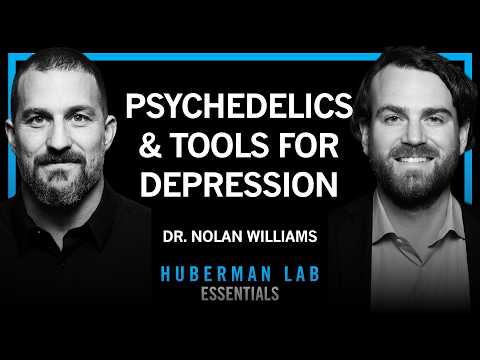 Watch on YouTube →
Overview
Dr. Nolan Williams discusses depression as a leading cause of disability, highlighting its connection to cardiovascular disease and the limitations of current treatments. He introduces transcranial magnetic stimulation (TMS) as a method to directly modulate brain circuits, particularly the dorsalateral prefrontal cortex, to restore mood regulation. Williams also explores the potential of psychedelics like psilocybin and MDMA, and ibogaine, for treating conditions such as depression and PTSD by facilitating neuroplasticity and re-processing memories, contrasting their rapid, circuit-focused mechanisms with the slower, less understood effects of SSRIs.
Key takeaways
- Depression is a significant global health issue, linked to cardiovascular disease, and current treatments are often insufficient for severe cases.
- Transcranial Magnetic Stimulation (TMS) can directly modulate brain circuits, like the dorsalateral prefrontal cortex, to restore mood regulation and has demonstrated rapid antidepressant effects.
- The 'chemical imbalance' theory of depression is largely debunked; newer approaches like TMS and psychedelics focus on circuit-level changes and neuroplasticity.
- MDMA shows promising long-term relief for PTSD (lasting years in ~2/3 of patients), while psilocybin offers antidepressant benefits, though with shorter durations in some trials.
- Ibogaine and Ayahuasca are potent, non-recreational psychedelics with potential for deep psychological processing and addressing issues like moral injury and addiction, but require careful medical supervision due to risks.
- Stanford's SAINT protocol dramatically accelerates TMS treatment by applying spaced learning principles, achieving high remission rates within days by delivering a concentrated, therapeutic stimulation signal.
Chapters
- Depression is the most disabling condition worldwide and a major risk factor for other illnesses, including coronary artery disease.
- Traditional treatments for severe depression, especially in acute settings, are limited.
- Neurology offers acute brain-based treatment options, inspiring similar engineering approaches in psychiatry.
- The connection between the heart and brain is a physical one, measurable through techniques like TMS.
- TMS uses magnetic pulses to induce electrical currents in brain tissue, specifically targeting the dorsalateral prefrontal cortex.
- This stimulation can decelerate heart rate by affecting mood regulatory regions, demonstrating a direct brain-heart connection.
- TMS can restore the governance of the left dorsalateral prefrontal cortex over the cingulate area, correlated with antidepressant effects.
- Rapid TMS protocols (e.g., 5-day blocks) can lead to significant, rapid improvements in mood and present-moment awareness.
- SSRIs are effective for some individuals with depression, OCD, and anxiety, but their delayed action suggests brain plasticity effects rather than direct serotonin replacement.
- The 'chemical imbalance' theory of depression is largely incorrect; there is no serotonin deficit.
- Psychiatry 3.0 focuses on brain circuitry and electrophysiology, moving beyond historical psychoanalytic (1.0) and chemical imbalance (2.0) models.
- TMS and psychedelics work by modulating brain circuits without directly altering serotonin levels, supporting the circuitry-focused approach.
- High-dose psilocybin and MDMA sessions can lead to improvements in trauma-related symptomology and depression.
- These substances facilitate new perspectives on old problems by inducing a highly plastic state where memories can be re-experienced and reconsolidated.
- MDMA shows a significant anti-PTSD effect, with about two-thirds of participants experiencing clinically significant change lasting for years.
- Psilocybin shows antidepressant effects, with open-label studies reporting 50-66% improvement and blinded trials around 33%.
- Psychedelics, like psilocybin, can lead to an overall decrease in brain activity but increase global connectivity.
- A key mechanism involves changes in connectivity between the subgenial anterior cingulate and the default mode network.
- This connectivity change, also seen with TMS, helps to 'unpair' negatively valanced mood states from self-representation, reducing feelings of being stuck.
- The brain may retain maladaptive, evolutionarily driven responses (e.g., PTSD triggers) that psychedelics can help to alleviate.
- Ibogaine, a long-acting psychedelic, facilitates a 'life review' and can be akin to years of psychotherapy in a single session, particularly for special operations veterans.
- It carries cardiac risks but can be screened for, and is not recreational, requiring significant introspection and 'hard work'.
- Ayahuasca, a South American sacrament combining DMT and MAOIs, has shown potential in reducing recidivism rates in Brazilian prisoners.
- Both ibogaine and ayahuasca are considered powerful, non-recreational tools requiring strict medical supervision due to their profound effects and potential risks.
- SAINT (now Stanford Neuromodulation Therapy) reorganizes TMS protocols using spaced learning theory to be more efficient.
- Instead of daily sessions over 6 weeks, SAINT condenses the treatment into a 5-day block with frequent stimulation.
- This intensive protocol delivers the equivalent of 7.5 months of standard TMS in 5 days, leading to 60-90% remission rates within 1-5 days.
- The therapy aims to send a 'turn on, stay on' signal to the brain, utilizing its natural communication style to exit a depressed state without side effects.
Summary, takeaways, and chapters were generated by AI from the video's transcript and may contain errors. The video belongs to its creator, Andrew Huberman.