Essentials: How to Access Your Creativity | Rick Rubin
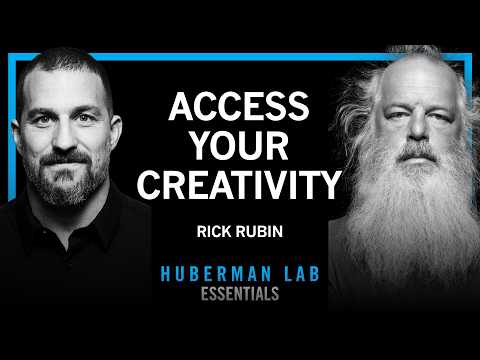 Watch on YouTube →
Overview
Rick Rubin and Andrew Huberman explore the nature of creativity, likening it to a dream or a cloud that shifts and can disappear. Rubin emphasizes that creativity is not an intellectual process but closer to magic, often undermined by adult "baggage" and learned rules. He advocates for embracing one's own feelings and taste, even when external feedback differs, and suggests a phased approach to creative work: seed collecting, experimentation, crafting, and completion, noting that deadlines can be beneficial in the final stages.
Key takeaways
- Creativity is not an intellectual pursuit but a feeling-driven, almost magical process that benefits from a lack of pre-conceived notions.
- Children's uninhibited nature and lack of 'baggage' make them inherently more creative than adults, who often filter through learned rules.
- The most effective feedback in creative endeavors is actionable experimentation rather than purely verbal critique.
- Rick Rubin proposes a four-phase creative process: seed collecting, experimentation, crafting, and completion, noting that deadlines are only truly effective in the final stage.
- Self-doubt can be a valuable tool for refinement, guiding creators toward masterpieces rather than hindering them.
- The ability to stay present and undistracted in the work is more critical for creation than one's emotional state (happy or unhappy).
Chapters
0:00
Creativity as a Shifting Cloud or Dream
- Rick Rubin describes creativity and ideas as akin to a cloud or a dream, which can change or vanish if not observed carefully.
- The creative process is driven by feelings of excitement, interest, or curiosity, not intellect.
- Language is insufficient to fully capture the essence of creativity, which is closer to magic than science.
2:33
Children's Uninhibited Creativity vs. Adult Constraints
- Children are more creative due to their openness and lack of pre-existing belief systems or knowledge of how things 'should' work.
- Adults filter data based on survival, procreation, and learned societal norms, which can undermine pure creative expression.
- Early career freedom from knowing rules, like Rubin's start in music production, allows for breaking conventions.
5:31
Actionable Suggestions Over Language in Creative Feedback
- When something feels creatively right, it's better to engage in actionable experimentation rather than relying solely on verbal feedback.
- Schooling often teaches rule-following, whereas art requires understanding rules as scaffolding to be selectively removed.
- Owning and trusting one's feelings is crucial to avoid self-doubt and external commercial pressures.
8:50
Shifting Aperture: Broadening or Narrowing Vision for New Ideas
- Creative breakthroughs can involve either broadening or narrowing one's perspective, changing the 'aperture' from the standard view.
- Comedians often tap into truth by stating the obvious in a novel way, making the familiar seem new and insightful.
- The ability to recognize something obvious once seen, but previously overlooked by others, is key to unique insights.
11:45
Navigating External Feedback and the Creative Process
- Immediate external feedback from platforms like Twitter or Instagram can be used or ignored; it doesn't dictate the creative outcome.
- The only controllable aspect is one's relationship to their own creation; external information that clouds this connection can be detrimental.
- Creating something you personally like or that fills a perceived gap as a fan is a core driver.
14:15
Phased Creative Workflow: Seed Collecting to Completion
- Rubin advocates for total focus on a project during engagement and complete disengagement when away from it, allowing the subconscious to work.
- He outlines four phases: seed collecting (ongoing, no deadlines), experimentation (setting the stage, not dictating), crafting (shaping the material), and completion (final edit).
- Deadlines can be applied to the completion phase without harming the project, a realization that came during the writing of his book.
Summary, takeaways, and chapters were generated by AI from the video's transcript and may contain errors. The video belongs to its creator, Andrew Huberman.