Essential Matrix Algebra for Neural Networks, Clearly Explained!!!
 Watch on YouTube →
Overview
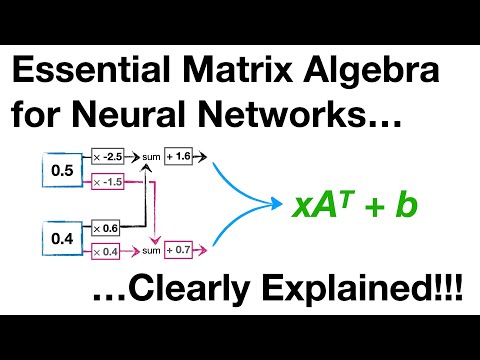
StatQuest with Josh Starmer explains essential matrix algebra for neural networks, demonstrating how linear transformations can be represented and manipulated using matrix multiplication. The video breaks down matrix multiplication by relating it to geometric transformations and then applies these concepts to a simple neural network, showing how weights and biases are incorporated into matrix equations, and explaining the purpose behind the specific row-by-column multiplication method for combining sequential transformations.
Key takeaways
- Matrix algebra provides a concise way to represent and compute linear transformations, which are fundamental to neural networks.
- The specific method of matrix multiplication (row by column, sum of products) is designed to efficiently combine sequential transformations into a single equivalent transformation.
- In neural networks, weights and biases are organized into matrices and vectors, allowing operations like forward passes to be expressed as matrix multiplications and additions.
- The `nn.linear` class in deep learning frameworks performs a linear transformation, corresponding to a core matrix operation in neural network layers.
- Understanding matrix transposition is crucial for correctly performing matrix multiplication and interpreting different notation styles in research papers and documentation.
- Attention mechanisms in advanced architectures like transformers rely on matrix multiplications (e.g., Q * K^T) to compute relationships between data points.
Chapters
0:00
Introduction to Matrix Algebra for Neural Networks
- Neural network documentation and error messages often involve complex matrix equations.
- Matrix algebra provides a compact way to describe neural networks, essential for understanding documentation and research papers.
- The video will build understanding from basic terminology to matrix multiplication, starting with linear transformations.
3:56
Linear Transformations and Matrix Representation
- A linear transformation involves operations that only multiply and add original variables (e.g., rotating coordinates).
- Nonlinear transformations, like exponential functions, result in non-constant changes in output.
- Linear transformations can be represented using matrix notation, with coefficients forming the transformation matrix.
10:08
Matrix Multiplication: Row by Column
- A row matrix (1x2) representing coordinates is multiplied by a transformation matrix (2x2).
- Matrix multiplication is performed by multiplying elements of a row by corresponding elements of a column and summing the products.
- This process yields the new coordinates after the transformation.
18:24
The Purpose of Matrix Multiplication: Combining Transformations
- The specific row-by-column multiplication method allows for combining sequential transformations into a single matrix.
- Multiplying two transformation matrices results in a new matrix that directly maps the original input to the final output.
- This simplifies calculations by avoiding intermediate steps when applying multiple transformations.
22:21
Matrix Transpose and Notation
- Matrix multiplication is not commutative (A*W != W*A), and dimensions must align (columns of first matrix = rows of second).
- Transposing a matrix swaps its rows and columns, denoted by a superscript 't'.
- Lowercase letters often represent row/column vectors, while uppercase letters represent matrices with multiple rows/columns.
Summary, takeaways, and chapters were generated by AI from the video's transcript and may contain errors. The video belongs to its creator, StatQuest with Josh Starmer.