ES.1802, October 7, 2026
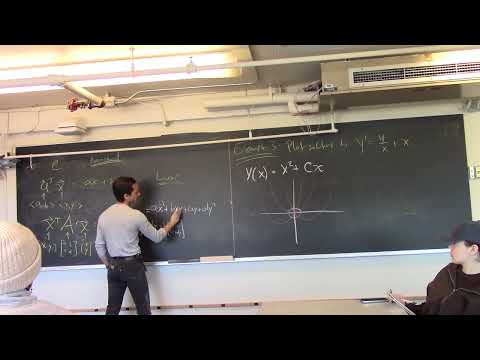 Watch on YouTube →
Overview
The lecture extends single-variable Taylor approximation to functions of several variables, moving from the tangent-plane formula to a second-order approximation using the Hessian. It connects quadratic forms such as ΔxᵀHΔx to curvature and explains why Hessian behavior helps classify critical points as minima, maxima, or saddle points before beginning a worksheet session.
Key takeaways
- The first-order approximation for a multivariable function is f(p) + ∇f(p)ᵀΔx, the matrix-vector version of the single-variable tangent-line formula.
- A quadratic form xᵀAx converts a matrix and vector into a scalar expression, making it suitable for representing second-order changes in a function.
- The Hessian is the Jacobian of the gradient: differentiating a scalar-valued function gives a gradient vector, and differentiating that vector gives a matrix.
- The second-order Taylor term is ½ ΔxᵀH_f(p)Δx; it captures curvature that a tangent-plane approximation cannot represent.
- At a critical point, the Hessian’s curvature behavior—and, in later analysis, its eigenstructure—helps determine whether the point is a local minimum, maximum, or saddle.
Chapters
0:00
From Tangent Lines to Multivariable Tangent Planes
- The single-variable linear approximation is f(p) + f′(p)Δx, where Δx = x − p.
- For a function of x and y, the tangent-plane approximation adds the gradient dot displacement: f(p) + ∇f(p)ᵀΔx.
- The dot product expands into the two partial-derivative terms, fₓ(p)Δx + fᵧ(p)Δy.
- A first-order approximation captures local slope but not the function’s curvature, motivating a second-order term.
4:46
Building Quadratic Forms from Vectors and Matrices
- The lecture progresses from a scalar constant to a linear form aᵀx, where coefficient and coordinate vectors produce a scalar expression.
- A quadratic form has the structure xᵀAx, with A a matrix of coefficients and x a coordinate vector.
- In two dimensions, multiplying [x y] by a 2×2 coefficient matrix and [x y]ᵀ produces a scalar quadratic expression in x and y.
- This matrix notation provides the multivariable counterpart to the single-variable second-derivative term f″(p)(Δx)².
10:08
The Hessian Taylor Term, Curvature, and Critical-Point Classification
- The second derivative of a scalar-valued multivariable function is the Hessian matrix, defined as the Jacobian of its gradient.
- The second-order approximation adds ½ ΔxᵀH_f(p)Δx to the constant and gradient terms; the full quadratic expression evaluates to a scalar.
- Near a critical point where the gradient is zero, the Hessian’s quadratic behavior describes local curvature and helps distinguish minima, maxima, and saddle points.
- The lecture previews using Hessian eigenstructure to classify critical points, then shifts at about 15:41 to the class’s first worksheet Wednesday.
Summary, takeaways, and chapters were generated by AI from the video's transcript and may contain errors. The video belongs to its creator, ChristianAltoSax.