Enzyme Catalysts, BIO105 Introductory Biology, David Champlin, USM
 Watch on YouTube →
Overview
David Champlin explains how reaction progress and Gibbs free energy distinguish a reaction’s equilibrium from its rate: ΔG indicates the energy change and equilibrium position, while activation energy governs how quickly the reaction proceeds. He shows how enzymes—typically proteins with substrate-specific active sites—lower activation energy without changing the reaction’s overall ΔG, and illustrates how they can catalyze sucrose hydrolysis, release products, and be reused.
Key takeaways
- Gibbs free-energy change, ΔG, determines the equilibrium position and energy difference between reactants and products; it does not determine reaction speed.
- Activation energy controls reaction rate: reactants cross a smaller energy barrier more readily than a larger one.
- Heating wood helps its reactants overcome activation energy, whereas cells use enzymes to lower the barrier without heating the body to combustion temperatures.
- An enzyme’s substrate-specific active site enables catalysis by binding the substrate and providing an alternative reaction pathway.
- Enzymes do not change a reaction’s overall ΔG, equilibrium, or energy released; they change how quickly the reaction proceeds.
- Enzymes are not used up in catalysis: after releasing products, a protein enzyme can catalyze additional reactions, with Champlin citing an approximate rate of 100 per second.
Chapters
0:00
Reaction Progress, Reversibility, and Gibbs Free Energy
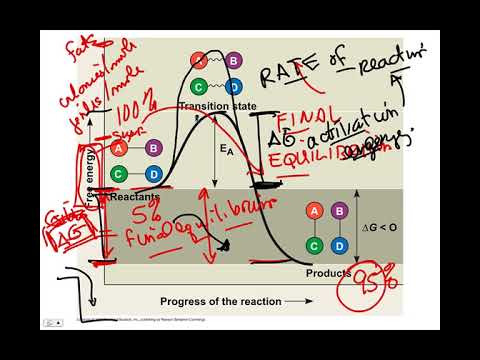
- The reaction-coordinate graph tracks reactants turning into products, with progress on the x-axis and free energy on the y-axis.
- Microscopic reversibility means products can also revert to reactants, so reactions commonly reach equilibrium rather than converting 100% of reactants into products.
- The change in Gibbs free energy, ΔG, describes the energy difference between reactants and products and determines the final equilibrium position.
4:10
Activation Energy Sets Reaction Rate
- Activation energy is the energy barrier reactants must overcome; a larger barrier generally means a slower reaction.
- Burning wood illustrates how heating raises reactants’ energy, making it more likely they cross the activation-energy barrier.
- Lowering activation energy speeds a reaction without changing its overall ΔG or the amount of energy released.
8:40
Enzyme Active Sites Catalyze Sucrose Hydrolysis
- Enzymes, typically proteins, bind specific substrates in active sites whose shape and chemistry complement the substrate.
- For sucrose hydrolysis, an enzyme provides an alternative chemical pathway that lowers the activation-energy barrier and helps break down the sugar.
- Substrate binding can change an enzyme’s conformation; after catalysis, products are released and the enzyme can be reused.
- Champlin gives an approximate turnover rate of 100 reactions per second for one enzyme molecule.
Summary, takeaways, and chapters were generated by AI from the video's transcript and may contain errors. The video belongs to its creator, The New Evolution for Everyone.