ENGR 201 Fall 2026 - Lecture 10: Review Exam #1
 Watch on YouTube →
Overview
Bruno Guidio reviews the force-vector, particle-equilibrium, and moment methods students need for ENGR 201 Exam #1, including component signs, 2D and 3D cable forces, and moment calculations. He emphasizes organizing solutions into labeled steps, explains that 2D particle equilibrium and 2D moments are definite exam topics, and notes that the 75-minute test will likely have three or four questions; equivalent couple systems are excluded.
Key takeaways
- Resolve each force into signed components before summing: cosine and sine depend on the reference angle, while left/down directions contribute negative components.
- For a 2D particle in equilibrium, draw the free-body diagram, write ΣFx = 0 and ΣFy = 0, and convert a suspended mass to weight; 120 kg corresponds to about 1,177.2 N.
- In 3D cable problems, form each unit direction vector from endpoint coordinates as (destination − start)/distance, multiply by the unknown cable-force magnitude, and apply equilibrium in x, y, and z.
- A force creates no moment about a point if its line of action passes through that point; otherwise use the perpendicular distance, or resolve an angled force into components.
- For 3D moments, use M = r × F with r directed from the moment point to the force’s line of action, and preserve the order of the cross product.
- Guidio identifies 2D particle equilibrium and 2D moments as definite exam topics; the test is planned for 75 minutes with roughly three or four questions, and equivalent couple systems are excluded.
Chapters
0:00
Opening, Review Plan, and Exam-Day Logistics
- Bruno Guidio opens with a prayer and says the review will cover the major topics, though he may not finish every practice problem.
- He plans to arrive early and aims to start the exam at 2:10; students may stay a few extra minutes if needed.
- The exam is designed for 1 hour and 15 minutes and will probably contain three or four questions.
2:30
Exam Scope and Organized Solution Format
- The review covers force vectors and resultants, 2D particle equilibrium, 3D particle equilibrium, and moments in 2D and 3D.
- Equivalent couple systems are explicitly excluded from Exam #1.
- Guidio plans to divide questions into labeled parts such as A: components, B: force sums, and later parts for solving unknowns.
5:00
Resolve Three Forces into Components and Find the Resultant
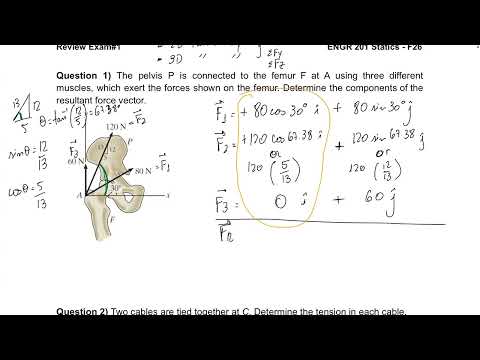
- The first practice problem asks for the resultant of three forces applied at point A, emphasizing separate x- and y-component calculations.
- For the 8 N force at 30° from the x-axis, use cosine for the x projection and sine for the y projection; both components are positive when the force points right and up.
- A 5-12-13 triangle provides an alternative to calculating an angle: its horizontal and vertical ratios give the corresponding direction components.
- A force directed along the positive y-axis has zero x-component; add all x-components together and all y-components together before finding resultant magnitude and direction.
16:30
Set Up a 2D Particle-Equilibrium Free-Body Diagram
- Guidio identifies particle equilibrium as a definite Exam #1 topic and asks students to begin with a free-body diagram.
- The practice setup has cable forces meeting at point C and a suspended mass of 120 kg.
- Convert mass to weight before writing equilibrium equations: 120 kg × 9.81 m/s² gives approximately 1,177.2 N downward.
- The requested sequence is to draw the diagram, resolve forces into components, write the x- and y-equilibrium equations, and solve for cable forces.
24:20
Resolve Cable Angles and Write Equilibrium Equations
- Guidio brings the diagram’s 30° and 40° cable angles close to point C; complementary angles of 60° and 50° are also usable.
- For cable FCA, the chosen 30° reference gives a leftward component of −FCA sin 30° and an upward component of FCA cos 30°.
- For cable FCB, the chosen 40° reference gives a rightward component of FCB cos 40° and a downward component of −FCB sin 40°.
- Set ΣFx = 0 and ΣFy = 0, including the 1,177.2 N weight, then solve the simultaneous equations; Guidio notes that his handwritten numerical result may be affected by rounding or calculation errors.
32:30
Practice 2D Force Components with a 3-4-5 Triangle
- The next particle problem focuses on drawing a free-body diagram and resolving forces before proceeding to equilibrium sums.
- A 3-4-5 triangle gives the direction ratios for an oblique force, allowing component calculations without first finding an angle.
- The force F points down and left, so both its x- and y-components are negative.
- A vertical 9-unit force has zero x-component; the cable tension angle is found using the complement of the given angle to 90°.
41:40
Begin 3D Equilibrium by Assigning Point Coordinates
- Guidio introduces a three-dimensional cable-equilibrium problem and identifies coordinate assignment as the first step.
- The diagram contains points A, B, C, and D; students must read each point’s x, y, and z coordinates before constructing force vectors.
- The goal is to express cable forces AB, AC, and AD in x-, y-, and z-components.
44:10
Build 3D Cable-Force Vectors from Unit Vectors
- For a cable from A to B, use the direction vector B − A and divide by its length to form the unit vector λAB.
- Write the cable force as FAB λAB, where FAB is the unknown magnitude and λAB = (B − A)/|B − A|.
- Apply the same coordinate-difference method to cables AC and AD, then impose ΣFx = 0, ΣFy = 0, and ΣFz = 0.
- The additional applied force is given as 500 j, so it contributes to the y-equilibrium equation.
49:55
Calculate 2D Moment About Point A
- Guidio reviews moment as force multiplied by the perpendicular distance from the force’s line of action to the reference point.
- The practice problem asks for the sum of moments about A, which is identified as the point in the middle of the diagram.
- A force whose line of action passes through A produces no moment about A, even if the force itself is nonzero.
- For angled forces, resolve the force into components to identify which component has a nonzero perpendicular lever arm.
54:30
Sum 2D Moments Using Perpendicular Lever Arms
- The 30 N force on the right has a 3 m moment arm about A and is treated as clockwise, hence negative in the worked setup.
- The 70 N force acts with a 0.5 m perpendicular distance and also contributes a clockwise moment.
- For the 80 N force at 25°, its 80 sin 25° component has a line of action through A and contributes no moment.
- The 80 cos 25° component acts with a 2 m lever arm; combine its moment with the other terms in N·m.
58:05
Form a 3D Cable Force for the Moment Calculation
- The 3D moment method requires a force vector and a position vector, followed by a cross product.
- For cable AB, construct the direction from B − A, normalize it by |B − A|, and multiply by the given force magnitude of 20.
- The coordinate differences are resolved along i, j, and k to produce the force’s three components.
- Guidio stresses that the force direction must follow the cable from its starting point A toward endpoint B.
1:02:15
Choose the Position Vector and Compute the 3D Moment
- Choose a position vector from the moment reference point to any point on the force’s line of action; Guidio selects OA as a convenient route.
- Compute the position vector by subtracting coordinates: rOA = A − O, with O at the origin in this example.
- The 3D moment is M = r × F, and the vector order matters: position vector first, force vector second.
- Expand the cross product using the i, j, and k components to obtain the moment-vector components.
1:04:30
Final Exam Reminders and Study Advice
- Guidio invites students to ask specific questions and offers to clarify homework or review material after class.
- He advises studying over the weekend rather than waiting until Monday night and staying up until 4 a.m.
- Students may use a calculator and pencil; no extra notes are allowed.
- Guidio says he can provide needed equations, including the moment relation, but students should bring their own calculator.
Summary, takeaways, and chapters were generated by AI from the video's transcript and may contain errors. The video belongs to its creator, Bruno Guidio, PhD.