ENGR 201 Fall 2026 - Lecture 08: 3D Moment
 Watch on YouTube →
Overview
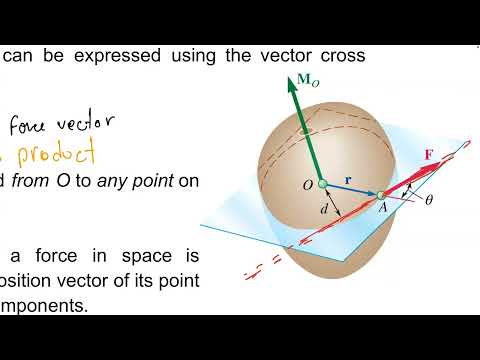
Bruno Guidio develops the three-dimensional moment formula, M_O = r × F, explaining how position and force vectors produce a moment vector whose direction identifies the rotation axis. He reviews two determinant methods for cross products, checks the vector approach against a two-dimensional example, and works through a cable-force problem in 3D using point coordinates and the right-hand rule.
Key takeaways
- For a force F about point O, calculate the moment with M_O = r × F, where r starts at O and ends at any point on the force’s line of action.
- Cross-product order matters: r × F gives the moment, while F × r reverses its direction.
- In a 3×3 determinant expansion, the J component has a negative cofactor sign; the diagonal method likewise subtracts the three opposite-direction products.
- A 2D moment appears as a single K component in the 3D formulation, and its sign corresponds to counterclockwise or clockwise rotation in the plane.
- For the cable example, D − C = (−0.30, 0.24, −0.32) m has length 0.50 m, so a 200 N force along CD has components (−120, 96, −128) N.
- The moment vector points along the rotation axis rather than describing linear motion; use the right-hand rule to determine the rotation sense.
Chapters
0:00
From 2D Moment Magnitudes to 3D Moment Vectors
- The lecture shifts from two-dimensional moments, where clockwise and counterclockwise signs suffice, to three-dimensional vector moments.
- In 3D, moments require I, J, and K components to represent rotation about an axis.
4:00
Position Vector and Force Vector in M = r × F
- Bruno Guidio writes the moment about O as M_O = r × F, with the cross product producing a vector.
- The position vector r runs from O to any point on the force’s line of action; it need not be perpendicular to that line.
10:00
A Moment Vector Identifies the Rotation Axis
- The moment vector does not indicate straight-line motion in its pointing direction; it identifies the axis about which the body tends to rotate.
- Guidio uses a bottle as a prop to show how a force produces rotation around the moment vector.
12:00
Cross Product Components from a 3×3 Determinant
- The cross product is set up with the unit vectors I, J, K in the first row, followed by the components of r and F.
- Expanding the determinant gives the I, J, and K components of the moment.
16:00
Two Determinant Techniques: Cofactor Expansion and Diagonals
- The first method hides one column at a time and subtracts the two remaining cross-products; the J component carries an extra negative sign.
- The diagonal mnemonic repeats the I and J columns, adds the three downward-diagonal products, and subtracts the three upward-diagonal products.
21:00
Set Up a 2D Example as a 3D Vector Problem
- Guidio applies the vector method to a planar force example to show it agrees with the perpendicular-distance method from the previous lecture.
- For a moment about B, the position vector must start at B and end at a known point on the force’s line of action.
24:00
Construct r and F from the 2D Diagram
- The example’s position vector is formed by subtracting the coordinates of B from the selected point A on the line of action.
- The 800 N force at 60° is resolved into components using cosine and sine, with no K component in the planar setup.
28:00
Evaluate the 2D Cross Product and Check Its Sign
- Guidio evaluates the determinant for the planar example and reports a moment of −202.56 N·m in the K direction.
- Negative K points into the board; the right-hand rule associates this direction with clockwise rotation in the diagram.
- The scalar moment method also gives −202.56 N·m, confirming agreement between the 2D and vector formulations.
40:00
Choose a Position Vector for the 3D Cable Moment
- The full 3D example asks for the moment about point A caused by a 200 N cable force along CD.
- Guidio selects coordinates and axes at B, noting that another valid origin or line-of-action point changes intermediate signs but should give the same moment about A.
- Either r_AC or r_AD can be used because C and D both lie on the force’s line of action.
46:00
Read A, C, and D Coordinates and Form r_AC
- The worked setup uses A = (0, 0, 0.32) m, C = (0.30, 0, 0.40) m, and D = (0, 0.24, 0.08) m.
- Subtracting A from C gives r_AC = (0.30, 0, 0.08) m.
- Coordinate values are assembled from the diagram’s stacked dimensions, converted from millimeters to meters.
51:00
Resolve the 200 N Cable Force Along CD
- The cable direction is obtained from D − C = (−0.30, 0.24, −0.32) m, whose length is 0.50 m.
- The unit vector along CD is multiplied by 200 N to obtain the force components (−120, 96, −128) N.
- The force-vector procedure uses the same coordinate subtraction and unit-vector method practiced in the previous lecture.
55:00
Compute the 3D Moment with r_AC × F_CD
- Guidio places r_AC first and F_CD second in the determinant; reversing their order would reverse the moment direction.
- The cross product gives moment components along I, J, and K, measured in N·m.
- The result’s negative I component and positive J and K components establish the direction of the resultant moment.
1:00:00
Use the Right-Hand Rule to Interpret 3D Rotation
- Guidio combines the signed components into a resultant moment vector and uses the right-hand rule to infer the rotation about its axis.
- The 3D example and a final tree-and-truck illustration connect the calculated vector direction to the physical sense of rotation.
- The homework is due the following Tuesday; the next Tuesday introduces a new topic, followed by an exam review on Thursday.
Summary, takeaways, and chapters were generated by AI from the video's transcript and may contain errors. The video belongs to its creator, Bruno Guidio, PhD.