ENGR 201 Fall 2026 - Lecture 06: 3D Equilibrium of a Particle
 Watch on YouTube →
Overview
Bruno Guidio, PhD, extends particle equilibrium from 2D to 3D by resolving cable forces into Cartesian components and applying ΣFx = ΣFy = ΣFz = 0. Two worked examples show how to choose coordinates, construct unit vectors, and solve for unknown tensions and applied forces; Guidio also introduces a balloon problem with a known 481 N cable tension for the next solution.
Key takeaways
- A 3D particle is in equilibrium only when all three component sums vanish: ΣFx = 0, ΣFy = 0, and ΣFz = 0.
- For a cable from point A to point B, calculate its direction with (B − A)/|B − A|, then multiply that unit vector by the unknown tension.
- In the 40 lb box example, symmetry in the x-components gives FAB = FAC ≈ 23.53 lb, and z-equilibrium gives FAD ≈ 15.06 lb.
- An axis-aligned force does not need a full coordinate-based unit-vector calculation: the AD cable is FAD k, and the box’s weight is -40j lb.
- The coordinate origin may be chosen for convenience; consistent coordinates preserve the physical solution even when intermediate signs and values change.
- For the 200 kg example, the weight is 1962 N, the solved cable tensions are approximately 1401.96 N and 1240.67 N, and the horizontal force P is about 225 N.
Chapters
0:00
Three Equilibrium Equations for a 3D Particle
- Bruno Guidio connects the previous class’s 3D force-vector methods with particle equilibrium.
- The equilibrium conditions are ΣFx = 0, ΣFy = 0, and ΣFz = 0.
- Forces along cables are written as magnitude times a direction unit vector, then resolved into i, j, and k components.
4:45
Set Up the 40 lb Box and Its Free-Body Diagram
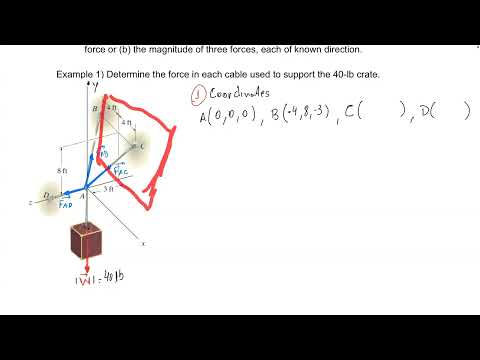
- A 40 lb box is held by cables AB, AC, and AD; the given 40 lb value is already its weight.
- Guidio recommends drawing a 3D free-body diagram directly on the supplied geometry.
- The forces to represent are the three cable tensions and the downward weight.
8:01
Assign Coordinates to Points A, B, C, and D
- The example uses A = (0, 0, 0), B = (-4, 8, -3), and C = (4, 8, -3).
- D lies on the z-axis, but its z-coordinate is not provided.
- The missing coordinate for D is unnecessary because AD already lies entirely along z, so its force needs no direction calculation.
13:13
Build Unit Vectors for the AB and AC Cable Forces
- For each cable, Guidio forms the displacement vector as endpoint coordinates minus starting-point coordinates, then divides by its magnitude.
- AB has direction vector (-4, 8, -3), while AC has (4, 8, -3); both have length approximately 9.43.
- The resulting force components are approximately FAB(-0.42i + 0.85j - 0.32k) and FAC(0.42i + 0.85j - 0.32k).
21:00
Represent the Axis-Aligned Forces and Write Equilibrium
- Because AD is vertical, its force is written directly as FAD k; no unit-vector calculation is needed.
- The weight acts downward along y and is represented as -40j lb.
- Guidio advises collecting all x, y, and z components before writing the three equilibrium equations.
25:05
Solve the Box Example Using the Simplest Equation First
- The x-equilibrium equation contains only FAB and FAC, and their opposite x-components imply FAB = FAC.
- Substituting that equality into the y-equilibrium equation gives each cable tension as approximately 23.53 lb.
- The z-equilibrium equation then gives FAD ≈ 15.06 lb.
30:25
Introduce a Wall-and-Cable Equilibrium Problem
- The second setup has two cable forces, a horizontal applied force P, and the weight of a 200 kg mass.
- The mass’s weight is calculated as 200 × 9.81 = 1962 N.
- The diagram’s coordinate origin is initially unspecified, so students consider where to place it.
33:20
Choose a Convenient Origin Without Changing the Physics
- Guidio explains that the origin can be placed at A, on the wall, or elsewhere, provided the coordinates describe the cable directions consistently.
- Changing the origin changes coordinate values and intermediate displacement vectors, but not the final force solution.
- He chooses A = (0, 0, 0) for convenience and notes that placing an axis along P can reduce sign mistakes.
37:26
Read Cable Coordinates from the Offset Wall Geometry
- The selected origin places A 1.2 units from the wall; the wall coordinates must account for that offset.
- Guidio illustrates how a point’s y-coordinate can differ depending on whether the origin is at A or on the wall.
- Students are reminded to state their chosen axes and origin when using a different coordinate setup.
42:17
Set Up the Second Example’s Force Components
- The known axis-aligned forces are P along x and the weight -1962j N along negative y.
- Students construct the AB and AC unit vectors from their coordinate differences and use them to write the cable-force components.
- Guidio has students compare component calculations before assembling the equilibrium system.
48:17
Check Component Signs and Assemble the Three Equations
- Guidio checks the cable components with the class and corrects a sign error in AC’s z-component: C’s negative z-coordinate makes that component negative.
- The displayed equations use approximate coefficients: x, -0.09FAB - 0.08FAC + P = 0; y, 0.78FAB + 0.70FAC - 1962 = 0; z, 0.62FAB - 0.70FAC = 0.
- The z-equation is the easiest starting point because it relates the two cable tensions without including P or the weight.
53:38
Solve for Cable Tensions and the Applied Force P
- The z-equation gives FAB ≈ 1.13FAC; substituting into the y-equation gives FAC ≈ 1240.67 N.
- The corresponding AB tension is approximately 1401.96 N.
- Substitution into the x-equilibrium equation gives P ≈ 225 N, with small variation possible from rounded component coefficients.
1:01:58
Recap the Workflow and Preview the 481 N Balloon Problem
- Guidio summarizes the method: establish coordinates, resolve each force, write all three equilibrium equations, and solve using the simplest equation first.
- The next setup is a balloon held by three cables, with the tension in cable AD given as 481 N.
- The remaining cable forces and the balloon’s upward force are unknown; Guidio leaves the problem for a later solution and reminds students to identify any relocated origin in homework or exams.
Summary, takeaways, and chapters were generated by AI from the video's transcript and may contain errors. The video belongs to its creator, Bruno Guidio, PhD.