ENEE 684 Lecture 10 (Pulse Propagation - Part 3)
 Watch on YouTube →
Overview
Ergun Simsek explains how group-velocity dispersion (β₂) broadens Gaussian optical pulses and adds chirp, then shows how pre-chirping, dispersion compensation, and fiber design can manage those effects. He connects the equations to fiber-optic bandwidth limits, ultrafast-laser ablation, chirp radar, four-wave mixing, and wavelength-division multiplexing, where a controlled amount of dispersion can reduce nonlinear crosstalk.
Key takeaways
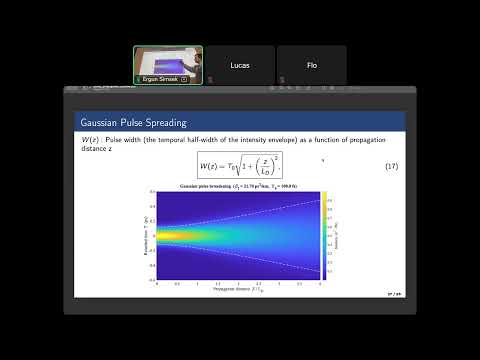
- For a Gaussian pulse, the characteristic dispersion length scales as t₀²/|β₂|, so reducing |β₂| or increasing pulse duration delays significant broadening.
- An initial chirp opposite in sign to a medium’s dispersion can compress a pulse temporarily; the pulse reaches a minimum width and broadens again afterward.
- In the lecture’s 10-Gbit/s NRZ example, a 100-ps bit period gives a 25-ps maximum broadening budget under the one-quarter-bit-period rule.
- Dispersion compensation uses a second fiber section with opposite accumulated dispersion to restore pulse shape and phase more closely.
- Dispersion is not always undesirable: in wavelength-division multiplexing, it can weaken four-wave-mixing phase matching and reduce nonlinear crosstalk.
- Focused ultrafast lasers enable localized ablation, with examples ranging from graphene patterning to cleaning valuable paintings.
Chapters
0:00
Gaussian Pulses, β₂, and Width Conventions
- β₁ describes inverse group velocity; frequency dependence of group velocity is captured by β₂, the group-velocity-dispersion term.
- A Gaussian pulse remains Gaussian in both time and frequency domains, with widths commonly described by full width at half maximum (FWHM).
- For the lecture’s Gaussian-envelope convention, the FWHM is about 1.665 times the characteristic half-width t₀.
6:00
The Dispersive Gaussian-Pulse Solution and Dispersion Length
- The linear Schrödinger equation describes how each offset frequency accumulates a β₂-dependent phase as the pulse propagates along z.
- The characteristic dispersion length is Lᴅ = t₀²/|β₂|; smaller |β₂| or a larger t₀ increases the distance over which dispersion matters.
- The time-domain solution predicts both pulse broadening and a change in peak intensity as the pulse travels.
12:00
Pulse Broadening and the Onset of Chirp
- For an initially unchirped Gaussian pulse, the width grows slowly when z is much smaller than Lᴅ and approaches nearly linear growth when z is much larger than Lᴅ.
- β₂ also creates chirp: the instantaneous frequency varies across the pulse rather than remaining at the central frequency ω₀.
- Simsek gives a scale example in which a 1-ps pulse with β₂ around 21.7 ps²/km has a dispersion length of roughly 46 m.
16:00
Normal and Anomalous Dispersion Produce Opposite Chirps
- The sign of dispersion determines the direction of the frequency sweep across the pulse; normal and anomalous dispersion produce opposite chirp behavior.
- A pulse passing through two sections with opposite dispersion can have some of its accumulated chirp and distortion reversed.
- Choosing fiber types and section lengths appropriately is the basic principle behind dispersion management.
20:00
Estimating Chirp Across a 10-ps Pulse
- Simsek works through a Gaussian-pulse example with t₀ = 6 ps, corresponding to an FWHM of about 10 ps and a characteristic frequency scale near 100 GHz.
- Using β₂ = −21.7 ps²/km and a propagation distance of 5 km, the example estimates a chirp-related frequency span of about 13 GHz.
- The frequency variation matters when selecting a photodetector: insufficient detector bandwidth can prevent resolving the changing pulse frequency.
24:00
Pre-Chirped Pulses Can Compress in a Dispersive Medium
- An initially chirped Gaussian is described by adding a chirp coefficient c to the pulse model.
- When the initial chirp and the medium’s β₂ have opposite signs, the pulse can narrow during propagation before broadening again.
- Differentiating the width-versus-distance relation identifies the position and value of the minimum pulse width.
28:00
Pulse Compression and Why Ultrafast Lasers Matter
- The width-versus-distance curves show that stronger suitable pre-chirp can produce substantially greater compression than ordinary dispersive broadening alone.
- Chirped-pulse amplification and compression underpin ultrashort-pulse generation; Simsek cites the 2018 Nobel Prize in Physics in this context.
- Ultrafast pulses are useful for studying nonlinear optical effects, which become important at high intensities.
32:00
Laser Ablation: From Graphene Patterning to Conservation
- A focused Gaussian laser concentrates intensity at its focal spot; when it exceeds a material’s ablation threshold, material can be removed locally.
- Simsek describes using controlled laser intensity to remove graphene layers and create patterned paths, holes, or gratings.
- Other applications include cleaning aged paintings and treating skin; ablating in water can help limit heat-related damage around the target.
38:00
Microscope Homework and Matching Refractive Indices
- For fluorescent molecules in water or a solution with refractive index near 1.3, a water-immersion objective is a better match than an oil-immersion lens near 1.5.
- Matching the lens and sample-medium indices helps reduce aberration.
- For weak fluorescence, Simsek recommends sensitive detectors such as an avalanche photodiode or photomultiplier tube rather than a basic camera or diode.
42:00
Fiber Dispersion Broadens Pulses Over Long Distances
- A worked example uses a 10-ps Gaussian pulse in single-mode fiber near 1550 nm and estimates a dispersion length of about 1.6 km.
- After 50 km in the example, the pulse broadens substantially, illustrating the risk of neighboring data pulses overlapping.
- At 10 Gbit/s, the bit period is 100 ps, so accumulated broadening can become a limiting factor in a communication link.
45:00
NRZ and RZ Signaling Set Different Broadening Budgets
- The lecture contrasts no-return-to-zero (NRZ), commonly used in internet fiber links, with return-to-zero (RZ), which returns the signal to zero after each bit.
- A common design rule limits RMS pulse broadening to less than one-quarter of the bit period for NRZ; the stricter RZ example uses one-eighth.
- For 10 Gbit/s, the 100-ps bit period makes the NRZ quarter-period budget 25 ps.
50:00
Using the Bandwidth–Distance Limit to Design Fiber Links
- Pulse broadening per unit length depends on fiber dispersion and the laser’s spectral width; their product constrains achievable bandwidth over distance.
- Lower dispersion and a narrower-linewidth source allow a larger bandwidth–distance product.
- Simsek applies the limit to a 10-Gbit/s, 1550-nm link with a 0.1-nm DFB laser linewidth, emphasizing that maximum reach depends on the fiber’s dispersion value.
54:00
Dispersion Compensation and Chirp Radar
- A second fiber section can compensate the first when its accumulated dispersion has the opposite sign and an appropriately chosen length.
- Chirp radar sweeps frequency across a transmitted signal; analyzing the return helps distinguish multiple targets and estimate their ranges.
- Chirped signals also connect to wavelet analysis, which tracks when signal changes occur as well as their frequency content.
58:00
Four-Wave Mixing, Frequency Conversion, and Signal–Idler Pairs
- In four-wave mixing, three optical frequencies can generate a fourth when the phase-matching conditions are satisfied.
- Combining nearby frequencies can also produce a difference-frequency signal, a basis for heterodyne detection and frequency conversion.
- Nonlinear optical media can generate signal and idler fields used in parametric amplification and quantum-optics applications.
1:05:00
WDM Crosstalk, Dispersion’s Useful Role, and Course Wrap-Up
- Wavelength-division multiplexing sends separate data channels at different wavelengths through one fiber, then separates them at the receiver.
- Four-wave mixing can create unwanted extra frequencies and crosstalk; some dispersion disrupts phase matching and can therefore protect WDM channels.
- Simsek recaps pulse broadening, chirp, and bandwidth–distance limits, then previews a hands-on diffraction topic and reminds students about the Wednesday homework deadline.
Summary, takeaways, and chapters were generated by AI from the video's transcript and may contain errors. The video belongs to its creator, Ergun Simsek.