Electric charge and electric force | AP Physics | Khan Academy
 Watch on YouTube →
Overview
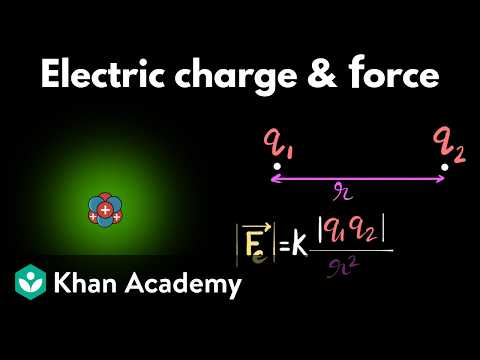
Khan Academy explains electric charge as a fundamental property of matter responsible for electromagnetic force, analogous to mass and gravity. Charge is a scalar quantity measured in coulombs, with two types: positive (protons) and negative (electrons). The elementary charge, 'e', is the magnitude of charge on a proton or electron, approximately 1.60 x 10^-19 C. Coulomb's Law quantifies the electric force between point charges, stating it's proportional to the product of charges and inversely proportional to the square of the distance, with a constant K (Coulomb's constant). The principle of superposition allows calculating forces on multiple charges by vectorially adding individual forces.
Key takeaways
- The 'contact force' felt when pushing objects is actually an electromagnetic repulsion between the electrons of the atoms involved.
- Electric charge is a fundamental scalar property of matter, measured in coulombs, responsible for electromagnetic forces.
- The elementary charge (e), approximately 1.60 x 10^-19 C, is the magnitude of charge on a single proton or electron.
- Coulomb's Law describes the force between two point charges: it's directly proportional to the product of their charges and inversely proportional to the square of the distance between them.
- Unlike gravitational force, electric force can be either attractive or repulsive, depending on the signs of the charges.
- The principle of superposition is used to calculate the net electric force on a charge in the presence of multiple other charges by vectorially adding the individual forces.
Chapters
- Contact force is an electromagnetic repulsion between electrons.
- Charge is a fundamental property of matter, like mass for gravity.
- Charge is a scalar quantity measured in coulombs (C).
- Atoms consist of a nucleus (protons) and an electron cloud.
- Protons have positive charge, electrons have equal negative charge.
- Neutral atoms have equal numbers of protons and electrons, resulting in zero net charge.
- The elementary charge 'e' is approximately 1.60 x 10^-19 C.
- Coulomb's Law: Force is proportional to the product of charges and inversely proportional to the square of the distance.
- Electric force can be attractive (unlike charges) or repulsive (like charges).
- Coulomb's constant K is approximately 8.99 x 10^9 Nm²/C².
- The principle of superposition states that the total force on a charge is the vector sum of forces from individual charges.
Summary, takeaways, and chapters were generated by AI from the video's transcript and may contain errors. The video belongs to its creator, Khan Academy.