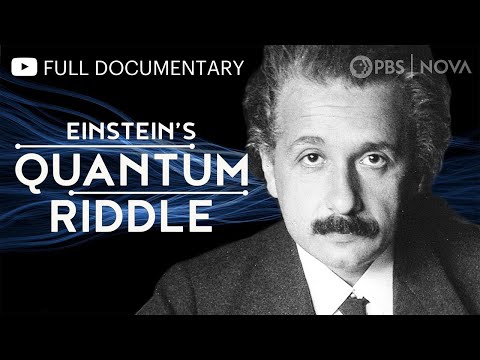
Einstein's Quantum Riddle | Full Documentary | NOVA | PBS
 Watch on YouTube →
Overview
Quantum entanglement, once dismissed by Albert Einstein as “spooky action at a distance,” has survived increasingly stringent tests: John Clauser and Stuart Freedman’s Bell experiment found quantum correlations, and Anton Zeilinger’s cosmic Bell test used light from quasars nearly eight billion years old to select measurement settings. Entanglement now underpins research into quantum computers and secure communications, while also inspiring theories that space-time itself may emerge from networks of quantum connections.
Key takeaways
- Bell’s 1964 theorem turned the Einstein–Bohr dispute into a testable question: measurement correlations can distinguish quantum mechanics from local hidden-variable explanations.
- Clauser and Freedman’s photon experiment found correlations stronger than Einstein-style local physics predicted, matching quantum mechanics.
- Zeilinger’s cosmic Bell test used fluctuations in light from quasars nearly eight billion years old to choose measurement settings and sharply constrain the common-cause loophole.
- Entangled qubits are being developed for quantum computing, while photon-based quantum communication can expose eavesdropping because interception disrupts the expected correlations.
- Some theoretical approaches propose that space-time may emerge from quantum entanglement, potentially making entanglement more fundamental than the spatial separation it appears to cross.
Chapters
0:00
Quantum Entanglement and the Canary Islands Cosmic Test
- Quantum mechanics predicts that entangled particles can show coordinated measurement results even when widely separated.
- Einstein rejected this as “spooky action at a distance,” while modern quantum computers and encryption depend on entanglement.
- Anton Zeilinger’s team planned to use light from distant quasars to choose measurements in a Bell test.
- Clouds, 100% humidity, and icy roads initially prevented the team from using the Roque de los Muchachos telescopes.
8:00
Einstein, Bohr, and the Quantum Debate at the 1927 Solvay Conference
- At the 1927 Solvay Conference in Brussels, Einstein challenged Niels Bohr and other founders of quantum mechanics.
- Quantum theory describes particles such as electrons through probabilities; before measurement, their possible states form a wave of possibilities.
- Einstein argued that physics should describe a complete, definite reality, famously questioning whether the Moon exists when nobody looks.
- Bohr’s explanations repeatedly answered Einstein’s challenges, but Einstein remained convinced that quantum mechanics was incomplete.
15:00
The 1935 EPR Paper Defines the Entanglement Paradox
- At Princeton in 1935, Einstein, Nathan Rosen, and Boris Podolsky wrote the paper now known as EPR.
- Their argument highlighted quantum predictions that measuring one particle would correlate with a distant partner, even across enormous distances.
- Einstein’s principle of locality held that an influence must travel through space and cannot exceed light speed.
- EPR proposed that particles might possess hidden properties that quantum mechanics failed to describe; Bohr defended the theory’s strange correlations, later called entanglement.
23:00
John Bell’s Inequality and Clauser–Freedman’s First Test
- John Bell’s 1964 theorem showed that Einstein-style local explanations and quantum mechanics make different predictions for correlations between measured particles.
- John Clauser and Stuart Freedman built an experiment using laser-excited calcium atoms to produce photon pairs and filters to measure them.
- After hundreds of thousands of measurements, their results showed correlations stronger than local hidden-variable physics allowed.
- The outcome matched quantum mechanics and provided experimental evidence that entanglement occurs in nature.
29:00
The Fundamental Fysiks Group Brings Entanglement into Public Debate
- The San Francisco-based Fundamental Fysiks Group, whose members included Clauser, explored the implications of Bell tests.
- Some members connected quantum physics with Eastern mysticism, and popular books such as Fritjof Capra’s The Tao of Physics promoted ideas of cosmic connectedness.
- The group held discussions at California’s Esalen Institute, but Clauser said it found no useful scientific link to Eastern mysticism.
- Despite its fringe reputation, the group treated entanglement as a central physics question decades before it became a major technology focus.
32:00
Google’s 72-Qubit Chip and the Promise of Quantum Computing
- A classical computer encodes information as bits, while a qubit can occupy a combination of zero and one.
- At Google’s Santa Barbara lab, Marissa Giustina’s team worked with a chip containing 72 qubits and aimed to control and entangle them.
- Entangled qubits could help solve problems with vast search spaces, such as finding an optimal route among 30 cities.
- Quantum computers could also threaten current encryption by solving certain code-breaking problems far faster than conventional computers.
36:00
Jian-Wei Pan’s Quantum Networks and Satellite Communications
- Jian-Wei Pan’s research center in Shanghai developed quantum communication systems using photons to detect eavesdropping.
- An optical-fiber network spanning more than 1,000 miles carried secure information between Beijing and Shanghai for banks and data companies.
- China’s quantum communication satellite sent entangled photons to distant users, extending communication beyond the limits of fiber links.
- Measuring and replacing an intercepted photon disrupts the expected entangled correlations, revealing an attempted intrusion.
39:00
Quasar Light Closes a Major Loophole in the Cosmic Bell Test
- A Bell-test loophole arises if a common cause influences both the particles and the supposedly random choices of measurement settings.
- Zeilinger’s team used two telescopes to collect light from separate quasars and let its fluctuations select which filters measured entangled photons.
- Because the quasar light had traveled for billions of years, a shared cause would have needed to influence the experiment far in the past.
- The team’s data showed quantum correlations; the measurement-setting light was nearly eight billion years old, making the local alternative highly implausible.
46:00
What Entanglement Means for Space, Measurement, and Reality
- The cosmic Bell test leaves little room for Einstein-like local explanations, though the researchers do not claim to have ruled out every conceivable alternative.
- Entanglement challenges common-sense assumptions about whether particles have definite properties before measurement and how separated systems can be correlated.
- Shohini Ghose describes the implications as radically counterintuitive, likening the quantum world to Alice in Wonderland.
48:00
Could Entanglement Generate Space-Time in a Holographic Universe?
- General relativity describes gravity and the large-scale universe, while quantum mechanics describes the microscopic world; a complete theory joining them remains elusive.
- Robbert Dijkgraaf discusses the possibility that space and time emerge from networks of entangled quantum particles rather than serving as fundamental ingredients.
- In the holographic-universe idea, quantum information on a distant boundary could encode the three-dimensional reality experienced within it.
- If space itself emerges from entanglement, the apparent paradox of connections across space may change because space is no longer fundamental.
Summary, takeaways, and chapters were generated by AI from the video's transcript and may contain errors. The video belongs to its creator, NOVA PBS Official.