Egypt's Lost Secrets: The Grand Tour of the Pharaohs
 Watch on YouTube →
Overview
History & Civilizations presents a Nile-side survey of pharaonic Egypt through representative monuments, linking their religious functions to the major political eras: the Old Kingdom’s pyramid culture at Saqqara and Giza, the New Kingdom’s monumental temple building at Luxor and Karnak, and the Greco-Roman reinvention of sacred space at Dendera and Philae. The narrative also traces how Egyptology emerged through European expeditions—Napoleon’s 1798 campaign with nearly 170 scholars, Champollion and Ippolito Rossellini’s Franco-Tuscan survey, Lepsius’s Prussian documentation, and Auguste Mariette’s creation of the Egyptian Antiquities Service in 1858 and the Boulaq Museum—before ending with the living ritual and astronomical program of Dendera’s 40,000-square-meter complex.
Key takeaways
- Egyptian sacred architecture changes with politics: the Old Kingdom prioritizes pyramids and mortuary complexes, the New Kingdom builds processional temples for Amun, and the Ptolemaic-Roman period repurposes temples with new rulers and iconography.
- Luxor Temple functioned as a ritual machine for the Opet festival, moving Amun, Mut, and Khonsu between Karnak and Luxor in a 2 km ceremonial procession lasting 11 days.
- Modern Egyptology emerged through competition and documentation, not just excavation: Napoleon's scholars, Champollion's decipherment of hieroglyphs, Lepsius's Denkmäler, and Mariette's administrative reforms each added a different layer of knowledge and control.
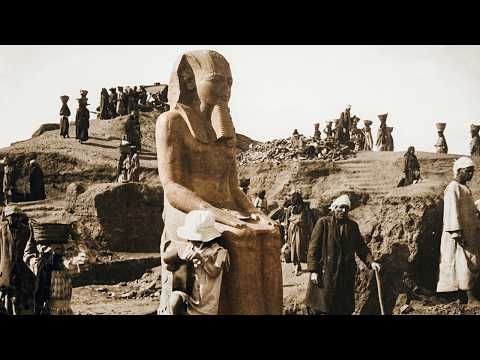
- The acquisition of Egyptian antiquities in the 19th century was often extractive and unregulated, as shown by Belzoni removing Young Memnon and the transfer of major objects to London and Paris.
- Dendera preserves a rare fusion of religion and science: its ceiling records the sun's path, lunar phases, eclipses, and zodiacal constellations, showing that priestly astronomy guided festival calendars.
- Egypt's antiquities system has shifted from foreign-led control to national management since Nasser, with international missions now limited in time and required to fund their own fieldwork.
Chapters
- The journey follows a dozen archaeological sites along the Nile, with Saqqara, Giza, Karnak, Luxor, Edfu, Kom Ombo, Philae, and Dendera as key stops.
- Each site is framed by its dominant deity: Hathor at Dendera, Amun at Karnak and Luxor, Horus at Edfu, Sobek at Kom Ombo, and Isis at Philae.
- The route is presented as an overview of pharaonic culture rather than a single dynasty or city.
- The Old Kingdom begins in the 3rd millennium BCE with the first pharaohs and the rise of divine kingship.
- Saqqara marks the beginning of stepped pyramids, while Giza becomes the high point under the Fourth Dynasty.
- The New Kingdom, between roughly 1500 and 1000 BCE, is described as the most prosperous era, producing major monuments such as Luxor Temple.
- The first millennium BCE is characterized by political fragmentation and foreign rulers: Ethiopians, Assyrians, and Libyans.
- Later, Egypt becomes part of the Persian Empire and then the Ptolemaic Greek world before falling under Roman control.
- At Philae, Roman presence appears through cultural blending, including mixed divine imagery and Latin-era traces.
- European rediscovery begins with early travelers in the Cairo region and later reaches Upper Egypt in the 16th and 17th centuries.
- Napoleon's 1798-1801 expedition brings nearly 170 scholars and produces the massive Description de l'Égypte.
- The Rosetta Stone, later studied by Jean-François Champollion, becomes central to deciphering hieroglyphs.
- Champollion and Ippolito Rossellini lead a Franco-Tuscan expedition funded by Charles X and the Grand Duke of Tuscany.
- Their survey runs from northern Egypt to Nubia, collecting drawings, notes, and monument descriptions.
- Richard Lepsius later follows the same route in a Prussian expedition and publishes the Denkmäler, expanding the documentary record.
- Bernardino Drovetti and Henry Salt compete in Egypt during 1815-1816, building the French and British collections.
- Giovanni Belzoni removes the bust known as Young Memnon from the Ramesseum in July 1816 and sends it to the British Museum.
- The period predates real antiquities legislation, allowing purchases, removals, and outright looting of artifacts.
- Auguste Mariette founds the Egyptian Antiquities Service in 1858 and creates the first Cairo archaeological museum, the Boulaq Museum.
- Mariette excavates from the Delta to Upper Egypt and builds state control over archaeological concessions and site protection.
- After his death, Gaston Maspero continues the service and helps establish the French School in Cairo, later the French Institute of Oriental Archaeology.
- After Gamal Abdel Nasser's revolution, Egyptians take control of the Antiquities Service and foreign missions work under permits.
- Modern expeditions are short, often only 1 to 5 months per year, and foreign teams now finance their own work.
- Current projects include excavation, epigraphic recording, iconography, architecture, restoration, and conservation by French, German, Italian, Spanish, Russian, American, and British teams.
- Luxor Temple, built mainly in the 18th and 19th Dynasties, is dedicated to Amun and linked to Karnak by a 2 km avenue with about 700 sphinxes.
- Amenhotep III begins the complex; Ramesses II adds six monumental statues and two obelisks, one of which now stands at Place de la Concorde in Paris.
- The temple's plan includes a pylon, a 74-column courtyard, processional colonnades, hypostyle halls, and a sanctuary for the sacred boat of Amun.
- Dendera lies about 65 km north of Luxor and was completed under Emperor Nero around 60 CE after beginnings under the Ptolemies.
- The temple of Hathor covers about 40,000 square meters, preserves richly colored crypts, and includes a rare astronomical ceiling.
- Its decoration shows 18 Hathoric columns, the Dendera zodiac, Roman emperors such as Augustus, Tiberius, Caligula, Claudius, and Nero, and a rooftop New Year ritual honoring Hathor's union with the solar disk.
Summary, takeaways, and chapters were generated by AI from the video's transcript and may contain errors. The video belongs to its creator, History & Civilizations.