EGME 333 FALL 2026 Week 3 Lecture 2
 Watch on YouTube →
Overview
Justin Tran works through two hydrostatic-gate equilibrium examples, showing how to find resultant pressure forces, centers of pressure, and moment arms before balancing moments about a hinge. He then introduces Archimedes’ principle, relates buoyant force to displaced-fluid volume, and compares buoyancy with weight to explain floating, sinking, and density criteria.
Key takeaways
- For a submerged plane, use F = ρgA h_c for resultant-force magnitude and locate its center of pressure below the centroid using the area moment of inertia.
- A hinged gate’s equilibrium is determined by summing signed moments about the hinge; each moment arm is the perpendicular distance to the force’s line of action.
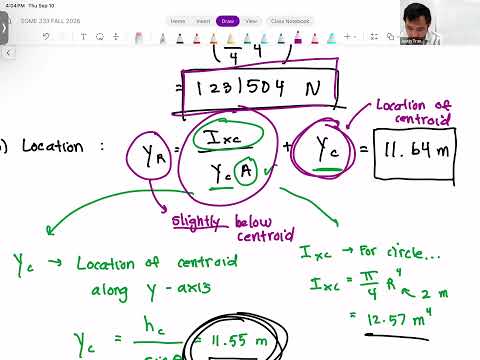
- In the 4 m circular-gate example, the 1.2315 MN water-pressure resultant acts only 0.09 m from the hinge, while a stopper force of about 55.4 kN acts with a 2 m arm.
- For the 3 m square water–oil gate, the stated moment-balance equation gives h_o ≈ 3.42 m; the lecture’s reported 3.476 m does not match the arithmetic from its stated inputs.
- Buoyant force is F_B = ρ_fluid gV_displaced, so a half-submerged cube of edge L experiences half the buoyancy of the same cube when fully submerged.
- For a fully submerged body, comparing object density with fluid density predicts whether it can float: lower-density bodies rise toward partial-submersion equilibrium, while denser bodies sink.
Chapters
0:00
Class Opening and Lecture Context
- Class begins at about 8:18 after a brief opening period.
- The planned sequence is to finish hydrostatic-force examples, introduce buoyancy, and begin Bernoulli’s equation the following week.
8:18
Reviewing Resultant Hydrostatic Force and Center of Pressure
- For a submerged plane surface, the resultant force magnitude is F = ρgA h_c, where h_c is the centroid’s vertical depth below the free surface.
- The center of pressure lies below the centroid; its position along the surface is found using the area moment of inertia and centroid location.
- For the inclined circular gate from Tuesday’s example, the centroid and pressure-resultant positions are 11.55 m and 11.64 m along the gate.
11:44
Visualizing the Inclined Gate’s Pressure Resultant
- The circular gate is inclined 60° to the horizontal, and its hinge is at the gate’s centroid.
- The coordinates y_c = 11.55 m and y_R = 11.64 m are measured parallel to the gate, not as direct vertical depths.
- Drawing both positions shows the small offset that creates a moment about the hinge.
16:18
Why the Gate Stopper Must Balance the Pressure Moment
- The pressure resultant acts below the central hinge and therefore tends to rotate the gate counterclockwise.
- A ledge or stopper supplies an opposing force that produces a clockwise moment.
- Static equilibrium requires the sum of moments about the hinge to equal zero.
20:20
Finding Moment Arms from Perpendicular Distance
- A force’s moment magnitude is its magnitude multiplied by the perpendicular distance from its line of action to the hinge.
- Extending the force’s line of action makes the shortest, perpendicular distance easier to identify than measuring directly to the force arrow.
- Justin uses counterclockwise moments as positive and clockwise moments as negative, while emphasizing that consistency matters more than the chosen convention.
24:58
Setting Up Moment Arms for the Circular Gate
- The 4 m diameter gate has its hinge at the center, so the ledge-force moment arm is the radius: D_L = 2 m.
- The pressure-force moment arm is the difference between its position and the hinge position along the gate.
- Using y_R = 11.64 m and y_c = 11.55 m gives D_R = 0.09 m.
27:37
Solving for the Circular Gate’s Stopper Force
- The moment equation is F_R D_R − F_L D_L = 0.
- With F_R ≈ 1,231,504 N, D_R = 0.09 m, and D_L = 2 m, the stopper force is approximately 55,418 N.
- The method illustrates how a large hydrostatic force can be balanced by a smaller force acting farther from the hinge.
33:02
Setting Up a Hinged Gate Between Water and Oil
- A vertical, square gate separates water on the left from motor oil on the right and is hinged at its top edge.
- The gate is 3 m on each side, so its area is 9 m²; the water and oil specific weights are 9,800 N/m³ and 5,000 N/m³.
- The water surface aligns with the hinge, and the unknown is the oil-surface distance h_o to the gate centroid.
41:07
Calculating the Water-Side Force and Its Location
- The water-side centroid depth is h_c = 1.5 m because the 3 m gate is square and the water surface aligns with its top edge.
- Using F_W = γ_W h_c A gives a water resultant of 132,300 N.
- For the square gate, I_x = (1/12)(3 m)^4 = 6.75 m⁴; the center-of-pressure formula places the resultant 2 m below the water surface.
49:21
Expressing the Oil-Side Force and Center of Pressure
- The oil force is F_O = γ_O h_o A = 45,000h_o N, using γ_O = 5,000 N/m³ and A = 9 m².
- The oil center of pressure is h_RO = h_o + I_x/(h_o A) = h_o + 0.75/h_o.
- Because h_o is unknown, both the oil force and its location remain expressions in h_o until the moment balance is applied.
54:44
Balancing Water and Oil Moments About the Top Hinge
- The water moment arm is 2 m because the water surface coincides with the hinge and its resultant is 2 m below that surface.
- For the oil side, the hinge is 1.5 m above the gate centroid, yielding an oil moment arm of 0.75/h_o + 1.5 m.
- Equating moments gives 264,600 = 45,000h_o(0.75/h_o + 1.5); the stated inputs imply h_o ≈ 3.42 m, although the lecture later reports 3.476 m.
1:04:09
Introducing Buoyancy and Archimedes’ Principle
- Buoyancy is the upward force a fluid exerts on an object that is fully or partly submerged.
- The force arises because fluid pressure increases with depth, producing a net upward effect on the submerged body.
- Archimedes’ principle states that buoyant-force magnitude equals the weight of the fluid displaced.
1:07:35
Computing Buoyant Force from Displaced Volume
- The working relation is F_B = ρ_fluid g V_displaced.
- Only the portion of an object below the fluid surface contributes to displaced volume; any exposed portion is excluded.
- The product ρg is the fluid’s specific weight, though Justin writes the density and gravity separately.
1:10:35
Fully and Partially Submerged Cube Examples
- A fully submerged cube with edge length L displaces L³ of fluid, giving F_B = ρ_fluid gL³.
- If only half the cube is submerged, the displaced volume is L³/2 and the buoyant force is ρ_fluid gL³/2.
- The cube’s weight acts downward while buoyancy acts upward; the submerged volume determines the buoyant-force magnitude.
1:15:30
Floating, Sinking, and Rising Conditions
- An object floats in equilibrium when buoyant force equals its weight, F_B = W; floating objects are commonly only partly submerged.
- If W > F_B, the net force is downward and the object sinks.
- If F_B > W, as when a kickboard is pushed underwater, the object rises until buoyancy and weight balance.
1:19:30
Density Criteria, Archimedes Anecdote, and Course Wrap-Up
- For a fully submerged object, buoyancy depends on fluid density while weight depends on object density; the comparison explains why lower-density objects can float.
- The lecture recounts the traditional Archimedes and “fool’s gold” story, while noting that the tale and choice of test fluid may be uncertain.
- The next class will finish buoyancy with an example and stability, then move from fluid statics to Bernoulli’s equation.
Summary, takeaways, and chapters were generated by AI from the video's transcript and may contain errors. The video belongs to its creator, Justin Tran.