EEL4514C Communication Systems and Components, Fall 2026, Lecture 20
 Watch on YouTube →
Overview
Mingyue Ji develops the properties and bandwidth analysis of angle modulation, contrasting PM’s phase sensitivity with FM’s frequency sensitivity and showing why FM tolerates a cubic nonlinearity better than DSB-SC. A Taylor expansion reveals FM’s theoretically infinite bandwidth, motivates narrowband FM when the modulation index is small, and leads to a sampling-based method for analyzing wideband FM.
Key takeaways
- PM changes phase directly according to m(t), while FM changes instantaneous frequency according to m(t); consequently, FM phase deviation depends on the integral of the message.
- A cubic nonlinearity can widen DSB-SC’s carrier-band message term from bandwidth B to roughly 3B, whereas FM’s corresponding cubic contribution mainly changes amplitude and phase deviation.
- The Taylor expansion of FM contains powers of the integrated message at every order, so its strict mathematical bandwidth is infinite even though higher-order sidebands may carry little energy.
- Narrowband FM is accurate when kfA(t) ≪ 1 and can be generated by adding a carrier to a DSB-SC-like term based on the integrated message; its approximate bandwidth is 2B.
- For a message bandlimited to B, piecewise-constant samples spaced 1/(2B) apart provide a Nyquist-rate representation that makes FM’s phase integral easier to evaluate interval by interval.
Chapters
0:00
Midterm Scope, Date, and Lecture Schedule
- The midterm is planned for Wednesday, October 21, at about 7:30 PM, with the room booking to be confirmed.
- Exam coverage runs through angle modulation, the final topic in analog communication before digital communication begins.
- Mingyue Ji plans to upload a prior-year practice exam and prerecorded lectures during the travel week; there will be no Friday lecture.
1:10
PM and FM: Phase, Frequency, and the General Angle-Modulation Model
- Instantaneous angular frequency is the time derivative of phase; PM sets phase to ωct + kp m(t), where kp is measured in radians per volt.
- FM sets instantaneous angular frequency to ωc + kf m(t), where kf is frequency sensitivity in radians per second per volt; integrating it gives phase ωct + kf∫m(τ)dτ.
- A general angle modulator applies an LTI system to m(t) to produce phase deviation; PM and FM are special cases, with phase sensitivity and frequency sensitivity respectively.
6:34
Angle-Modulation Properties and DSB-SC’s Cubic-Distortion Problem
- When carrier frequency greatly exceeds message bandwidth, angle-modulated signals have nearly constant power over a carrier-period-scale observation window.
- Angle modulation is nonlinear in the message, unlike the linear DSB-SC modulation operator discussed in class.
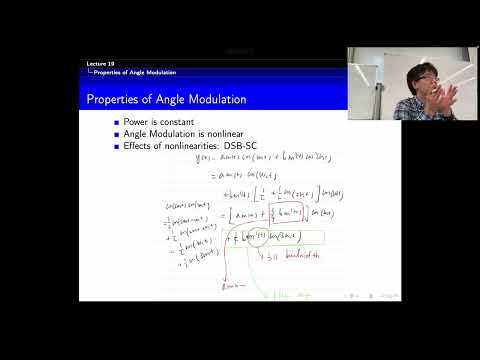
- For a DSB-SC input passed through y = a s + b s³, the cubic term creates an in-band carrier-frequency component proportional to m³(t), whose bandwidth can grow to about 3B.
10:21
Why FM Is More Robust to a Cubic Nonlinearity
- For an FM input Ac cos(ωct + φ(t)), cubic expansion produces a carrier-frequency component with a changed amplitude and phase deviation scaled by a constant.
- The additional cubic harmonic appears around three times the carrier frequency and can be removed with filtering.
- Unlike DSB-SC’s m³(t) term, FM’s carrier-band term does not broaden the message bandwidth, making FM more robust to this nonlinearity.
16:43
Why FM Bandwidth Is Hard to Determine Directly
- Bandwidth is assessed from a signal’s frequency-domain energy distribution, not just from its time-domain waveform.
- FM contains a cosine whose phase includes an integral of the message, so directly Fourier-transforming the waveform is difficult.
- Mingyue Ji introduces complex exponentials as a more tractable way to expose FM’s spectral components.
20:26
Taylor Expansion Reveals FM Sidebands at Every Order
- Writing A(t) = ∫m(τ)dτ expresses FM as the real part of Ac exp(jωct) exp(jkfA(t)).
- Expanding exp(jkfA(t)) produces terms involving A(t), A²(t), A³(t), and higher powers, each modulated around the carrier.
- If A(t) has bandwidth B, its nth power can have bandwidth up to nB, so the sequence of FM sidebands extends to arbitrarily high frequencies.
31:30
FM’s Infinite Theoretical Bandwidth and the Small-Index Condition
- Because higher powers of A(t) generate progressively wider sidebands, the Taylor-series analysis gives FM infinite bandwidth in the strict mathematical sense.
- When kfA(t) is much smaller than 1, higher-order terms become small and contribute little energy despite the infinite theoretical extent.
- The size of kfA(t) provides a practical condition for simplifying bandwidth analysis; later analysis will offer another bandwidth measure.
35:30
Narrowband FM as a Carrier Plus a DSB-SC-Like Term
- For kfA(t) ≪ 1, FM is approximated by Ac cos(ωct) − Ac kfA(t)sin(ωct), retaining only the carrier and first-order term.
- The message-bearing term resembles DSB-SC with A(t), the integral of m(t), as its message and a 90-degree phase shift from the usual cosine form.
- A practical narrowband-FM modulator integrates m(t), scales it by kf, multiplies it by a sine carrier in a DSB-SC modulator, then adds the unmodulated carrier; the approximate bandwidth is 2B.
40:49
Wideband FM Analysis via Nyquist-Rate Message Sampling
- When kfA(t) is not small, the narrowband Taylor approximation is inadequate; wideband FM requires a different way to analyze the phase integral.
- The method approximates m(t) with piecewise-constant samples m(tk), using sample spacing 1/(2B) for a message bandlimited to B.
- Replacing the message on each interval by a constant makes the phase integral explicit over that interval, allowing the resulting FM spectrum to be analyzed piece by piece.
- Mingyue Ji sets the message amplitude range from −Mp to Mp before continuing the wideband analysis in the prerecorded follow-up.
Summary, takeaways, and chapters were generated by AI from the video's transcript and may contain errors. The video belongs to its creator, Mingyue Ji.