EEL4514C Communication Systems and Components, Fall 2026, Lecture 18
 Watch on YouTube →
Overview
Mingyue Ji reviews single-sideband (SSB) and vestigial-sideband (VSB) modulation, then derives quadrature amplitude modulation (QAM) from the orthogonality of cosine- and sine-carrier components. The lecture connects complex-baseband analysis and coherent QAM demodulation to analog applications: AM radio, 6 MHz analog TV channels using VSB and QAM, and long-distance telephony multiplexing 600 voice channels through frequency-division multiplexing.
Key takeaways
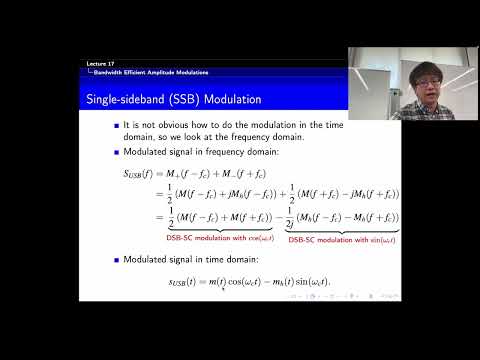
- An SSB signal can be generated as m(t) cos(ωct) − m̂(t) sin(ωct), using the Hilbert transform to form the quadrature component needed to suppress one sideband.
- QAM transmits two independent message signals in the same carrier band by placing them on cosine and sine carriers whose inner product is zero when the message bandwidth is B and fc > B.
- The complex envelope m1(t) + j m2(t) is a compact analysis model; multiplying it by e^(jωct) and taking the real part yields the physical QAM waveform.
- Coherent QAM reception uses separate synchronized cosine and sine mixers followed by low-pass filters to recover the I and Q messages.
- The analog-TV example combines VSB-shaped luminance video and QAM color information within a roughly 6 MHz channel; unequal I/Q bandwidths mean the color branches must be understood as a jointly designed system.
- Long-distance telephone FDM assigns roughly 4 kHz to each speech channel and combines 12-channel groups into larger multiplexes; OFDM retains frequency subchannels but uses orthogonal, overlapping spectra.
Chapters
0:00
SSB Modulation, Hilbert Transforms, and the VSB Filter Criterion
- SSB removes one sideband: USB shifts positive-frequency content upward, while LSB retains the opposite sideband.
- The SSB waveform can be written as m(t) cos(ωct) − m̂(t) sin(ωct), where m̂(t) is the Hilbert transform of m(t).
- Hilbert transformation preserves spectral magnitude and shifts phase by −π/2 for positive frequencies and +π/2 for negative frequencies.
- VSB smooths the abrupt SSB spectral transition; input and output filters are designed so their combined response restores the message-band signal.
7:20
QAM: Sending Two Signals on Orthogonal Carriers
- The SSB discussion motivates QAM: transmit one message on a cosine carrier and another on a sine carrier.
- The two branches form sQ(t) = m1(t) cos(ωct) − m2(t) sin(ωct), allowing two baseband signals to share the same carrier band.
- Unlike SSB, QAM does not require the second message to be the Hilbert transform of the first.
- Both QAM branches are DSB-SC signals, so QAM carries two messages without increasing the occupied bandwidth relative to a single DSB-SC channel.
11:00
Why QAM’s Cosine and Sine Branches Are Orthogonal
- Ji evaluates the branches’ inner product in the frequency domain using Parseval’s relation.
- For message spectra limited to bandwidth B, the carrier must satisfy fc > B so shifted spectral copies do not overlap.
- After shifting the cross-products to baseband, corresponding integrals are equal and cancel, giving an inner product of zero.
- That zero inner product establishes the orthogonality that lets a receiver separate m1(t) and m2(t).
19:00
QAM as a Complex Baseband Signal
- The two real messages can be represented together as the complex envelope m1(t) + j m2(t).
- In this representation, m1(t) is the in-phase (I) component and m2(t) is the quadrature (Q) component.
- Complex signals need not have conjugate-symmetric spectra; the symmetry G(−f) = G*(f) applies to real-valued signals.
- Complex notation simplifies analysis even though the physical over-the-air passband waveform is real.
23:00
Complex Exponential Modulation Produces the Real QAM Waveform
- Multiplying the complex envelope by e^(jωct) shifts its spectrum to the carrier using a single complex frequency shift.
- Expanding (m1 + j m2)e^(jωct) gives real part m1 cos(ωct) − m2 sin(ωct) and imaginary part m1 sin(ωct) + m2 cos(ωct).
- The transmitted signal is the real part; the imaginary component is an analysis representation rather than a separately transmitted waveform.
- This complex-passband construction reproduces the two-branch QAM signal while making frequency-shift analysis more direct.
27:50
Coherent QAM Demodulation with Two Synchronous Detectors
- Recover m1(t) by multiplying the received QAM signal by a synchronized cosine and low-pass filtering.
- Recover m2(t) with a synchronized sine detector and a second low-pass filter.
- Using a factor of 2 in the mixers compensates for the carrier multiplication’s amplitude scaling.
- As with SSB, the receiver needs coherent detection: its local carrier must have the correct frequency and phase.
30:45
AM Broadcast Radio: Audio Bandwidth and Skywave Propagation
- The lecture gives AM broadcast audio a maximum frequency of about 10 kHz and a corresponding double-sideband bandwidth of about 20 kHz.
- AM stations use different transmission approaches by day and night because propagation conditions change.
- At night, skywave propagation can reflect signals from the ionosphere, enabling long-distance reception.
- Large AM wavelengths require large antennas; Ji points to a Gainesville-area station site with multiple tall antennas.
35:00
Analog Television: VSB Video and QAM Color Information
- Analog TV carries luminance (black-and-white picture), audio, and color information as distinct signal components.
- The lecture describes an approximately 6 MHz channel, with a VSB video spectrum including about 4.75 MHz of upper sideband and 1.25 MHz of lower-sideband vestige.
- The audio component is placed around 4.5 MHz, while the luminance video bandwidth is about 4.2 MHz.
- Color information uses QAM; its I and Q components have unequal bandwidths and are shaped together, so it is misleading to describe the I branch alone as VSB and the Q branch alone as ordinary DSB-SC.
44:20
Long-Distance Telephony: SSB and FDM Channel Hierarchies
- Speech is limited to roughly 3.4 kHz, so the telephone system allocates about 4 kHz per voice channel and uses SSB to conserve spectrum.
- Frequency-division multiplexing (FDM) assigns different frequency slots to simultaneous callers on a shared transmission channel.
- The described hierarchy combines 12 voice channels into a group and scales the groups into higher-level multiplexes supporting 600 users.
- Modern OFDM also divides transmissions across frequency subchannels, but its subcarriers are orthogonal rather than separated by the fully non-overlapping guard spacing shown in the older FDM example.
Summary, takeaways, and chapters were generated by AI from the video's transcript and may contain errors. The video belongs to its creator, Mingyue Ji.