EEL4514C Communication Systems and Components, Fall 2026, Lecture 17
 Watch on YouTube →
Overview
Mingyue Ji develops bandwidth-efficient amplitude modulation from single-sideband (SSB) to vestigial-sideband (VSB) and quadrature amplitude modulation (QAM). The lecture derives SSB using the Hilbert transform and coherent detection, explains why ideal SSB filtering is impractical, formulates VSB equalization, and introduces QAM as two independent messages carried on orthogonal in-phase and quadrature carriers.
Key takeaways
- SSB reduces DSB bandwidth by half by transmitting only USB or LSB, and the Hilbert transform supplies the quadrature message needed to construct that single sideband.
- The USB time-domain signal is m(t)cos(ωct) − m̂(t)sin(ωct); coherent multiplication and low-pass filtering recover m(t), but require a phase-aligned carrier.
- Ideal SSB demands an unrealistically sharp frequency cutoff, while VSB preserves a small sideband remnant to allow smoother, practical filtering.
- VSB recovery depends on the combined overlapping filter response Hᵢ(f + fc) + Hᵢ(f − fc); the receiver equalizer is chosen as its reciprocal under the lecture's convention.
- QAM uses cosine and sine carriers separated by 90° to transmit independent I and Q messages in the same DSB-SC bandwidth, rather than removing redundant spectral content.
Chapters
0:00
AM Demodulation Review and Why SSB Saves Bandwidth
- The previous lecture covered square-law and diode-rectifier AM demodulators, which use low-pass filtering to recover the message without a local carrier.
- These noncoherent AM methods are convenient but not power-efficient.
- Because a real message signal has conjugate-symmetric positive- and negative-frequency components, conventional double-sideband transmission uses bandwidth for redundant information.
- SSB sends only the upper sideband (USB) or lower sideband (LSB), reducing the transmitted bandwidth by half relative to DSB.
6:25
Hilbert Transforms Represent the SSB Sidebands
- The Hilbert transform creates a quadrature version of the message, denoted m̂(t), with a frequency-domain phase shift of −90° for positive frequencies and +90° for negative frequencies.
- The Hilbert transform changes phase but preserves the message spectrum's magnitude.
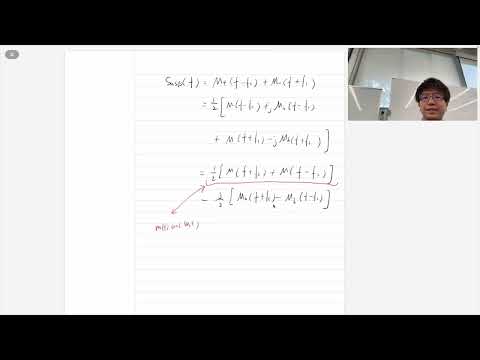
- The analytic-signal components are expressed as M⁺(f) = ½[M(f) + jM̂(f)] and M⁻(f) = ½[M(f) − jM̂(f)].
- Shifting these components around the carrier frequency isolates USB or LSB in the frequency domain.
13:00
USB Time-Domain Formula and Modulator Architecture
- The USB waveform is sUSB(t) = m(t)cos(ωct) − m̂(t)sin(ωct); the LSB uses the opposite sign.
- The USB signal combines ordinary DSB-SC modulation of m(t) on a cosine carrier with DSB-SC modulation of its Hilbert transform on a sine carrier.
- A practical block diagram splits m(t): one path modulates cos(ωct), while the other applies a Hilbert transform and modulates sin(ωct).
- Adding the two paths produces the SSB waveform without transmitting the redundant sideband.
17:20
Coherent Detection Recovers the SSB Message
- The receiver multiplies the received SSB signal by a synchronized cos(ωct) carrier.
- For USB, this multiplication yields a baseband term m(t)/2 plus terms centered at 2ωc, including components from m̂(t).
- A low-pass filter removes the 2ωc components, leaving a scaled copy of m(t), which can be restored by gain adjustment.
- Unlike envelope detection for conventional AM, SSB recovery requires coherent detection with the receiver carrier aligned in phase.
22:50
Why Ideal SSB Filters Lead to VSB
- SSB is bandwidth- and power-efficient, but its ideal frequency response requires an abrupt sideband cutoff.
- A perfectly sharp transition in frequency would require an ideal filter, which cannot be realized in practice.
- VSB, or vestigial-sideband modulation, retains one main sideband and a small remnant of the other sideband.
- That vestige makes the spectral transition smoother than SSB, at the cost of a modest increase in bandwidth.
29:00
VSB Modulation and Coherent Receiver Structure
- The VSB transmitter first multiplies m(t) by 2cos(ωct), then applies a shaping filter Hᵢ(f) to form the vestigial-sideband spectrum.
- At the receiver, coherent multiplication by 2cos(ωct) shifts the sidebands back toward baseband and also creates high-frequency components.
- A low-pass output filter Hₒ(f) removes the high-frequency terms and compensates for the transmitter's VSB shaping.
- The intended output is the original message spectrum M(f), assuming the carrier is coherently synchronized.
34:30
VSB Equalization Condition for Message Recovery
- After coherent demodulation, the two overlapping sideband contributions combine around baseband as M(f)[Hᵢ(f + fc) + Hᵢ(f − fc)].
- The receiver filter is designed to compensate for that combined response so the recovered spectrum equals M(f).
- The lecture gives the condition Hₒ(f) = 1/[Hᵢ(f + fc) + Hᵢ(f − fc)] for the stated modulation convention.
- This transmitter-filter/receiver-equalizer pairing is an example of frequency-response equalization, a design idea also used in digital communications.
38:50
QAM Motivation: Two Messages in the DSB Bandwidth
- QAM is widely used in digital communications and is also applicable to analog communication.
- Rather than removing a redundant sideband as SSB does, QAM places two independent message signals in the same DSB-SC bandwidth.
- The motivation is to improve bandwidth efficiency over DSB-SC while avoiding the filtering complexity of SSB and VSB.
- QAM uses two carriers at the same frequency with a 90° phase offset, making them orthogonal.
43:00
I/Q Modulation and the Open Question of Recovery
- The modulator multiplies message m₁(t) by a cosine carrier and message m₂(t) by a sine carrier, then adds the two paths.
- The cosine-carrier path is the in-phase component I; the sine-carrier path is the quadrature component Q.
- Unlike SSB, QAM does not derive its second path by Hilbert-transforming the first message; it carries a separate message instead.
- Mingyue Ji ends by previewing the next lecture's question: how coherent demodulation separates the two messages from the combined QAM signal.
Summary, takeaways, and chapters were generated by AI from the video's transcript and may contain errors. The video belongs to its creator, Mingyue Ji.