EEL4514C Communication Systems and Components, Fall 2026, Lecture 16
 Watch on YouTube →
Overview
Mingyue Ji reviews AM envelope-detection constraints, modulation index, and power efficiency, showing that single-tone AM reaches only 33% maximum efficiency because much of its power is carried by the carrier. The lecture then introduces non-coherent diode/envelope detection and bandwidth-efficient modulation, deriving SSB using positive- or negative-frequency selection and the Hilbert transform, with USB/LSB frequency translation deferred to the next lecture.
Key takeaways
- Proper AM envelope detection requires a + m(t) > 0, which gives μ = m_p/a ≤ 1; μ > 1 causes overmodulation and envelope distortion.
- Single-tone AM has a maximum power efficiency of 33%, because the carrier consumes substantial power without carrying message information.
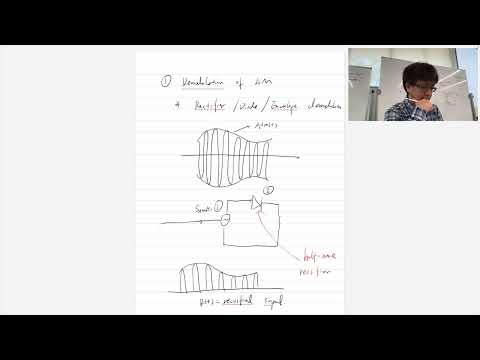
- A diode half-wave rectifier followed by a low-pass filter extracts a scaled version of a + m(t), and DC removal recovers a scaled message m(t) without requiring carrier-phase synchronization.
- Real messages have redundant positive- and negative-frequency spectra, so SSB reduces AM bandwidth from 2B to B by transmitting only USB or LSB.
- The Hilbert transform implements frequency-side selection through H(f) = −j sgn(f), preserving magnitude while imposing opposite 90-degree phase shifts on positive and negative frequencies.
- USB and LSB can be generated from m(t) and its Hilbert transform, then shifted around carrier frequency f_c; the frequency-translation implementation is the next lecture’s topic.
Chapters
0:00
AM Envelope Constraints and Power Efficiency
- Envelope detection requires a + m(t) > 0; if |m(t)| is bounded by m_p, the carrier amplitude must satisfy a > m_p.
- The AM modulation index is μ = m_p/a, with 0 < μ ≤ 1 for proper modulation and μ > 1 indicating overmodulation.
- Assuming a zero-DC message, total AM power is decomposed into carrier, cross-term, and message-signal components using power inner products and Parseval’s identity.
- For single-tone AM, the maximum power efficiency is 1/3, or approximately 33%, demonstrating that most transmitted power does not carry message information.
5:00
Squaring Demodulation and the Bandwidth-Efficiency Problem
- The squaring demodulator squares the received AM signal, low-pass filters the resulting high-frequency terms, and applies a square root to recover the envelope.
- AM remains attractive because squaring detection is simple even though carrier power is inefficient.
- Real baseband signals with bandwidth B occupy approximately 2B after modulation to a passband because positive and negative frequency components are both transmitted.
- Single-sideband (SSB), vestigial-sideband (VSB), and quadrature amplitude modulation (QAM) are introduced as bandwidth-efficient alternatives.
9:00
Diode Half-Wave Rectifier for AM Detection
- A diode removes the negative half-cycles of the received AM waveform, producing a half-wave-rectified signal r(t).
- The rectified waveform can be modeled as the AM signal multiplied by a periodic rectangular wave synchronized to the carrier frequency f_c.
- The rectangular gating waveform has period 1/f_c and conducts over approximately half of each carrier cycle.
- The goal is to extract the slowly varying envelope a + m(t) from the rectified carrier waveform.
15:00
Fourier-Series Analysis of Half-Wave Rectification
- Mingyue Ji expands the rectangular-wave gating function into a cosine Fourier series containing a DC term and odd harmonics such as ω_c, 3ω_c, and 5ω_c.
- Multiplying the rectified AM signal by a cosine at ω_c creates a useful DC/baseband term through cos²(ω_c t) = [1 + cos(2ω_c t)]/2.
- The desired low-frequency component is proportional to (1/π)[a + m(t)], while harmonics and terms around 2ω_c and higher are rejected.
- A low-pass filter produces signal 3, proportional to a + m(t); a subsequent DC-removing capacitor produces signal 4, proportional to m(t).
20:00
Non-Coherent AM Receivers and SSB Motivation
- Diode and envelope detectors are classified as non-coherent receivers because they do not generate or synchronize with a local carrier having the transmitted phase.
- Coherent demodulation requires knowledge of the carrier phase or timing delay, whereas AM’s transmitted carrier enables simpler non-coherent approaches.
- For a real message signal, the positive- and negative-frequency spectra contain redundant information because M(-f) = M*(f).
- SSB targets this redundancy by transmitting only one sideband instead of the full double-sideband spectrum.
25:00
DSB Spectrum, Upper Sideband, and Lower Sideband
- A baseband message with bandwidth B produces a DSB passband spectrum occupying approximately 2B around ±f_c.
- The portion above the carrier is the upper sideband (USB), while the portion below the carrier is the lower sideband (LSB).
- Because the message is real, USB and LSB encode equivalent information, so transmitting both consumes twice the necessary bandwidth.
- An SSB signal transmits either USB or LSB and reduces occupied bandwidth from 2B to B.
30:00
Positive-Frequency Selection with the Sign and Unit-Step Functions
- The positive-frequency portion of M(f) is isolated using M⁺(f) = M(f)u(f), where u(f) is the frequency-domain unit-step function.
- For a real signal, the same selection can be written using the sign function: M⁺(f) = [M(f) + M(f)sgn(f)]/2.
- Adding M(f)sgn(f) cancels the negative-frequency portion and doubles the positive-frequency portion before normalization by two.
- The inverse Fourier transform of sgn(f) is associated with j/(πt), leading directly to the Hilbert-transform formulation.
36:00
Hilbert Transform and Its ±90-Degree Phase Response
- The Hilbert transform of m(t) is defined as m_h(t) = m(t) * [1/(πt)], where * denotes convolution.
- Its frequency response is H(f) = -j sgn(f): −j for f > 0 and +j for f < 0.
- The Hilbert filter has unit magnitude at all nonzero frequencies, so it preserves amplitude while shifting phase by −π/2 for positive frequencies and +π/2 for negative frequencies.
- The analytic-signal-like positive-frequency component is formed from m(t) and its Hilbert transform, producing a complex representation suitable for SSB generation.
42:00
USB/LSB Formation and Frequency Translation
- The positive-frequency component is represented as M⁺(f) = M(f)u(f), while the negative-frequency component is M⁻(f) = M(f)u(−f).
- In the time domain, the corresponding components combine m(t) with ±j m_h(t), yielding the USB and LSB baseband signals.
- To generate USB, the positive-frequency component is shifted upward by f_c and the corresponding negative-frequency component is shifted downward by f_c.
- Mingyue Ji ends by setting up the frequency-domain translation operation for USB; the detailed time-domain implementation is reserved for the next lecture.
Summary, takeaways, and chapters were generated by AI from the video's transcript and may contain errors. The video belongs to its creator, Mingyue Ji.