EEL4514C Communication Systems and Components, Fall 2026, Lecture 15
 Watch on YouTube →
Overview
Mingyue Ji explains why conventional AM adds a carrier to DSB-SC: the carrier enables simpler demodulation without exact phase synchronization, at the cost of power efficiency. Under zero-DC message and carrier-frequency assumptions, AM power efficiency is Pm/(A² + Pm), reaching only 33% for a fully modulated single tone; square-law demodulation is simple but requires fc > 2B to separate its doubled-bandwidth components.
Key takeaways
- Coherent DSB-SC detection depends on carrier-phase alignment: multiplying by a mismatched cosine can produce a zero or inverted message, so carrier recovery or a PLL is needed.
- Conventional AM uses μ = mp/A ≤ 1 to preserve a nonnegative envelope; μ = 1 is 100% modulation, while μ > 1 causes envelope inversion and distortion.
- With zero message DC and fc > B, the carrier and DSB-SC component are orthogonal, giving total AM power (A² + Pm)/2 and efficiency Pm/(A² + Pm).
- For single-tone AM, efficiency is μ²/(2 + μ²); even at maximum undistorted modulation, μ = 1, only about 33% of transmitted power carries message information.
- Square-law demodulation squares, low-pass filters, square-roots, DC-blocks, and rescales the signal, but its frequency expansion forces the stricter carrier condition fc > 2B.
Chapters
0:00
DSB-SC Coherent Detection and the Carrier Phase Problem
- Multiplying a received DSB-SC signal by a cosine at the carrier frequency creates a baseband copy of m(t) plus high-frequency terms.
- A low-pass filter removes the high-frequency terms, and a gain correction restores the message amplitude.
- A phase mismatch can make coherent detection recover no signal or the inverted message, motivating carrier recovery or a phase-locked loop (PLL).
3:17
AM Adds a Carrier to Enable Envelope-Based Recovery
- Conventional AM adds a carrier term to the DSB-SC signal, producing the form (A + m(t))cos(ωct).
- The envelope follows A + m(t), allowing recovery without reproducing the received carrier's exact phase.
- For an undistorted envelope, A + m(t) must remain positive; with mp denoting the message's peak magnitude, the modulation index is μ = mp/A ≤ 1.
5:42
AM Modulation Index: 100% Modulation and Overmodulation
- At μ = 1, the AM signal is 100% modulated: its envelope just reaches zero at its minimum.
- When μ > 1, the signal is overmodulated and the envelope crosses zero, so simple envelope recovery becomes distorted.
- Mingyue Ji introduces power efficiency and AM demodulation as the lecture's two main topics.
9:04
AM Power Efficiency and the Message-Signal Assumptions
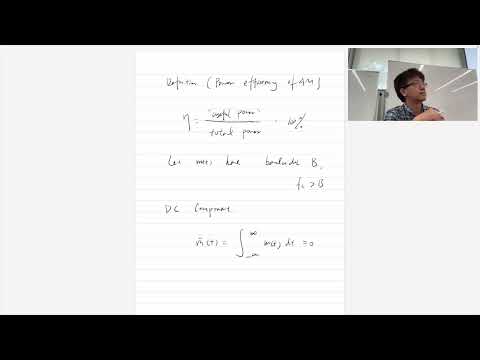
- AM power efficiency is the useful message-bearing power divided by total transmitted power, expressed as a percentage.
- The derivation assumes message bandwidth B, carrier frequency fc > B, and zero DC content in m(t).
- A coupling capacitor can remove a constant DC offset from the message before modulation.
- Expanding the AM signal's power produces carrier power, a carrier–message cross term, and modulated-message power.
16:05
Parseval’s Theorem Shows the Carrier and DSB-SC Terms Are Orthogonal
- The cross term between the carrier and m(t)cos(ωct) is evaluated in the frequency domain using the Fourier-transform inner-product relationship.
- The cosine spectrum consists of impulses at ±fc; multiplying by the shifted message spectra samples m(f) at 0 and ±2fc.
- Zero message DC and fc > B make those sampled terms vanish, so the carrier and DSB-SC component are orthogonal.
- The modulated-message power is Pm/2, since frequency shifting preserves power and the two sidebands each contribute a factor of one-half.
31:26
AM Total Power and the Efficiency Formula
- With carrier power A²/2 and message-bearing power Pm/2, total AM power is (A² + Pm)/2.
- The resulting efficiency is ηAM = [Pm/(A² + Pm)] × 100%, under the stated zero-DC and fc > B assumptions.
- The carrier consumes power but carries no message information, so increasing the carrier amplitude reduces the fraction of power devoted to the message.
35:32
Single-Tone AM Reaches Only 33% Efficiency at Full Modulation
- For a single-tone message with peak amplitude μA, message power is Pm = μ²A²/2.
- Substitution gives tone-modulation efficiency ηAM = [μ²/(2 + μ²)] × 100%.
- At μ = 1, efficiency is 1/3, or about 33%; at μ = 1/2 it is about 11.1%, and at μ = 1/4 it is about 3.0%.
- AM remains useful because its demodulation can be much simpler, not because it uses transmitted power efficiently.
39:31
Square-Law AM Demodulation Uses Filtering, a Square Root, and DC Blocking
- The proposed detector squares the received AM signal, yielding (A + m(t))²cos²(ωct).
- Using cos²(ωct) = [1 + cos(2ωct)]/2 and low-pass filtering removes the component around 2fc, leaving (A + m(t))²/2.
- When μ ≤ 1, taking the square root produces (A + m(t))/√2; a DC blocker removes the A term, and scaling recovers m(t).
45:57
Why Square-Law Detection Requires a Higher Carrier Frequency
- Squaring in time corresponds to convolution in frequency, so the message-related baseband bandwidth expands from B to 2B.
- The squared signal also has components around 2fc, extending from 2fc − 2B to 2fc + 2B.
- To keep that band separate from the baseband through filtering, the condition is 2fc − 2B > 2B, or fc > 2B.
- Compared with fc > B in the earlier power analysis, square-law detection requires a higher carrier frequency and a wider low-pass filter.
Summary, takeaways, and chapters were generated by AI from the video's transcript and may contain errors. The video belongs to its creator, Mingyue Ji.