EEL4514C Communication Systems and Components, Fall 2026, Lecture 14
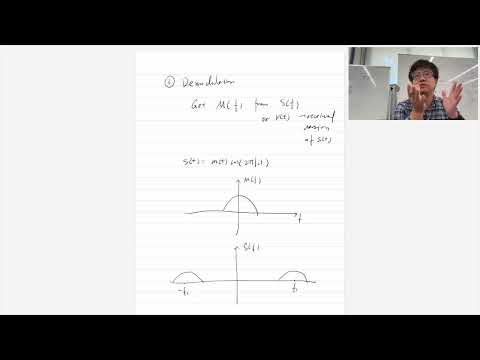 Watch on YouTube →
Overview
Mingyue Ji develops amplitude-modulation demodulation from the DSB-SC signal model, showing how multiplying by a carrier and low-pass filtering recovers the message when the receiver’s carrier phase is synchronized. He explains why propagation delay creates a phase error, then compares transmitting a carrier in conventional AM with using a phase-locked loop; the lecture concludes with envelope detection, its no-overmodulation condition, and the modulation index μ = M_p/A.
Key takeaways
- Coherent demodulation of a DSB-SC signal multiplies by a synchronized carrier and low-pass filters; the result is m(t)/2, so a gain of 2 restores the original amplitude.
- A carrier phase error changes the recovered signal by a factor proportional to cos(θ): a π/2 error erases the baseband output, while a π error inverts it.
- A propagation delay τ creates carrier phase offset θ = 2πf_cτ, which is why coherent detection requires phase synchronization as well as carrier-frequency knowledge.
- Conventional AM transmits a carrier reference to simplify detection, while a PLL can synchronize a local carrier without relying on a separately transmitted carrier component.
- Envelope detection works only when A + m(t) remains nonnegative for all t; for |m(t)| ≤ M_p, this requires A ≥ M_p and gives modulation index μ = M_p/A ≤ 1.
- DSB-SC transmits both upper and lower sidebands without a carrier tone; the sidebands contain redundant information for a real message, trading extra bandwidth for simpler spectral placement.
Chapters
0:00
Random-Signal PSD Review and the Purpose of Carrier Modulation
- For a random power signal, Mingyue Ji describes computing autocorrelation through the expectation of the signal and its delayed conjugate, then Fourier-transforming the result to obtain PSD.
- Carrier modulation multiplies a message by a sinusoid to move its power spectral density into another frequency band.
- The lecture shifts from the previous discussion of modulation to the problem of recovering the message at the receiver.
2:00
AM, FM, and PM as Three Ways to Encode a Message
- A basic carrier-modulated signal is m(t)cos(2πf_ct); in frequency, the message spectrum appears shifted to ±f_c with half-amplitude copies.
- The general carrier signal can encode m(t) through amplitude, frequency, or phase variation, corresponding to AM, FM, and PM.
- A mixer is the circuit element that multiplies the message and carrier to generate the modulated signal.
4:35
BASK, DSB-SC, and the Upper and Lower Sidebands
- Binary amplitude-shift keying uses message values +1 and −1; the same two states can be represented as BPSK phases 0 and π.
- Multiplication by a cosine produces upper and lower sidebands, so the signal is double-sideband (DSB).
- DSB-SC means double-sideband suppressed-carrier: both sidebands are transmitted, but no separate carrier tone is included.
- For a real message, the two sidebands contain redundant spectral information; transmitting both increases bandwidth but can simplify demodulation.
9:10
Recovering the Message by Shifting the Spectrum Back to Baseband
- The receiver’s goal is to recover m(t) from the received signal r(t), initially assuming r(t) equals the transmitted signal.
- In the frequency domain, shifting the modulated spectrum by f_c and low-pass filtering would isolate the original message spectrum.
- A frequency shift corresponds to multiplication by a complex exponential in time, so the lecture tests the more practical real-carrier operation instead.
11:00
Coherent Demodulation: Multiply by the Carrier and Low-Pass Filter
- For s(t) = m(t)cos(2πf_ct), multiplying again by cos(2πf_ct) gives m(t)/2 plus a component at 2f_c.
- The resulting spectrum contains a half-amplitude baseband copy and shifted copies centered at ±2f_c.
- A low-pass filter removes the 2f_c terms, leaving m(t)/2; scaling by 2 restores the message amplitude.
- This method is coherent demodulation because the receiver multiplies by a carrier aligned in frequency and phase with the transmitted carrier.
18:00
Propagation Delay Creates a Carrier-Phase Error
- A propagation delay τ changes the received carrier from cos(2πf_ct) to cos(2πf_c(t−τ)), introducing phase offset θ = 2πf_cτ.
- With a π/2 phase error, multiplying by the receiver’s cosine produces only a high-frequency term, so low-pass filtering removes the message.
- With a π phase error, the recovered baseband message is negated, turning positive symbol values into negative ones and vice versa.
- Coherent detection therefore requires phase synchronization, not merely knowledge of the carrier frequency.
30:30
Two Carrier-Recovery Strategies: Conventional AM and the PLL
- One approach transmits a carrier along with the DSB-SC component, giving conventional AM and providing the receiver a phase reference.
- A phase-locked loop (PLL) uses a control loop to align a local carrier’s phase with the received carrier.
- Mingyue Ji notes that transmitting the carrier can support simple analog-audio detection but spends energy on a component that carries no message information.
- A brief radar comparison explains that known transmitted signals and measurable round-trip delay can estimate distance; narrow pulses help resolve delay.
38:30
AM Envelopes and the Condition for Envelope Detection
- Conventional AM adds a carrier term to the message, producing a spectral carrier impulse at ±f_c alongside the shifted message spectra.
- When A + m(t) stays positive for every t, the modulated waveform’s envelope follows the message shifted upward by A.
- An envelope detector can recover the message from that envelope without multiplying by a locally generated cosine.
- If A + m(t) becomes negative, the carrier undergoes a 180° phase reversal and the waveform envelope no longer matches the intended message.
46:00
AM Modulation Index and the Cost of Avoiding Overmodulation
- For bounded message amplitude |m(t)| ≤ M_p, envelope detection requires A ≥ M_p so that A + m(t) does not cross zero.
- The modulation index is μ = M_p/A, where M_p is the message’s maximum absolute amplitude and A is the carrier’s DC amplitude.
- Keeping μ ≤ 1 avoids overmodulation, but a larger carrier component uses transmission energy without carrying additional message information.
Summary, takeaways, and chapters were generated by AI from the video's transcript and may contain errors. The video belongs to its creator, Mingyue Ji.