EEL4514C Communication Systems and Components, Fall 2026, Lecture 13
 Watch on YouTube →
Overview
EEL4514C Lecture 13 concludes power spectral density (PSD) by connecting it to autocorrelation through the Wiener–Khinchin theorem and explaining how ergodicity makes time averages useful for estimating random-process statistics. Mingyue Ji then introduces carrier modulation, compares AM, FM, and PM, and derives the spectrum and terminology for double-sideband suppressed-carrier modulation, including how a binary example can represent information as either ASK or BPSK.
Key takeaways
- The Wiener–Khinchin theorem makes PSD accessible through autocorrelation: Fourier-transform the power-signal autocorrelation to obtain its frequency-domain power distribution.
- Ergodicity equates time averages with ensemble expectations for the relevant random-process statistic, enabling autocorrelation and PSD estimation from a sufficiently long observation.
- Multiplying a message by \u03cos(2πf_ct) creates two half-amplitude spectral copies centered at \(+f_c\) and \(-f_c\), rather than leaving the message spectrum at baseband.
- AM, FM, and PM distinguish whether message information directly varies carrier amplitude, frequency deviation, or phase; frequency and phase are related but not interchangeable definitions.
- A binary waveform using amplitudes \(+1\) and \(-1\) can be interpreted as ASK or BPSK because the sign reversal is equivalent to a phase shift of π.
- DSB-SC transmits both upper and lower sidebands while suppressing the carrier, unlike a scheme that explicitly sends a carrier component.
Chapters
0:00
From Energy Spectral Density to Power Spectral Density
- For a real signal, the autocorrelation function is even and can be represented as a convolution of the signal with its time-reversed version.
- Fourier-transforming the energy-signal autocorrelation gives the energy spectral density, linking a time-domain correlation measure to frequency-domain energy.
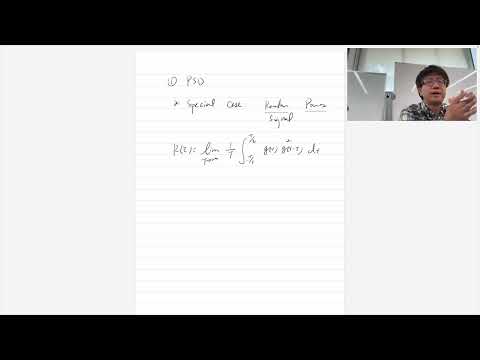
- For a power signal, truncate the signal over a finite interval, apply the Fourier-transform norm-preserving property, and take the long-time limit to define PSD.
4:00
Power Autocorrelation and the Wiener–Khinchin Theorem
- Computing PSD directly can be impractical because its definition involves a limit as the observation time approaches infinity.
- Define the power-signal autocorrelation by averaging the product of the signal and a delayed, conjugated version over an interval, then take the infinite-time limit.
- The Fourier transform of this power autocorrelation is the PSD, a relationship known as the Wiener–Khinchin theorem.
- For real signals, positive- and negative-frequency contributions are symmetric; power in a frequency band is found by integrating PSD over that band.
8:00
Ergodicity Makes Random-Signal PSD Estimation Practical
- A random process depends on both time and a sample-space outcome; fixing time produces a random variable.
- For an ergodic process, the time average of the signal and its delayed conjugate equals the ensemble expectation of that product.
- This second-order ergodicity assumption lets practitioners estimate autocorrelation from observed time samples and then obtain PSD by Fourier transform.
- Periodic-signal autocorrelation can also be expressed using squared Fourier-series coefficient magnitudes, reflecting the power represented by each harmonic.
14:30
Modulation Maps Information to a Transmission Signal
- Modulation is defined as mapping information onto a signal appropriate for transmission through a channel.
- In common communication systems, carrier modulation uses a sinusoid to move a message signal's PSD to a different frequency band.
- The carrier frequency is denoted by \(f_c\) or \(f_0\); the simplest example multiplies message \(m(t)\) by \(\cos(2\pi f_c t)\).
18:00
Cosine Modulation Shifts the Message Spectrum
- Multiplying \(m(t)\) by a cosine in the time domain convolves its Fourier transform with the cosine spectrum, which consists of impulses at \(+f_c\) and \(-f_c\).
- The resulting spectrum is ½M(f-f_c)+½M(f+f_c): two shifted copies of the message spectrum, each scaled by one half.
- In the time-domain sketch, the cosine oscillations are shaped by the message, so the signal's envelope carries information in this basic amplitude-modulation example.
26:00
AM, FM, and PM Control Different Carrier Properties
- A general carrier-modulated signal can vary its amplitude, instantaneous frequency, or phase to encode the message.
- For AM, the carrier amplitude varies linearly with \(m(t)\); for FM, the frequency deviation varies linearly with \(m(t)\).
- For PM, the carrier phase varies linearly with \(m(t)\); Mingyue Ji notes that phase and frequency are related but encode information through different specified quantities.
- AM, FM, and PM are introduced as the three principal analog-modulation types, while phase modulation is also important in digital communication.
33:00
A Modulator and Mixer Generate the Carrier Product
- A modulator is a circuit that generates a modulated signal; the course represents it as a block operating on message \(m(t)\) and a carrier cosine.
- The multiplication device is called a mixer because it multiplies two signals, commonly the message and carrier.
- Although digital information is represented as symbols such as 1 and 0 before transmission, the transmitted waveform is analog and must be physically represented by a signal.
37:00
Binary Amplitude and Phase Shifts in ASK and BPSK
- The example represents digital symbols with amplitudes \(+1\) and \(-1\), shaped by a simple square waveform, then multiplies them by a carrier with \(f_c=1/T\).
- Changing the symbol amplitude gives amplitude-shift keying (ASK); with two amplitude states, the example is binary ASK.
- The \(+1\) symbol produces a carrier phase of 0, while \(-1\) flips the carrier to phase π, so the same waveform can also be described as binary phase-shift keying (BPSK).
- ASK and BPSK labels overlap in this particular example because the two amplitude signs correspond exactly to two carrier phases.
44:00
Upper and Lower Sidebands in DSB-SC Modulation
- The two shifted message-spectrum copies are the upper sideband and lower sideband; transmitting both is double-sideband (DSB) modulation.
- For \(s(t)=m(t)\cos(2\pi f_c t)\), the carrier itself is not transmitted as a separate component.
- Because the carrier is absent, this form is called double-sideband suppressed-carrier (DSB-SC) modulation; demodulation is introduced as the next topic.
Summary, takeaways, and chapters were generated by AI from the video's transcript and may contain errors. The video belongs to its creator, Mingyue Ji.