EEL4514C Communication Systems and Components, Fall 2026, Lecture 11
 Watch on YouTube →
Overview
Mingyue Ji connects Fourier-transform properties to communication-system behavior, showing how time compression increases bandwidth, how nonlinear amplification causes spectral regrowth, and what distortionless transmission requires. The lecture then derives Parseval’s theorem and Fourier-domain inner-product preservation, defines energy spectral density (ESD), analyzes rectangular-pulse and double-sideband suppressed-carrier spectra, and introduces autocorrelation.
Key takeaways
- Compressing a pulse in time broadens its spectrum; the lecture’s example associates a 10-fold increase in data rate with roughly 10-fold greater bandwidth.
- A distortionless LTI channel must preserve spectral magnitude up to a constant and add only linear phase, corresponding to a scaled delay in time.
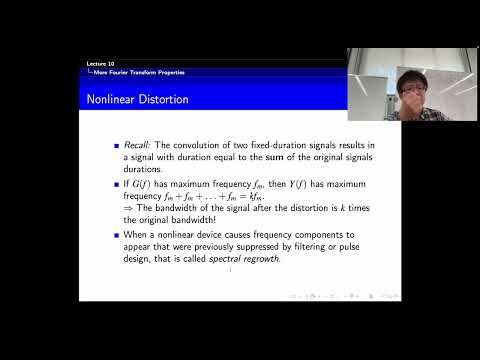
- A nonlinear power-amplifier model g(t)^k creates repeated spectral convolution and can expand an input bandwidth B to roughly kB, producing spectral regrowth.
- Parseval’s theorem equates finite-signal energy in time and frequency, while a periodic signal’s average power equals the sum of squared Fourier-series coefficient magnitudes.
- Energy spectral density is |G(f)|²; integrating it over a frequency band gives the energy passed by an ideal bandpass filter.
- DSB-SC modulation shifts the baseband spectrum to ±f₀; when f₀ > B, the copies do not overlap and their ESDs add without cross terms.
Chapters
0:00
Time Scaling Trades Pulse Duration for Fourier Bandwidth
- The Fourier time-scaling property makes a signal narrower in time and wider in frequency, with a magnitude factor of 1/|a| for x(at).
- Ji illustrates the bandwidth cost with a transmission example: increasing the rate from 100 megabits per second to 10 times that rate requires roughly 10 times the bandwidth.
- Square-wave examples in the lecture notes illustrate how changing pulse width changes the spectrum.
2:11
Time Shifts, Linear Phase, and Distortionless Transmission
- A time delay t₀ corresponds to a frequency-domain phase factor e^(−j2πft₀); the sign changes with the direction of the shift.
- Distortionless transmission requires the received signal to be a scaled, delayed copy of the input, so H(f) must have constant magnitude and linear phase.
- The phase is typically displayed wrapped into the range from −π to π; Ji contrasts phase sensitivity in vision with the ear’s greater sensitivity to amplitude distortion.
5:23
Power-Amplifier Nonlinearity Causes Spectral Regrowth
- A nonlinear example maps an input g(t) to g(t)^k, which corresponds to repeated convolution of G(f) with itself.
- For an input bandwidth B, the resulting spectrum can extend to roughly kB, requiring a wider transmission filter.
- This bandwidth expansion is called spectral regrowth, even when the time-domain waveform may appear recoverable.
7:33
Fourier-Series Coefficients Represent Signal Power and Energy
- The lecture frames Fourier series and Fourier transforms as signal-space representations that preserve inner products and norms.
- For a periodic signal, energy over all time is infinite, so average power over one fundamental period is the relevant quantity.
- An orthonormal Fourier-series basis lets the signal be represented by coefficients whose squared magnitudes sum to its average power.
11:36
Parseval’s Theorem Equates Time-Domain Power and Spectral Energy
- Expanding a periodic signal in complex exponentials makes cross terms vanish over one period because distinct Fourier-series basis functions are orthogonal.
- The resulting average power is the sum of the squared magnitudes of the Fourier-series coefficients.
- Ji illustrates the coefficients using a periodic square-pulse train: its discrete spectral lines follow the sinc-shaped spectrum of a single pulse.
21:12
Fourier Transforms Preserve Inner Products
- For finite-energy signals G₁(t) and G₂(t), the inner product is the integral of G₁(t) times the complex conjugate of G₂(t).
- Substituting the inverse Fourier transform for G₂ and exchanging the order of integration yields the frequency-domain inner product of G₁(f) and G₂(f).
- Setting the two signals equal gives Parseval’s energy relation: ∫|g(t)|²dt = ∫|G(f)|²df.
27:36
Energy Spectral Density Measures Energy Across Frequency
- An ideal bandpass filter passes only a selected frequency range; the output energy is the integral of |G(f)|² over the passed bands.
- This motivates the energy spectral density definition Ψg(f) = |G(f)|², whose integral over frequency gives signal energy.
- For a real-valued signal, G(−f) = G*(f), so the spectral energy is symmetric across positive and negative frequencies.
36:59
Rectangular-Pulse ESD Has a Squared-Sinc Spectrum
- A rectangular pulse has a sinc-shaped Fourier transform, so its ESD is the squared magnitude of that transform.
- The example reinforces that ESD retains spectral magnitude and energy while discarding Fourier phase.
- The rectangular-pulse spectrum is reused as a building block for understanding modulated signals.
39:29
DSB-SC Modulation Shifts the Spectrum to ±Carrier Frequency
- For s(t) = g(t)cos(2πf₀t), the spectrum is S(f) = ½[G(f−f₀) + G(f+f₀)].
- Choosing f₀ greater than the message bandwidth B keeps the two shifted copies from overlapping.
- With nonoverlapping copies, the cross terms in |S(f)|² vanish, leaving one-quarter of each shifted message ESD.
47:09
Autocorrelation Compares a Signal with a Delayed Copy
- Autocorrelation measures the inner product of an energy signal g(t) with a delayed version of itself.
- For an energy signal, the definition is Rgg(τ) = ∫g(t)g*(t−τ)dt.
- For a periodic power signal, the corresponding autocorrelation is averaged over the fundamental period; its relationship to ESD is left for the next lecture.
Summary, takeaways, and chapters were generated by AI from the video's transcript and may contain errors. The video belongs to its creator, Mingyue Ji.