EEL4514C Communication Systems and Components, Fall 2026, Lecture 10
 Watch on YouTube →
Overview
Mingyue Ji develops Fourier-transform properties that connect pulse duration, frequency bandwidth, and time delay, then applies them to communication channels. Examples show why faster digital pulse transmission requires more bandwidth, how distortionless transmission requires a constant channel magnitude and linear phase, and how nonlinear amplification can cause spectral regrowth.
Key takeaways
- Fourier time scaling makes the time–bandwidth tradeoff explicit: compressing a pulse by a factor of two doubles its frequency-domain width.
- In the lecture's digital-pulse example, raising the rate from 100 Mbps to 1 Gbps requires tenfold narrower pulses and increases the required bandwidth from 100 MHz to 1 GHz.
- A channel is distortionless under the stated definition when H(f) = Ke^(−j2πft_d), giving the signal only constant gain and constant delay.
- Nonlinear power-amplifier behavior such as y(t) = [g(t)]^k produces k-fold convolution in frequency and can broaden a spectrum from B to kB in the illustrated baseband case.
- Time delay does not change spectral magnitude; it adds linear phase, which is why channel phase response matters when preserving signal shape.
- The lecture distinguishes perceptual priorities: it characterizes audio as more sensitive to amplitude distortion and visual signals as more sensitive to phase distortion.
Chapters
0:00
Periodic Signals and Delta-Train Fourier Transforms
- A periodic signal's Fourier transform is a sum of frequency-domain impulses weighted by its Fourier-series coefficients.
- For a periodic delta train with period T₀, every Fourier-series coefficient is 1/T₀, producing another delta train in frequency.
- The delta-train transform relationship is highlighted as useful later in digital communications.
5:00
Bandwidth Definitions and the Rectangle–Sinc Pair
- The lecture revisits zero-to-null bandwidth and the null-to-null bandwidth used for a modulated rectangular pulse.
- A unit-width rectangular pulse has a sinc-shaped Fourier transform with its first zeros at frequencies ±1.
- Rectangular pulse shapes are relevant to communication waveforms, including OFDM and cellular systems such as 3G, 4G, and 5G.
5:48
Time Scaling a Pulse Expands Its Frequency Spectrum
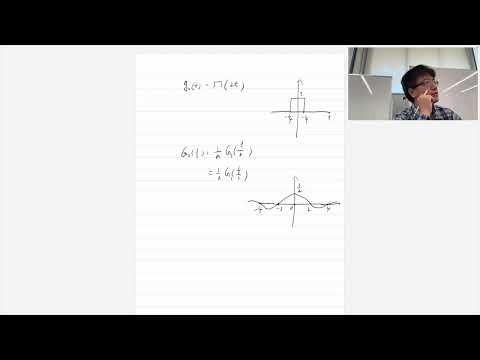
- The Fourier time-scaling property maps g(at) to (1/|a|)G(f/a).
- Compressing a unit-height rectangular pulse by a factor of two halves its time width while doubling its frequency-domain width.
- The pulse peak remains one because the example scales the time argument, not the signal amplitude.
13:00
Digital Pulse Rate Trades Directly Against Bandwidth
- A digital sequence can be understood as a stream of pulses, with each pulse representing a bit.
- Increasing a pulse rate from 100 megabits per second to 1 gigabit per second requires pulses ten times narrower in the example.
- That tenfold time compression requires roughly ten times the bandwidth, from 100 MHz to 1 GHz, which a channel may not support.
19:20
Time Shifts Create Linear Phase in the Frequency Domain
- Applying the Fourier-transform definition and substituting u = t − t₀ derives the time-shift property.
- A delay g(t − t₀) produces G(f)e^(−j2πft₀), preserving the spectrum's magnitude while adding a frequency-dependent phase.
- The negative sign corresponds to a delay; the resulting phase varies linearly with frequency.
25:29
LTI Channel Output in Magnitude-and-Phase Form
- For an input x(t) and an LTI channel with impulse response h(t), the output is y(t) = x(t) * h(t).
- In the frequency domain, Y(f) = X(f)H(f), so the channel's magnitude and phase responses directly shape the output.
- Writing X(f) and H(f) in polar form shows that their magnitudes multiply and their phases add.
30:00
Distortionless Transmission Requires Constant Gain and Linear Phase
- The lecture defines distortionless transmission as y(t) = Kx(t − t_d), where K is a constant gain and t_d is a constant delay.
- The corresponding channel response is H(f) = Ke^(−j2πft_d).
- The channel must have constant magnitude K and phase that is linear in frequency, apart from phase wrapping.
34:59
Audio and Visual Signals Differ in Sensitivity to Distortion
- Mingyue Ji explains that human hearing relies substantially on energy detection and is less sensitive to phase distortion than amplitude distortion.
- For audio communication design, the lecture therefore emphasizes preserving amplitude response.
- The lecture contrasts this with vision, describing human eyes as more sensitive to phase distortion because spatial features such as edges carry important phase information.
40:03
Power-Amplifier Nonlinearity Distorts the Transmitted Signal
- A nonlinear system applies an operation such as y(t) = [g(t)]^k rather than the convolutional behavior of an LTI system.
- Power amplifiers can become nonlinear near saturation, departing from their linear amplification range.
- Even when an odd-power operation might permit recovery in the time domain, nonlinear processing changes the signal's frequency content.
45:00
K-Fold Spectral Convolution Causes Bandwidth Regrowth
- Multiplication of g(t) by itself k times corresponds to convolving G(f) with itself k times.
- Convolution adds spectral support widths; the lecture's baseband example with bandwidth B expands to a total width of kB.
- The new frequency components are called spectral regrowth and may be rejected by a bandwidth-limited channel, preventing recovery of the original signal.
- The lecture closes by previewing energy and power calculations in the frequency domain for the next class.
Summary, takeaways, and chapters were generated by AI from the video's transcript and may contain errors. The video belongs to its creator, Mingyue Ji.