EEL4514C Communication Systems and Components, Fall 2026, Lecture 08
 Watch on YouTube →
Overview
Mingyue Ji connects the Fourier transform of a single-period pulse to the Fourier-series coefficients of the periodic waveform formed by repeating it: the coefficients are samples of the pulse transform at harmonics, scaled by 1/T₀. A rectangular pulse produces a sinc-shaped spectrum, whose regularly spaced zeros explain how frequency-shifted, orthogonal subcarriers can be packed in OFDM, a principle used in 4G, 5G, 6G, and Wi-Fi.
Key takeaways
- For a periodic repetition of a single-period waveform g(t), the Fourier-series coefficient at harmonic n is cₙ = G(n/T₀)/T₀, so a continuous Fourier transform can directly yield the discrete series coefficients.
- A unit-height rectangular pulse of width τ has transform G(f) = τ sinc(τf), with zeros at f = k/τ for nonzero integers k.
- The spectrum of a periodic signal is formed by sampling the single-period waveform’s transform at multiples of 1/T₀; the pulse shape determines the sample amplitudes.
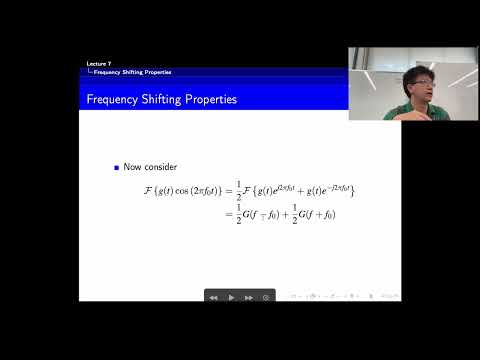
- Multiplication by a cosine shifts a real signal’s spectrum into positive- and negative-frequency copies, enabling signals to be placed in a channel’s usable frequency band.
- OFDM uses frequency-shifted subcarriers aligned with one another’s spectral zeros to achieve orthogonality and pack multiple signals closely in frequency; Ji cites 4G, 5G, 6G, and Wi-Fi as applications.
Chapters
0:00
Fourier Transform Review: Continuous Spectra and Real-Signal Symmetry
- Unlike a periodic signal’s discrete harmonics, a nonperiodic signal generally requires a continuous range of frequency components.
- For real-valued signals, the negative-frequency spectrum is the complex conjugate of the positive-frequency spectrum, so it adds no independent information.
- Mingyue Ji reviews the Fourier transform as a linear operator and notes that frequency-domain multiplication replaces time-domain convolution in LTI-system analysis.
4:43
Impulse and Cosine Transforms Lead to Frequency-Domain Modulation
- The Dirac delta has a Fourier transform equal to 1 at every frequency; an LTI system with impulse response δ(t) therefore leaves its input unchanged.
- A shifted delta in frequency corresponds to a complex exponential in time; combining positive and negative shifts produces a cosine.
- Multiplying a real signal by a cosine shifts its spectrum in both directions, a practical way to move signal content into a channel’s passband.
8:28
Representing a Periodic Waveform as Repeated Copies of One Pulse
- Ji introduces the link between Fourier transforms and Fourier series, with the goal of calculating series coefficients from a transform table.
- A periodic signal s(t) with period T₀ is represented as repeated, shifted copies of a single-period waveform g(t): s(t) = Σₙ g(t − nT₀).
- The pulse width τ describes the nonzero portion of each period; this representation lets the transform of g(t) stand in for a direct Fourier-series calculation.
13:39
Deriving Fourier-Series Coefficients from the Pulse Transform
- The Fourier-series coefficient is defined by integrating the periodic signal over one fundamental period against the complex exponential basis.
- Within that period, the signal equals g(t), so the coefficient integral can use the single-period pulse instead.
- Comparing the coefficient integral with the Fourier transform gives cₙ = (1/T₀)G(n/T₀): evaluate the continuous transform at harmonic frequencies and scale by 1/T₀.
18:14
Rectangular Pulses Produce a Sinc Spectrum
- For a unit-height rectangular pulse of width τ, direct integration of e^(−j2πft) over −τ/2 to τ/2 gives G(f) = τ sinc(τf).
- Using sinc(x) = sin(πx)/(πx), the spectrum has its peak value τ at f = 0 and zeros at nonzero integer multiples of 1/τ.
- The Fourier-series coefficients of the repeated pulse are consequently cₙ = (τ/T₀)sinc(nτ/T₀), samples of the sinc envelope at f = n/T₀.
28:47
Harmonic Sampling and Sinc Zeros Determine Which Coefficients Vanish
- The periodic signal’s spectrum consists of discrete samples spaced by the fundamental frequency 1/T₀, with sample heights set by the sinc envelope.
- A coefficient is zero when a sampled harmonic lands on a sinc zero, which occurs when n/T₀ is a nonzero integer multiple of 1/τ.
- Changing the relationship between τ and T₀ changes which harmonic samples coincide with spectral zeros and therefore which Fourier-series coefficients disappear.
34:12
Sinc-Zero Orthogonality Explains OFDM Subcarrier Packing
- Frequency-shifting copies of the sinc spectrum by integer multiples of 1/τ places each copy’s center at the other copies’ zero crossings.
- In the time domain, those frequency shifts correspond to multiplying the signal by complex exponentials; receiver-side frequency sampling can separate the orthogonal components without interference.
- Ji connects this subcarrier-packing principle to OFDM, naming 4G, 5G, 6G, and Wi-Fi as technologies that use it.
Summary, takeaways, and chapters were generated by AI from the video's transcript and may contain errors. The video belongs to its creator, Mingyue Ji.