EEL4514C Communication Systems and Components, Fall 2026, Lecture 07
 Watch on YouTube →
Overview
Mingyue Ji develops the transition from Fourier series for periodic signals to the Fourier transform for aperiodic energy signals, then shows how LTI systems act on frequency components through multiplication by their response. The lecture connects these tools to communication-system ideas including OFDM, real-signal conjugate symmetry, impulse transforms, and modulation by complex exponentials or cosines.
Key takeaways
- Fourier series represent periodic signals with discrete harmonics, while letting the period approach infinity turns the harmonic grid into a continuous frequency variable and leads to the Fourier transform.
- For an LTI system, time-domain convolution becomes the simple spectral product R(f) = H(f)S(f), which makes frequency response and channel estimation easier to compute.
- A complex exponential is an eigenfunction of every LTI system: the system changes its amplitude and phase through a frequency-dependent scalar without changing its frequency.
- For real-valued signals, G(−f) = G*(f); therefore, the negative-frequency spectrum mirrors the positive-frequency spectrum, and one-sided bandwidth W is reported rather than the full span 2W.
- The Fourier transform of δ(t) is 1, while a cosine at f₀ transforms into two half-weight impulses at ±f₀; these impulse pairs represent the sinusoid's discrete spectral components.
- Modulation by a complex exponential shifts a signal's spectrum, and modulation by a cosine creates two shifted copies, allowing a baseband signal to be placed within a channel's passband.
Chapters
0:00
Delta Sampling, Unit Steps, and Fourier-Series Bases
- The delta sampling property extracts a continuous-time signal value at a chosen time by multiplying by a shifted delta and integrating.
- Integrating the delta produces the unit step; differentiating the unit step recovers the delta, and multiplying a signal by a unit step makes it causal.
- Fourier-series representations use independent, orthogonal basis functions; real signals can be expanded with cosine and sine terms.
4:00
Complex Fourier Series and Harmonics of Periodic Signals
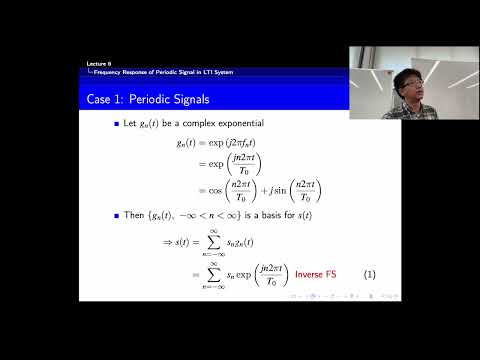
- Euler's formula combines sine and cosine bases into complex exponentials, allowing one Fourier-series form to handle both real and complex signals.
- The synthesis equation reconstructs a periodic signal from coefficients, while the analysis equation computes those coefficients from the signal.
- A periodic signal's Fourier-series frequencies occur only at integer multiples of its fundamental frequency.
9:00
Fourier-Series Convergence and Discontinuity Values
- The stated Fourier-series conditions are sufficient rather than necessary; some signals that fail them can still have useful Fourier-series representations.
- At a jump discontinuity, the reconstructed Fourier series converges to the midpoint of the left- and right-hand values, rather than necessarily matching the assigned point value.
- Changing a signal at isolated points does not change its Fourier coefficients because isolated points contribute zero measure to the integrals.
12:00
LTI Frequency Response, Convolution, and OFDM
- For an LTI system, convolution follows from representing the input as shifted delta impulses and applying linearity and time invariance.
- A periodic input's Fourier-series coefficient at each harmonic is multiplied by the system response at that frequency to produce the output coefficient.
- This frequency-by-frequency relationship simplifies channel estimation and motivates OFDM (orthogonal frequency-division multiplexing), used in systems such as 5G, 6G, and Wi-Fi.
- Practical OFDM signals are time-limited rather than infinitely periodic, so truncation creates effects that require additional handling.
17:00
Complex Exponentials as LTI Eigenfunctions
- A complex exponential input to an LTI system emerges as the same exponential multiplied by a complex scalar, the system's frequency response at that frequency.
- This eigenfunction property makes a complex exponential a convenient probe for characterizing a system, much like an eigenvector in linear algebra.
- The lecture's roadmap introduces aperiodic-signal frequency response, energy signals, negative frequencies, common Fourier-transform pairs, and transform properties.
20:00
Deriving the Fourier Transform from Fourier Series
- For an aperiodic energy signal, the fundamental frequency approaches zero as the period tends to infinity, making the harmonics dense and the frequency variable continuous.
- Replacing the discrete harmonic index times the fundamental frequency with continuous frequency yields the Fourier-transform analysis and synthesis equations.
- Using frequency in hertz gives exponential factors of ±j2πft; using angular frequency instead requires the corresponding 1/(2π) normalization.
- The forward and inverse transforms differ in the sign of the exponential, and the Fourier-transform operator is linear.
25:00
Aperiodic LTI Filtering and Negative-Frequency Symmetry
- For an aperiodic input S(f) and an LTI system response H(f), the output spectrum is R(f) = H(f)S(f); this is the frequency-domain counterpart of time-domain convolution.
- For a real-valued signal, its spectrum satisfies G(−f) = G*(f), so negative-frequency components are determined by positive-frequency components.
- Positive and negative frequency terms combine as conjugates to produce a real signal; the negative-frequency half is redundant when specifying the bandwidth of a real signal.
- The intuitive claim that negative frequency has no physical meaning is only a preliminary explanation; the lecture notes that a fuller interpretation comes later.
31:00
Bandwidth and Fourier Transforms of Delta Impulses
- For a real signal with mirrored spectral support from −W to W, the one-sided bandwidth is W, not 2W, because the negative-frequency spectrum is redundant.
- The Fourier transform of a delta impulse at time zero is the constant 1, obtained by applying the delta sampling property to the transform integral.
- An LTI system with impulse response δ(t) has frequency response 1 and reproduces its input, consistent with convolution by a delta.
36:00
Impulse Shifts, Sinusoids, and Frequency-Domain Modulation
- A shifted impulse in frequency corresponds to a complex exponential in time, with the sign in the exponent determined by whether the forward or inverse transform is used.
- Generalized-function delta impulses allow Fourier transforms of periodic sinusoids: a cosine at f₀ produces impulses at +f₀ and −f₀, each scaled by one half.
- Multiplying a time-domain signal by a complex exponential shifts its spectrum; multiplying by a cosine creates two shifted spectral copies.
- Modulation moves a baseband signal into a channel's passband; cosine modulation produces half-amplitude copies around the positive and negative carrier frequencies.
Summary, takeaways, and chapters were generated by AI from the video's transcript and may contain errors. The video belongs to its creator, Mingyue Ji.