EEL4514C Communication Systems and Components, Fall 2026, Lecture 06
 Watch on YouTube →
Overview
Mingyue Ji develops the Fourier-series description of periodic signals, moving from delta-function sampling and real trigonometric bases to complex Fourier coefficients, spectral convergence, and bandwidth. The lecture then derives convolution for linear time-invariant (LTI) systems and shows that each input harmonic is scaled by the system’s frequency response, before introducing complex exponentials as LTI eigenfunctions and connecting Fourier series to the Fourier transform for aperiodic signals.
Key takeaways
- The Dirac-delta sampling identity extracts g(T) from ∫g(t)δ(t − T)dt and provides the key step in deriving the continuous-time convolution integral.
- A periodic signal with fundamental frequency f₀ has Fourier-series components only at integer harmonics n f₀, creating a discrete frequency spectrum.
- At a jump discontinuity, a Fourier series converges to the midpoint of the signal’s one-sided limits, regardless of the assigned value at that isolated point.
- For an LTI system, y(t) = ∫x(τ)h(t − τ)dτ; the impulse response and input together determine the output.
- An LTI system scales each periodic input coefficient Sₙ by H(nf₀), preserving the input’s harmonic frequencies while changing their amplitudes and phases.
- Complex exponentials are eigenfunctions of LTI systems, and the Fourier transform extends the frequency-analysis idea from periodic to aperiodic signals.
Chapters
0:00
Review: Complex Numbers, Signal Power, and Special Functions
- Mingyue Ji reviews Cartesian and polar complex-number forms, conjugation, and Euler’s identity e^(jθ) = cos θ + j sin θ.
- The inner product defines the norm, while a zero inner product identifies orthogonal signals or vectors.
- Energy signals have finite total energy; periodic sinusoids instead have infinite energy and are described using average power.
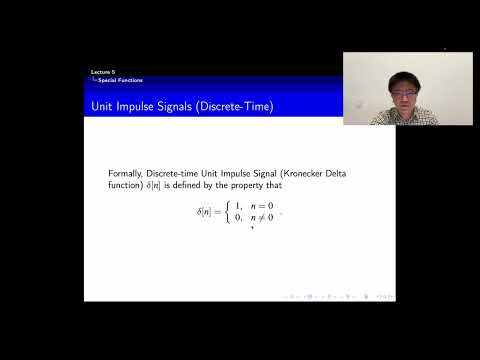
- The review covers complex exponentials, continuous-time Dirac delta, and discrete-time Kronecker delta.
8:55
Dirac Delta Sampling and the Unit-Step Relationship
- The sampling property integrates g(t)δ(t − T) to extract the signal value g(T).
- This delta-based sampling identity is identified as a starting point for deriving convolution.
- The unit-step function is zero for t < 0 and one for t ≥ 0; integrating the Dirac delta produces the step.
- Differentiating the unit step gives the Dirac delta in the continuous-time setting.
12:50
Real Fourier Series: Trigonometric Bases and Coefficients
- A real periodic signal can be represented using cosine and sine basis functions at integer multiples of its fundamental frequency.
- Orthogonality and linear independence make the basis functions suitable for representing distinct frequency components.
- The synthesis equation combines coefficients to reconstruct x(t); the analysis equations calculate those coefficients from x(t).
- Frequency in hertz f and angular frequency ω are related by ω = 2πf.
18:27
Bandwidth and Harmonics in Periodic Signals
- Bandwidth describes a frequency range containing most of a signal’s power; the required fraction depends on the application.
- Frequency analysis represents a signal as contributions from individual frequencies, enabling power-based bandwidth estimates.
- A periodic signal with fundamental period T₀ has fundamental frequency f₀ = 1/T₀ and harmonics at n f₀ for integer n.
- The lecture distinguishes periodic-signal analysis with Fourier series from aperiodic-signal analysis with the Fourier transform.
23:00
Complex Fourier Series: Synthesis and Analysis Equations
- The complex Fourier synthesis equation reconstructs a periodic signal by summing harmonics weighted by coefficients Sₙ.
- The analysis equation computes each Sₙ by taking an inner product with the corresponding complex-exponential basis over one period.
- The complex form accommodates complex-valued periodic signals and uses harmonic indices from negative to positive integers.
- The lecturer interprets synthesis and analysis as inverse and forward transformations between a periodic signal and its harmonic coefficients.
27:00
Square-Wave Fourier Coefficients and the Discrete Spectrum
- For the illustrated square wave, Mingyue Ji identifies a fundamental period of 4, spanning the displayed interval from −2 to 2.
- The DC Fourier coefficient is 1/2; the remaining coefficients describe the signal’s harmonic content.
- The spectrum is discrete: coefficients occur at integer multiples of the fundamental frequency, not at every frequency.
- Although the signal is continuous in time, its Fourier-series spectrum is indexed by discrete integers.
33:00
Fourier-Series Convergence and Dirichlet Conditions
- A finite Fourier-series approximation gets closer to the signal as more terms are included, though a finite sum may differ substantially.
- The stated Dirichlet sufficient conditions include finite absolute integral over one period, finitely many maxima and minima, and finitely many finite discontinuities.
- At a jump discontinuity, the Fourier series converges to the midpoint of the left- and right-hand values.
- Changing the signal’s value at an isolated discontinuity does not change its Fourier coefficients, because a single point contributes zero to the integral.
37:00
LTI System Linearity and Superposition
- An LTI system is both linear and time invariant; Mingyue Ji introduces its impulse response h(t) as the output to a Dirac-delta input.
- Linearity requires the output for a combined input a x₁(t) + b x₂(t) to equal a y₁(t) + b y₂(t).
- The block-diagram test compares combining and scaling inputs before a system with combining and scaling the separate outputs afterward.
- Impulse response h(t) is presented as a way to characterize a system’s behavior.
45:00
Time Invariance and the Affine-System Example
- Time invariance means delaying the input by τ and then processing it produces the same result as processing first and delaying the output by τ.
- A system y(t) = A x(t) + B is time invariant, but it is not linear when B is nonzero.
- When B = 0, the gain system y(t) = A x(t) satisfies both linearity and time invariance.
- Checking an LTI system requires testing linearity and time invariance separately.
49:00
Deriving Continuous-Time Convolution from the Delta Identity
- For an LTI system, convolution is the input-output relation y(t) = ∫ x(τ)h(t − τ)dτ, not merely a definition introduced without justification.
- The derivation first represents x(t) as an integral of shifted Dirac deltas weighted by x(τ), using the sampling property.
- Linearity moves the system operation inside the integral, and time invariance maps each shifted delta input to a correspondingly shifted impulse response.
- The resulting convolution integral expresses the output entirely in terms of the input x(t) and impulse response h(t).
55:10
Periodic LTI Output and Harmonic-by-Harmonic Frequency Response
- Substituting the input’s Fourier series into the convolution integral shows how the system acts on each harmonic.
- The output coefficient at harmonic n is the input coefficient Sₙ multiplied by the system frequency response H(nf₀).
- Each input frequency component is scaled by the response at that same frequency; the harmonic frequencies themselves are unchanged.
- Because the output remains a Fourier series at the same fundamental frequency, a periodic input to the LTI system produces a periodic output.
59:50
Complex Exponentials as LTI Eigenfunctions and the Fourier-Transform Bridge
- An eigenfunction is an input whose output is a constant multiple of that same input; for LTI systems, complex exponentials have this property.
- The proportionality factor H(f) is the system’s frequency response and describes its effect at frequency f.
- The lecture introduces the Fourier transform as the frequency representation for continuous-time aperiodic signals.
- Fourier transform is motivated as the limiting extension of Fourier series when the signal period grows without bound.
Summary, takeaways, and chapters were generated by AI from the video's transcript and may contain errors. The video belongs to its creator, Mingyue Ji.