EEL4514C Communication Systems and Components, Fall 2026, Lecture 02
 Watch on YouTube →
Overview
Mingyue Ji introduces the physical foundations of wireless propagation, deriving wavelength from sinusoidal signal delay and emphasizing the key relation λ = c/f, with c ≈ 3 × 10^8 m/s. The lecture then classifies how RF waves interact with surfaces—reflection, diffraction, and scattering—and begins an isotropic-radiator model for understanding received power; course logistics and the required software-defined-radio hardware are also covered.
Key takeaways
- For an electromagnetic wave traveling at approximately 3 × 10^8 m/s, wavelength is λ = c/f, so increasing carrier frequency shortens wavelength.
- A 900 MHz signal has a wavelength of about 33 cm, while a 1 MHz AM signal has a wavelength of about 300 m; this frequency difference strongly affects antenna scale.
- A receiver at distance d experiences propagation delay τ = d/c, which appears in a sinusoidal received signal as a time shift.
- RF interactions with environmental surfaces include reflection from smooth surfaces, diffraction around sharp features, and scattering from rough surfaces.
- An isotropic radiator provides a baseline model for propagation: its power spreads in all directions over a sphere, and received power depends on how much of that spread a receiver captures.
- Lab Zero requires software installation and purchase of SDR hardware, with equipment links and course materials organized in Canvas.
Chapters
0:00
Lab Zero, Required SDR Hardware, and Course Support
- Lab Zero starts with installing the required software and optionally trying the software-defined radio (SDR) equipment.
- Students are required to buy the SDR hardware; Mingyue Ji directs them to the SDR info page in Canvas for purchase links.
- Office hours are flexible, including scheduled Zoom meetings at night; TA Leo handles labs and homework.
3:30
Canvas Materials and the Course’s Application Focus
- Canvas Pages contains lecture notes, slides, videos, and SDR information; related course files are also grouped under Files.
- The first lecture introduced the syllabus, course overview, and telecommunications history.
- After a short review of continuous- and discrete-time signals and systems, the class applies those concepts to wireless communication and propagation.
6:19
Lecture 2 Roadmap: Wavelength, Surfaces, and Antennas
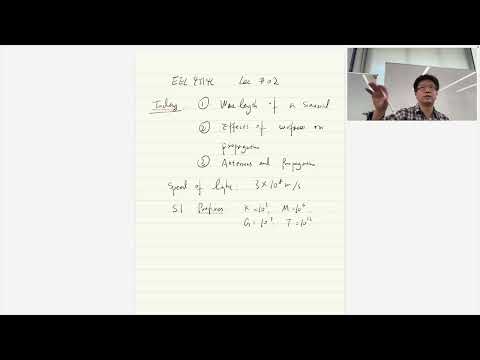
- The three planned topics are sinusoidal wavelength, surface effects on electromagnetic propagation, and antenna-dependent propagation.
- Mingyue Ji identifies continuous-time signal systems as the main prerequisite, with a brief review planned over two or three lectures.
- The lecture treats sinusoidal signals as foundational because communication systems use them extensively.
8:30
Speed of Light, SI Prefixes, and High-Frequency Bands
- Electromagnetic waves travel at approximately c = 3 × 10^8 m/s in free space.
- The lecture reviews k = 10^3, mega = 10^6, giga = 10^9, and tera = 10^12, prefixes used for radio frequencies.
- Higher carrier frequencies can offer access to wider bandwidths; examples include 2.4 GHz, 28–30 GHz millimeter-wave systems, and sub-terahertz research.
11:09
Deriving Wavelength from Propagation Delay
- Wavelength λ is the distance covered during one fundamental period of an electromagnetic sinusoid.
- For a receiver at distance d, propagation delay is τ = d/c, so a transmitted cosine A cos(ωt) arrives as A cos(ω(t − d/c)).
- A phase change of 2π corresponds to one wavelength, yielding λ = 2πc/ω; substituting ω = 2πf gives the practical formula λ = c/f in meters.
26:27
Wavelength Examples at 900 MHz and AM Radio Frequencies
- At 900 MHz, λ = (3 × 10^8)/(9 × 10^8) ≈ 0.33 m, or about 33 cm.
- At 1 MHz, a representative AM radio frequency, wavelength is about 300 m, much longer than a cellular wavelength.
- Antenna dimensions scale with wavelength, helping explain why lower-frequency AM systems use large antennas while phone antennas can be much smaller.
29:58
How Surfaces Change RF Propagation
- RF waves propagate outward from a source until they encounter environmental objects such as buildings, furniture, or people.
- Surface interactions depend on wavelength relative to surface features and on whether a surface is smooth or rough.
- Reflection occurs at smooth surfaces; a smooth ground plane can create a reflected path alongside a direct line-of-sight (LOS) path.
37:42
Diffraction at Edges and Scattering from Rough Surfaces
- Diffraction describes RF waves bending or changing direction around sharp features or edges.
- Scattering occurs when rough, bumpy surfaces redirect incident energy into many directions rather than a single reflected path.
- Reflection, diffraction, and scattering are common propagation effects in real wireless environments.
42:09
Isotropic Radiator as a Model for Received Power
- Mingyue Ji introduces received power as a quantity that varies with both transmitter–receiver distance and signal frequency or wavelength.
- An isotropic radiator is an idealized point source that radiates equally in every direction.
- Because its power spreads over a sphere, the lecture asks how much a receiver with a given antenna area captures; the received-power formula is deferred to the next lecture.
Summary, takeaways, and chapters were generated by AI from the video's transcript and may contain errors. The video belongs to its creator, Mingyue Ji.