EEL4514C Communication Systems and Components, Fall 2026, Lecture 01
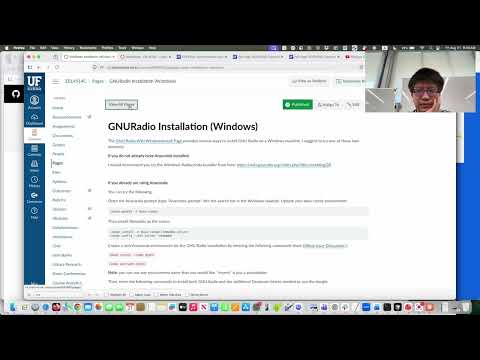 Watch on YouTube →
Overview
Mingyue Ji introduces EEL4514C, its Canvas and lab logistics, and the course focus on communication systems, especially wireless communication. He maps the end-to-end communication chain, compares RF, wired, optical, and acoustic channels, explains RF sensing and interference, and previews analog labs, digital modem concepts, and the history of radio, television, cellular networks, and Wi-Fi.
Key takeaways
- The course’s grading emphasizes implementation: labs account for 35% of the final grade, compared with 15% for homework and 25% each for the midterm and final.
- Digital communication protects information in two complementary ways: source coding can compress it, while channel coding adds redundancy to help correct transmission errors.
- RF links support both communication and sensing: timing estimates distance, antenna measurements can indicate direction, and Doppler shifts can reveal object speed.
- Wireless propagation brings tradeoffs absent from a contained wire: interference, path loss that can reach roughly 100–200 dB, and antenna-size constraints tied to wavelength.
- Most labs are designed for completion at home with an SDR receiver and GNU Radio; lab attendance is generally optional, though some experiments may require campus hardware.
- Modern cellular systems evolved from analog 1G through GSM 2G, CDMA 3G, LTE 4G, and 5G, while Wi-Fi and IoT radios such as Zigbee and LoRa address distinct networking needs.
Chapters
0:00
EEL4514C Introduction and Mingyue Ji’s Edge AI Lab
- Mingyue Ji introduces EEL4514C Communication Systems and Components, a combined lecture-and-lab course.
- Ji’s Edge AI Lab works on edge machine learning, 6G wireless communication and sensing, cloud and edge computing, and Internet of Things networks.
- TA Leo will help with lab work and homework; Ji invites students interested in research to contact him.
4:00
Canvas, Course Website, Lecture Notes, and Recordings
- Canvas and Ji’s course website provide equivalent course information; Canvas is used to submit homework and labs.
- Course pages and files contain the syllabus, SDR setup information, lecture notes, slides, and lab materials.
- Ji records lectures and plans to post processed videos, generally by Friday or Saturday rather than on the lecture day.
9:00
Grading, SDR Hardware, Textbooks, and GNU Radio
- The planned grading breakdown is 15% homework, 35% labs, 25% midterm, and 25% final; Ji expects roughly five homework assignments and 10 or 11 labs.
- Students should obtain the software-defined radio (SDR) receiver and antenna kit listed on Canvas for hardware-based experiments.
- The fifth edition of the required communications textbook is sufficient; the sixth edition is available, but Ji says major changes are not needed for this course.
- GNU Radio is the main software tool, used primarily through its graphical interface.
13:30
Exam Format, Late Penalties, Lab Attendance, and Collaboration
- The midterm covers the first half of the course and the non-comprehensive final covers the second half; each is worth 25%, and the exam format may change because of AI tools.
- Homework and labs generally earn 10 points each; submissions lose 2 points per weekday late, so a Friday deadline submitted Monday counts as one day late.
- Labs begin the following week; most can be completed at home with personal hardware, with no regular lab-attendance requirement.
- Homework collaboration is allowed if collaborators are acknowledged, but plagiarism and copying solutions are prohibited.
21:00
Communication-System Architecture: From Message to Recovered Output
- The system converts an input message—such as voice, images, or files—into a signal, transmits it through a channel, and reconstructs an output message.
- Voice is analog by nature, while files can already be digital; digital communication represents information with zeros and ones.
- Source coding can compress data, while channel coding adds redundancy to help recover information when transmission errors occur.
- Noise, interference, and other channel distortions make receiver-side recovery necessary.
26:00
RF, Fiber, Wired, and Acoustic Channels—and RF Sensing
- Communication channels include RF wireless links, optical fiber, wired media such as coaxial cable and twisted pair, and acoustic links used underwater.
- RF signals can pass through some walls and support long-range links; HF is around 30 MHz, while Wi-Fi operates in bands including 2.4, 5, and 6 GHz.
- Radar-like RF sensing estimates distance from signal timing, direction from measurements across multiple antennas, and motion from Doppler frequency shifts.
- Integrated sensing and communication is challenging because communications use information-bearing signals while sensing benefits from known, deterministic waveforms.
35:00
RF Interference, Attenuation, Antennas, and Digital Modems
- Wireless signals spread beyond a single controlled path, creating interference; Ji also highlights substantial path loss, potentially around 100–200 dB.
- Antenna size depends on wavelength, so lower-frequency operation such as 30 MHz HF can require much larger antennas than 2.4 GHz devices.
- Digital communication systems add network and physical-layer processing, including source encoding, channel encoding, modulation, and amplification.
- A digital modem combines encoding and modulation with their receiver-side counterparts; Ji previews these topics for a later digital-communications course.
39:00
Radio Origins: Maxwell, Hertz, and Marconi
- The historical overview begins with James Clerk Maxwell’s prediction of electromagnetic waves and Heinrich Hertz’s experimental demonstration.
- Guglielmo Marconi advanced practical wireless telegraphy, including long-distance communication and early transatlantic experiments.
- Wireless telegraphy sent short written messages without a wired connection, an important precursor to radio broadcasting.
43:00
FM Radio, Television Broadcasting, and the Analog-to-Digital Shift
- Ji identifies FM, or frequency modulation, as a major course topic and connects it to the continued use of FM radio.
- The broadcast history spans black-and-white television, color TV, and satellite broadcasting before digital television.
- The United States ended high-power analog TV transmissions in 2009 and remaining low-power analog stations in 2015.
45:00
From Early Mobile Telephony to 1G, GSM, CDMA, LTE, and 5G
- Early mobile telephone systems used push-to-talk, walkie-talkie-style operation; full-duplex service and automatic call switching improved usability.
- Cellular networks organize service around base stations that serve groups of users.
- Ji surveys the generations: analog 1G, GSM-based 2G, CDMA-based 3G, LTE 4G, and current 5G, with 6G on the horizon.
49:00
Wi-Fi, IoT Radios, Information Theory, and the Modem Preview
- The closing survey covers Wi-Fi development through Wi-Fi 7 and anticipates Wi-Fi 8 around 2028.
- RF technologies such as RFID, Zigbee, LoRa, and Bluetooth serve different needs, including low power and longer range.
- Information theory studies how to measure and represent information, compression limits, and limits on transmission rate.
- The course will introduce a simplified modem chain—encoding, bit-to-symbol mapping, pulse shaping, and modulation—and include a related lab.
Summary, takeaways, and chapters were generated by AI from the video's transcript and may contain errors. The video belongs to its creator, Mingyue Ji.