Edit Distance and Matrix Chain Multiplication
 Watch on YouTube →
Overview
Kent Quanrud develops two dynamic-programming algorithms from conservative recursive specifications: edit distance and matrix-chain multiplication. Memoizing the edit-distance suffix pairs yields an O(mn) algorithm, while splitting matrix intervals at every possible final multiplication yields an O(k³) algorithm for k matrices.
Key takeaways
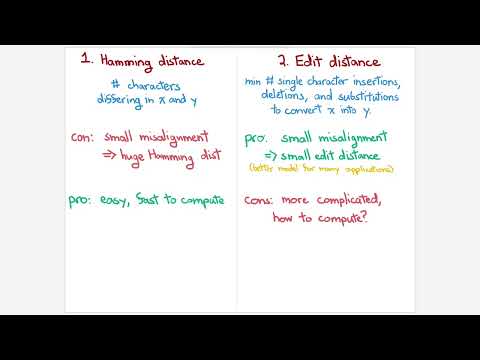
- Edit distance is the minimum number of insertions, deletions, and replacements needed to transform one string into another; unlike Hamming distance, it handles unequal lengths and shifts.
- A correct but exponential edit-distance recursion considers the three possible first edits; memoizing suffix pairs reduces the number of distinct subproblems to O(mn).
- Dynamic-programming runtime is found by multiplying the number of distinct subproblems by the work per subproblem; edit distance has O(mn) states with constant nonrecursive work each.
- The cost of multiplying an n₁ × n₂ matrix by an n₂ × n₃ matrix is O(n₁n₂n₃), so matrix-chain parenthesization can dramatically affect total computation.
- For matrix-chain multiplication, each optimal interval solution has a final split into two consecutive intervals; testing all splits across O(k²) intervals yields an O(k³) algorithm.
Chapters
0:00
String Distance Applications: Git Diff and DNA Sequences
- Git’s diff functionality compares lines to highlight changes; the lecture uses it to motivate measuring differences between strings.
- Computational biology compares DNA sequences over the alphabet A, C, G, and T to study similarity among people, species, and viruses.
- Pairwise sequence similarity can support tasks such as tracing lineage and reconstructing evolutionary relationships.
3:15
Hamming Distance and Error-Correcting Codes
- Hamming distance counts character positions that differ and is most directly applicable to strings of equal length.
- The lecture connects Hamming’s work on coding theory to digital signals, where error-correcting codes can recover messages despite flipped bits.
- A character shift can make two intuitively similar strings appear far apart under position-by-position comparison.
5:45
Edit Distance: Insertions, Deletions, and Replacements
- Edit distance is the minimum number of insertions, deletions, and replacements needed to transform one string into another.
- Moving a character can cost two edits—delete it at its original position and insert it at its new one.
- Unlike Hamming distance, edit distance accommodates strings of different lengths and small misalignments.
7:00
Metric Properties and the Triangle Inequality
- A distance metric is nonnegative, zero only for identical objects, symmetric, and subject to the triangle inequality.
- For edit distance, reversing a transformation swaps insertions with deletions, establishing symmetry.
- Concatenating an edit sequence from X to Z with one from Z to Y gives a valid X-to-Y transformation, proving the triangle inequality.
11:14
Why Edit Distance Models Misalignment Better Than Hamming Distance
- A small shift can produce a large Hamming distance because every later character may become positionally mismatched.
- Edit distance can better model a dropped DNA letter or a line of code moved elsewhere in a file.
- Hamming distance remains easy to compute with a single scan, while edit distance requires finding a minimum over possible transformations.
14:00
Searching for a Correct Recursive Edit-Distance Algorithm
- Global character counts or matching visible chunks do not reliably determine the best alignment.
- Greedy matching can fail when early choices prevent better matches later in the strings.
- The lecture shifts from heuristics to a conservative strategy: consider all possible first edit operations and recurse.
19:27
Edit-Distance Specification and Empty-String Base Cases
- Define a recursive function on strings X and Y that returns their minimum number of edit operations.
- If X is empty, the distance is the length of Y; if Y is empty, it is the length of X.
- These base cases let the recursion terminate as edits consume characters from the strings.
23:17
Three First-Character Choices for Edit Distance
- When the first characters differ, an optimal transformation must handle the mismatch through deletion, insertion, or replacement.
- Each choice costs one edit and reduces the problem to a smaller pair of suffixes.
- When the first characters match, the algorithm can advance past both; taking the minimum across available choices preserves correctness.
30:00
The Exponential Recursion and Its Repeated Subproblems
- The straightforward recursive algorithm explores up to three choices at each mismatch, producing exponential work in the string lengths.
- Many different edit sequences reach the same pair of remaining suffixes, so the recursion repeatedly solves identical subproblems.
- Caching each subproblem’s answer avoids repeating that work without changing the recursive definition.
40:30
Memoizing Suffix Pairs Produces an O(mn) Algorithm
- Index each subproblem by suffix starting positions i and j, making it straightforward to store answers in a two-dimensional array.
- There are at most m choices of i and n choices of j, so only O(mn) distinct subproblems arise.
- Each memoized subproblem performs constant work apart from its recursive calls, giving O(mn) total running time.
45:00
Dynamic-Programming Solution Expectations and Proofs
- The core of a dynamic-programming solution is a clear recursive specification with a manageable number of distinct subproblems.
- The cache or memoization layer is mechanical; the important work is defining subproblems, transitions, and base cases.
- Correctness is usually proved by induction, and runtime follows by counting subproblems and the work per subproblem.
55:21
Matrix Multiplication Cost Depends on Parenthesization
- Multiplying an n₁ × n₂ matrix by an n₂ × n₃ matrix takes O(n₁n₂n₃) arithmetic operations with the standard method.
- For three compatible matrices, multiplying the first pair and multiplying the last pair can have very different costs.
- Matrix-chain multiplication asks for the parenthesization that minimizes total scalar operations while preserving matrix order.
1:00:00
Parenthesization Trees Reveal Matrix-Chain Subproblems
- Trying every possible next adjacent multiplication is correct but creates many intermediate states as matrices are combined in different orders.
- Every valid parenthesization forms a binary tree, and its top-level split identifies the final multiplication.
- Once that final split is chosen, the matrices on its left and right form two independent consecutive-interval subproblems.
1:07:00
Interval Recurrence and the O(k³) Matrix-Chain Algorithm
- Define a subproblem for the minimum cost of multiplying a consecutive interval of matrices Aᵢ through Aⱼ.
- Try every split point k, adding the optimal costs of the left and right intervals to the cost of multiplying their resulting matrices.
- There are O(k²) intervals and up to O(k) split choices per interval, giving O(k³) time for k matrices.
Summary, takeaways, and chapters were generated by AI from the video's transcript and may contain errors. The video belongs to its creator, Kent Quanrud.