EDF9850_Unit4_Review_Part1
 Watch on YouTube →
Overview
Lesa Hoffman reviews Unit 4 multilevel modeling, emphasizing how to interpret cross-level interactions, specify random slopes, separate within- and between-cluster effects, and choose between maximum likelihood and REML. R/Shiny demonstrations and a teacher–student intervention example show why small cluster counts, predictor centering, and model structure affect inference; the review also walks through writing and interpreting the corresponding equations.
Key takeaways
- In a multilevel model, a random slope describes how a level-one relationship varies across clusters; omitting it can inflate Type I error for both that slope and its cross-level interactions.
- More clusters increase power to detect random-slope variance, while a stronger slope-variance signal also improves detection; with only 25 clusters, weak signals are difficult to identify.
- For small-cluster linear mixed models, REML helps prevent random-effect variance underestimation that can otherwise produce overly small standard errors and p-values; REML is unavailable for generalized outcome models.
- A raw level-one predictor can combine within-cluster and between-cluster relationships; cluster-mean centering separates the within effect, while adding the cluster mean models the between effect.
- Centering a predictor at a meaningful value, such as ability 100, makes model intercepts and reference slopes interpretable and can avoid estimating effects at implausible predictor values.
- A cross-level interaction's sign cannot be interpreted without its reference slope: a positive interaction strengthens a positive slope, whereas a negative interaction weakens it.
Chapters
0:00
Course Announcements: Enrollment Survey and New SEM Offering
- Lesa Hoffman asks College of Education students to complete a course survey because classes may be canceled if enrollment falls below eight.
- A new structural equation models course is planned for spring, with one scheduled meeting hour and two asynchronous hours each week.
- Hoffman is also planning to teach multiple regression on Monday nights in the following block.
4:00
Unit 4 Schedule Changes, Assignments, and Project Feedback
- Hoffman moves the syllabus schedule back one week and says the optional third lecture video will cover estimation and matrix details.
- Project-plan feedback is available through document links in the homework portal; students should report file-not-found errors caused by naming issues.
- Homework 2 is due the following week, Activity 5 moves up to next class, and Homework 3 is planned for release the next day.
- The schedule now gives Unit 4 one extra week, compresses cross-classified models into one class, and leaves presentation dates flexible.
8:00
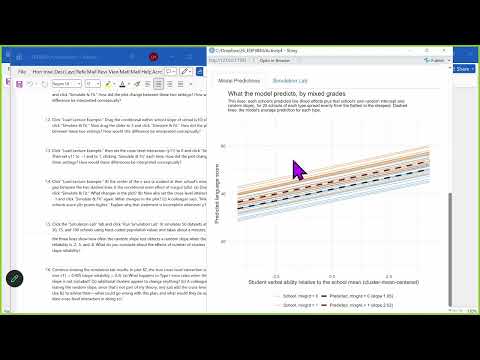
Activity 4 Shiny App: Random-Slope Variance and Group Slopes
- Increasing random-slope variance makes cluster-specific lines more different; setting it to zero makes lines parallel within each group.
- With mixed grades coded as the moderator, the within-slope main effect describes the reference group, while the cross-level interaction changes the other group's slope.
- A positive interaction strengthens a positive reference slope; a negative interaction weakens it, so the interaction's meaning depends on the main-effect sign.
11:00
Reading Mixed-Grade Interactions from Predicted Lines
- The mixed-grade main effect describes the gap between groups when the within-person predictor is zero.
- When the cross-level interaction is present, that group gap changes across the predictor, so one school type may not be better for every student.
- With the interaction set to zero, the gap remains constant and the main effect supports a consistent group difference.
18:00
Shiny Simulation: Slope Reliability and Cluster Sample Size
- Hoffman cautions that the slope-reliability formula is a descriptive approximation and may fail with multiple correlated random slopes.
- The simulation shows that more clusters increase power to detect random-slope variance because that variance represents a cluster-level characteristic.
- A stronger slope-variance signal improves detection; with only 25 clusters, detection is poor when the signal is weak.
22:00
Why Omitting a Random Slope Inflates Cross-Level False Positives
- When the true cross-level interaction is zero, a model that omits the associated random slope produces excessive Type I error.
- Including the random slope yields larger standard errors for its level-one fixed effect and related cross-level interactions.
- More clusters improve the chance of detecting the random slope and selecting the model that preserves the intended Type I error rate.
- With roughly 10–50 clusters, Hoffman advises caution about dropping borderline random slopes based only on significance.
28:00
ML Versus REML: Small-Cluster Variance Estimation
- Maximum likelihood can underestimate random-effect variances in small samples; REML adjusts for the fixed effects estimated in the model.
- Underestimated random-effect variance can produce overly small standard errors and p-values, increasing Type I error risk.
- The amount of ML underestimation depends on both the number of clusters and the number of fixed effects; Hoffman recommends defaulting to REML when applicable.
- REML and ML generally leave fixed-effect estimates similar, but REML improves random-effect variance estimates.
34:00
When REML Is Unavailable and Why Estimation Still Matters
- REML is not available for generalized models, such as models for categorical outcomes or proportions, or for structural equation models.
- A beta-binomial model for the proportion of people who quit must use maximum likelihood rather than REML.
- For ordinary regression, lme4's linear mixed-model machinery can reproduce ordinary least squares estimates.
36:00
Teacher Intervention Example: Diagnose Estimation and Fixed Effects
- The formative-assessment scenario assigns an intervention to teachers, placing treatment at level two and students at level one, with only 20 teachers.
- Hoffman recommends REML for this small-cluster linear mixed model because ML may underestimate variance and make tests for the ability slope or its treatment interaction too optimistic.
- A raw student-ability predictor combines within-teacher and between-teacher information, making the model's effects difficult to interpret.
40:00
Fixing Smooshed Effects: Random Slopes and Ability Centering
- The teacher–student model needs a random slope for the level-one ability predictor, not merely a random intercept.
- Adding a random slope for uncentered ability can reproduce the same within/between conflation as the fixed slope and impose an unintended variance pattern.
- Cluster-mean centering, ability minus the teacher's mean ability, isolates student-to-student differences within a teacher.
- Constant-centering ability at 100 makes the intercept refer to a student of average ability instead of a student with an implausible score of zero.
47:00
Building the Multilevel Model with Within- and Between-Teacher Ability
- The within-teacher ability slope can vary by treatment group through a cross-level interaction between centered student ability and group.
- Adding teacher-level mean ability and its treatment interaction allows between-teacher ability differences to have distinct effects across groups.
- Cluster-mean centering applies to level-one predictors; at the highest modeled level, Hoffman uses constant centering rather than cluster-mean centering.
- A three-way interaction is optional and addresses whether the ability-by-peer-ability relationship itself differs by treatment.
53:30
Writing Multilevel Equations with Word’s Equation Editor
- Hoffman demonstrates opening Word's equation editor with Alt+= and using underscores and backslash commands for subscripts and Greek letters.
- The level-one equation includes the fixed intercept, the within-teacher centered-ability predictor, and a level-one residual.
- Two level-two equations are needed for the level-one intercept and ability slope; their terms encode teacher mean ability, treatment, and interactions.
- In the equation notation, every term in a given equation starts with the same beta index because those terms jointly predict that beta.
1:05:00
Interpreting Ability Slopes, Treatment Moderation, and Three-Way Terms
- The within-teacher ability main effect is the reference slope for a control-group teacher whose class mean ability is 100.
- A group-by-within-ability term tests whether the effect of a student's ability relative to classmates differs between treatment and control.
- A three-way interaction tests whether an ability-by-peer-ability relationship changes across treatment groups; it was not required by the assessment prompt.
- Hoffman distinguishes cluster-mean-centered models, which isolate within effects, from constant-centered models, which require corresponding cluster means to separate within and between effects.
1:12:00
Centering Choices, Contextual Effects, and Break
- Using raw ability at level one requires including the corresponding teacher-level mean to avoid forcing within- and between-teacher slopes to be equal.
- Using cluster-mean-centered ability without its teacher mean instead assumes the between-teacher effect is zero.
- With raw ability and the teacher mean in the model, the level-two coefficient represents a contextual effect: the between association relative to the within association.
- Hoffman closes this review section at about 73:46 and schedules a seven-minute break before addressing remaining questions.
Summary, takeaways, and chapters were generated by AI from the video's transcript and may contain errors. The video belongs to its creator, Lesa Hoffman.