ECE1756_lecture2_part2_2026_compute_models
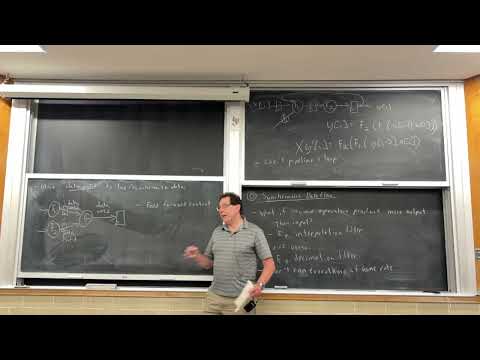 Watch on YouTube →
Overview
Vaughn Betz compares inelastic synchronous data flow, valid-tagged feed-forward control, and elastic streaming data flow for FPGA designs, showing how FIFOs and backpressure handle mismatched rates and variable latency. He then explains the area-versus-flexibility tradeoffs of configurable operations and FPGA partial reconfiguration, including why reconfiguration can take milliseconds and imposes strict physical and interface constraints.
Key takeaways
- A valid bit identifies whether a data bus contains a usable token, but it does not prevent a fast producer from overwriting data; loss prevention requires backpressure or a rate guarantee.
- Elastic data flow combines FIFOs with ready/backpressure control so variable-latency blocks can pause upstream producers without immediately dropping tokens.
- For short buffers, shift registers are simple, but deeper FIFOs are generally more area- and power-efficient when implemented with RAM and read/write pointers.
- FPGA designs can combine elastic boundaries around unpredictable blocks such as DRAM with efficient inelastic pipelines inside predictable computations.
- Compile-time constants can let Quartus synthesis simplify multipliers and remove logic, while runtime-selectable operations require extra operators and multiplexers.
- Partial reconfiguration can change an FPGA region without shutting down the whole system, but even a small region may take around 1 millisecond and requires compatible placement, wiring, and safe outputs.
Chapters
0:00
Synchronous Data Flow: When Input and Output Rates Differ
- Single-rate synchronous data flow assumes each input token eventually produces one output token at a predictable rate.
- An interpolation filter can turn 200 million samples per second into 400 million by adding samples between inputs.
- A decimation filter can reduce the rate by discarding samples, such as retaining every other sample.
4:00
Valid Bits Mark Which FPGA Data Tokens Can Be Used
- A one-bit valid signal accompanies each data bus; it marks the entire bus as valid or invalid.
- An operator such as G computes only when both input valid bits are set, then marks its output valid.
- Pipeline registers must carry both the data bus and its valid bit so their timing stays aligned.
- This distributed scheme is called feed-forward control because each operator checks its immediate inputs.
9:46
Why Valid-Only Flow Can Still Drop Data
- Valid bits tell G whether its current inputs contain data, but they do not tell F1 or F2 to stop producing tokens.
- If G is busy or one producer is faster, a producer can overwrite data before G consumes it.
- The approach therefore requires carefully chosen rates for F1, F2, and G to avoid dropping tokens.
- Inputs must also arrive in the intended order; valid bits alone cannot match arbitrarily reordered streams.
15:08
Elastic Data Flow Handles Variable Latency and Output Rates
- Dynamic or elastic streaming data flow extends valid-tagged flow with buffering and the ability to stall operators.
- Newton–Raphson iteration may need different numbers of cycles for different inputs, while DRAM response times can vary.
- Huffman encoding produces variable-length output because common symbols use shorter codes than rare symbols.
- Worst-case timing can handle variation, but may force the whole design to run less efficiently.
20:00
FIFOs and Backpressure Prevent Token Loss
- FIFOs between F1, F2, and G retain tokens while a downstream operator is busy; G consumes the oldest entries.
- A ready or backpressure signal tells an upstream operator when it must stop sending data.
- Backpressure should assert before a FIFO is full, leaving room for tokens already in flight.
- With a five-cycle pipeline, control must account for up to five additional cycles of data unless pipeline registers can be stalled.
25:45
Stalling Pipelines and Paying for Elasticity
- Elastic flow can stall operators under backpressure, whereas the earlier inelastic pipelines cannot pause.
- If a design can guarantee that backpressure is never needed, valid-only inelastic flow is more area-efficient.
- FIFO depth depends on how long downstream stalls last and how much data remains in flight.
- A stallable pipeline can hold its registers when backpressure arrives, reducing the amount of advance warning required.
29:20
Implementing FPGA FIFOs with Registers or RAM
- Small FIFOs can use shift registers and multiplexers, but moving wide words through many stages costs area and power.
- For deeper buffers, RAM plus read and write pointers is typically more efficient than a large shift-register FIFO.
- FIFO sizing can absorb brief slowdowns and preserve average throughput, but prolonged stalls eventually propagate upstream.
- FPGA tools such as Intel Quartus and AMD Vivado provide FIFO IP cores, including configurable word widths and depths.
35:35
Combining Elastic Boundaries with Efficient Inelastic Pipelines
- Designers can use FIFOs and backpressure around a variable-latency block, such as a DRAM interface, while keeping predictable internal computations inelastic.
- Buffers can hide occasional slow responses; if delays persist, full FIFOs eventually backpressure earlier stages.
- Worst-case delay requirements make buffering less useful than average-throughput requirements do.
- Choosing which regions need elasticity avoids paying FIFO and control overhead throughout the entire design.
42:15
Streaming Data Flow with Allocation Adds Runtime Flexibility
- Streaming data flow with allocation allows operations or connections to change over time.
- One option is to build multiple operators, such as square root and exponential units, then select between them with a multiplexer.
- A more general operator can accept runtime parameters, such as A, B, and C for computing ax² + bx + c.
- Both approaches add hardware to gain flexibility compared with a fixed, static dataflow graph.
48:55
Fixed FPGA Coefficients Enable Stronger Synthesis Optimization
- A fixed-coefficient quadratic can use less area and run faster than a general version whose coefficients arrive as runtime inputs.
- Quartus synthesis can simplify multiplication by constants by eliminating logic associated with constant zero and one bits.
- Selecting between complete operators requires implementing both circuits and a bus-wide multiplexer, which can be costly.
- The best choice depends on whether the application needs runtime flexibility or can use compile-time specialization.
52:30
Full and Partial FPGA Reconfiguration Have Different Downtime
- Full FPGA reconfiguration reloads configuration bits that control routing and lookup tables, typically taking about 100 milliseconds.
- At 100 MHz, 100 milliseconds spans 10 million clock cycles, so a continuously running system cannot casually discard that much input data.
- Partial reconfiguration changes only a region of the FPGA and is supported by high-end devices, but takes time proportional to the region's size.
- Even a 1% region may take about 1 millisecond to reconfigure, ruling out switching operations from one clock cycle to the next.
59:00
Telecom Routers Use Partial Reconfiguration for Protocol Changes
- High-bandwidth telecom systems aggregate inputs using protocols such as Ethernet and SONET before sending data over optical links.
- Routers may need to add, remove, or change customer protocols without taking the entire system offline.
- Partial reconfiguration can replace an input-processing region while other traffic continues through the FPGA.
- This is useful when a configuration remains active for days or months, rather than changing for each incoming token.
1:03:30
Partial Reconfiguration Requires Matched Placement and Safe Interfaces
- Alternative blocks such as F1 and F1′ must fit in the same reserved physical region and use compatible FPGA resources.
- Matching logical input and output signals is not enough: the blocks must connect through the same physical wires at the region boundary.
- Downstream logic must receive safe values during reconfiguration; valid outputs can be forced low so consumers ignore transitional data.
- Partial reconfiguration is a specialized option because it is slower than cycle-by-cycle switching and makes CAD and RTL design more constrained.
Summary, takeaways, and chapters were generated by AI from the video's transcript and may contain errors. The video belongs to its creator, Vaughn Betz.