Earth's Crust and Mantle Explained: Crash Course Geology #3
 Watch on YouTube →
Overview
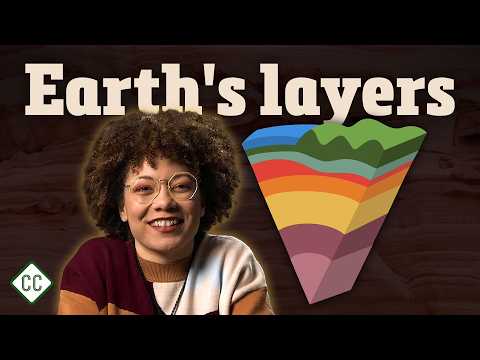
Crash Course Geology #3, hosted by Sage, explores Earth's crust and mantle, detailing early attempts like Project Mohole and the Kola Superdeep Borehole to penetrate these layers. The video explains the composition and structure of the crust, its tectonic plates, and the mantle's distinct layers (asthenosphere, transition zone, lower mantle), emphasizing how seismic waves and meteorite analysis provide insights into Earth's interior.
Key takeaways
- The Kola Superdeep Borehole (12.2 km) and Project Mohole were pioneering but ultimately limited attempts to explore Earth's interior.
- Earth's crust, primarily oxygen and silicon, forms tectonic plates, while the mantle, rich in iron and magnesium, drives plate tectonics through convection.
- The mantle exhibits distinct layers: the upper mantle, transition zone, and lower mantle, with increasing temperature, pressure, and density.
- Seismic wave analysis, volcanic ejecta, and studies of meteorites (like those containing bridgmanite) are crucial methods for understanding Earth's deep structure.
- Recent expeditions, like the JOIDES Resolution drilling in 2023, have retrieved mantle samples that offer clues to the origin of life.
- Despite technological limitations, ongoing research continues to expand knowledge of Earth's interior and its connection to surface processes.
Chapters
0:00
Early Exploration Attempts: Kola Superdeep Borehole and Project Mohole
- The Kola Superdeep Borehole in Russia reached 12.2 km, barely scratching Earth's surface.
- Project Mohole aimed to drill through the crust to the Mohorovicic discontinuity.
- Early scientific speculation included hollow Earth models and subterranean worlds.
- Project Mohole faced challenges with drilling technology and funding, ultimately dissolving.
5:38
Earth's Crust and Mantle: Composition and Structure
- Earth's crust, 1.4% of total volume, is composed of oxygen, silicon, aluminum, iron, and calcium in tectonic plates.
- Continental crust is thicker (up to 70 km) than oceanic crust (5-10 km).
- The mantle, 84% of Earth's volume (2,900 km deep), generates convection currents driving tectonic plates.
- The lithosphere includes the crust and upper mantle; the asthenosphere is a hotter, stretchy part of the mantle.
8:51
Mantle Layers and Internal Exploration Methods
- The upper mantle (up to 410 km) is greenish-black due to olivine.
- The mantle transition zone (410-660 km) features mineral rearrangement and color changes due to pressure.
- The lower mantle (660-2700 km) has less flow and contains large continental-sized blobs (Tuzo and Jason).
- Geologists study Earth's interior using seismic waves, volcanic rock samples, and iron meteorites (like bridgmanite).
Summary, takeaways, and chapters were generated by AI from the video's transcript and may contain errors. The video belongs to its creator, CrashCourse.