Ear Infections | Clinical Medicine
 Watch on YouTube →
Overview
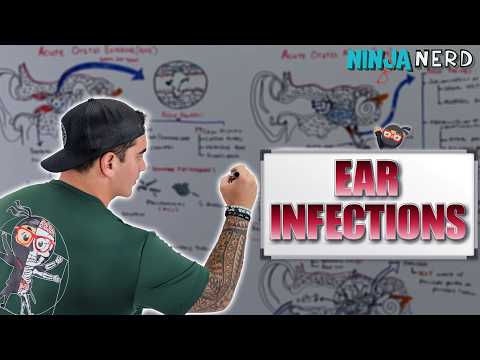
Ninja Nerd's comprehensive lecture details the diagnosis, complications, and treatment of ear infections, specifically acute otitis externa (AOE) and acute otitis media (AOM). The presentation emphasizes the pathophysiology of each, including the breakdown of the skin-cerumen barrier in AOE leading to bacterial overgrowth and the Eustachian tube dysfunction in AOM causing fluid buildup and infection. Key complications discussed include hearing loss, mastoiditis, cholesteatoma, labyrinthitis, and CNS infections, with diagnostic approaches like otoscopy and the HINTS exam highlighted.
Key takeaways
- Acute Otitis Externa (AOE) stems from a compromised skin-cerumen barrier, often due to moisture or injury, leading to bacterial overgrowth, primarily Pseudomonas.
- Acute Otitis Media (AOM) is frequently triggered by viral URIs causing Eustachian tube dysfunction, leading to middle ear effusion and secondary bacterial infection by pathogens like Streptococcus pneumoniae.
- Complications like mastoiditis, cholesteatoma, labyrinthitis, and CNS infections require aggressive management, often involving IV antibiotics, surgical intervention, and advanced imaging (CT/MRI).
- The HINTS exam is crucial for differentiating peripheral vertigo (e.g., labyrinthitis) from central causes (e.g., stroke) in patients presenting with acute vertigo and nystagmus.
- Treatment decisions for AOM, particularly antibiotic use in pediatric patients, depend on age, symptom severity, laterality, and presence of risk factors like TM perforation or cochlear implants.
Chapters
0:00
Introduction to Ear Infections: AOE and AOM
- Ear infections are categorized into acute otitis externa (AOE) and acute otitis media (AOM).
- Inner ear infections like labyrinthitis are often complications of AOM.
- Pediatric populations are particularly susceptible to ear infections.
1:33
Pathophysiology of Acute Otitis Externa (AOE)
- AOE is an infection of the external ear canal (external acoustic meatus).
- Triggered by a breakdown in the skin-cerumen barrier, allowing bacteria to thrive.
- Inflammation leads to swelling, fluid trapping, and an alkaline environment conducive to bacterial growth.
9:55
Risk Factors for AOE: Moisture and Skin Injury
- Excessive moisture from swimming or humid climates compromises the cerumen barrier.
- Skin injury from cotton swabs, hearing aids, or scratching can create entry points for bacteria.
- Pseudomonas is a common pathogen associated with moist environments.
13:20
Common Pathogens in AOE
- Pseudomonas aeruginosa is the most common pathogen.
- Staphylococcus aureus is another common pathogen, often from skin flora.
- Antibiotic choice is guided by pathogen identification (e.g., aminoglycosides or fluoroquinolones for Pseudomonas).
15:38
Anatomy and Pathophysiology of Acute Otitis Media (AOM)
- AOM involves infection of the middle ear.
- The Eustachian tube connects the middle ear to the nasopharynx, equalizing pressure and draining secretions.
- Obstruction or inflammation of the Eustachian tube leads to decreased ventilation, negative pressure, and fluid accumulation (effusion).
25:03
Triggers for Eustachian Tube Dysfunction
- Viral upper respiratory tract infections (e.g., adenovirus, rhinovirus) are the most common trigger, causing inflammation.
- Allergic rhinitis and rhinosinusitis can also cause inflammation.
- Anatomical obstructions like nasal polyps or enlarged adenoids can physically block the Eustachian tube.
29:01
Pediatric Predisposition to AOM
- Pediatric patients have a higher risk due to a more horizontal, less rigid, and shorter Eustachian tube.
- This anatomy facilitates obstruction, poor drainage, and increased susceptibility to infection.
- Combined with URIs or allergies, the risk for AOM is significantly elevated in children.
33:20
AOM: Tympanic Membrane Changes and Effusion
- Initial negative pressure can cause tympanic membrane (TM) retraction.
- Accumulating effusion and pressure eventually lead to TM bulging.
- A bulging TM is a critical finding for diagnosing AOM.
35:10
Common Pathogens in AOM: Mixed Infections
- AOM is often a mixed infection, involving both viral triggers and secondary bacterial superinfection.
- Common bacterial pathogens include Streptococcus pneumoniae (gram-positive), Haemophilus influenzae (H. flu, non-typeable), and Moraxella catarrhalis (gram-negative diplococcus).
- Consideration of anaerobes is also important.
39:12
Clinical Presentation of AOE
- Primary symptom is otalgia (ear pain) due to inflammation and edema of the ear canal.
- Pain is often exacerbated by pulling the pinna or pushing the tragus.
- Otorrhea (drainage from the ear canal) may be present; its presence suggests AOE or a TM perforation in AOM.
43:50
Otoscopic Findings in AOE
- Characterized by a red, inflamed, and edematous ear canal.
- The tympanic membrane (TM) is typically normal or may be obscured by swelling and debris.
- Normal TM appearance is key to differentiating from AOM.
45:51
Malignant Otitis Externa (MOE)
- A severe complication of AOE, extending into bone tissue.
- High-risk patients include uncontrolled diabetics and the immunocompromised.
- Caused primarily by Pseudomonas aeruginosa, leading to osteomyelitis of the skull base.
1:06:42
Complications of AOE: Hearing Loss
- Swelling and edema of the external acoustic meatus obstruct sound conduction.
- This causes conductive hearing loss, which is usually temporary and resolves with treatment.
- Weber test lateralizes to the affected ear; Rinne test is negative (bone conduction > air conduction).
1:15:00
Malignant Otitis Externa (MOE) Pathophysiology and Presentation
- Pseudomonas aeruginosa invades bone via fissures of Santorini, causing osteomyelitis.
- Symptoms include severe, nocturnal ear pain, fever, cranial nerve VII palsy, and granulation tissue on otoscopy.
- Involves skull base, mastoid process, and potentially TMJ.
1:27:23
Complications of AOM: Conductive Hearing Loss
- Caused by decreased TM mobility and middle ear effusion.
- Effusion impedes stapes vibration and oval window tapping, reducing inner ear stimulation.
- Weber test lateralizes to the affected ear; Rinne test is negative.
1:35:18
Mastoiditis: A Complication of AOM
- Infection spreads from the middle ear to the mastoid air cells, causing inflammation and destruction of bony septa.
- Leads to a coalescent cavity filled with pus.
- Clinical signs include postauricular swelling, tenderness, and erythema, pushing the ear outward and forward.
1:43:44
Cholesteatoma: Formation and Consequences
- Develops from retraction pockets in the TM due to chronic Eustachian tube dysfunction and negative middle ear pressure.
- Keratin debris accumulates, eroding into the middle ear, ossicles, and mastoid sinus.
- Causes conductive deafness, mastoiditis, and foul-smelling otorrhea.
1:55:00
Tympanic Membrane Perforation: A Complication of AOM
- High middle ear pressure from AOM can cause TM perforation.
- Classic presentation: otalgia followed by sudden relief of pressure and otorrhea.
- Contributes to conductive hearing loss.
1:58:50
Labyrinthitis: Inner Ear Infection
- Inflammation of cochlea and vestibule, often spreading via round or oval window from AOM.
- Causes vestibular dysfunction (vertigo, nystagmus) and cochlear dysfunction (hearing loss, tinnitus).
- Results in sensorineural hearing loss; Weber test lateralizes to the good ear, Rinne test is positive.
Summary, takeaways, and chapters were generated by AI from the video's transcript and may contain errors. The video belongs to its creator, Ninja Nerd.