Dynamics, Lectures 7 & 8: Oxford Mathematics 1st Year Student Lecture
 Watch on YouTube →
Overview
This lecture introduces 2D motion using polar coordinates, deriving the acceleration vector in terms of radial and angular components. It then extends Newton's second law to conservative forces in 3D, establishing conservation of energy and the work-energy theorem. The lecture also defines angular momentum and torque, proving that central forces conserve angular momentum and constrain motion to a plane, and introduces constraint forces and their impact on energy conservation, using examples like a snowboarder and a simple pendulum.
Key takeaways
- In polar coordinates, acceleration has radial and angular components: a_r = r_ddot - r*theta_dot^2 and a_theta = 2*r_dot*theta_dot + r*theta_ddot.
- For a central force F = f(r)er, angular momentum L0 = R x m*R_dot is conserved, and motion is restricted to a plane.
- The quantity R^2 * theta_dot is constant for central forces, directly related to angular momentum conservation.
- Torque tau_P = (R - X) x F is the rotational analog of force, and dL_P/dt = tau_P is Newton's second law for rotation.
- Frictionless constraint forces (like normal forces from surfaces) do no work and do not affect mechanical energy conservation.
- A snowboarder leaves the ground when the normal force N becomes zero or flips sign, indicating the surface can no longer provide the necessary centripetal acceleration.
Chapters
0:00
Introduction to 2D Motion and Polar Coordinates
- Transitioning from 1D to 2D motion, emphasizing the utility of polar coordinates.
- Defining polar coordinates (r, theta) and their relation to Cartesian (x, y).
- Introducing radial (er) and angular (etheta) basis vectors.
1:55
Deriving Basis Vector Derivatives in Polar Coordinates
- Calculating the time derivatives of er and etheta.
- er_dot = theta_dot * etheta
- etheta_dot = -theta_dot * er
5:30
Expressing Acceleration in Polar Coordinates
- Deriving the second derivative of the position vector r_dot_dot.
- r_dot_dot = (r_ddot - r*theta_dot^2)er + (2*r_dot*theta_dot + r*theta_ddot)etheta
- Identifying radial and angular components of acceleration.
10:30
Simplifying the Angular Component of Acceleration
- Recognizing the angular acceleration term can be written as 1/r * d/dt(r^2 * theta_dot).
- Highlighting this as a key simplification for central force analysis.
12:00
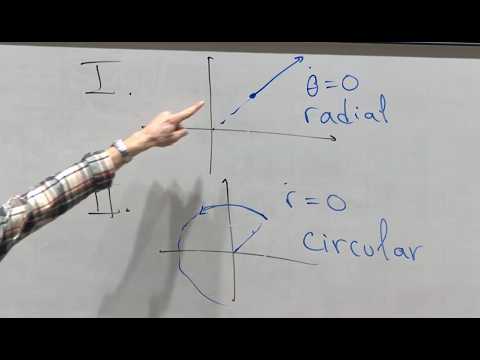
Acceleration in Radial and Circular Motion
- Analyzing acceleration for purely radial motion (theta_dot = 0).
- Analyzing acceleration for circular motion (r_dot = 0, r = R).
- Deriving the centripetal acceleration formula: a = -R*omega^2*er = -v^2/R*er.
16:07
Conservation of Energy in 1D and 3D
- Recalling 1D conservation of energy for conservative forces (F = -dV/dx).
- Extending to 3D: conservative force F = -grad(V).
- Deriving conservation of energy: 1/2*m*|r_dot|^2 + V(r) = constant.
21:30
Work Done by a Force Field
- Defining work as a line integral: W = integral(F . dr).
- Relating work to the change in kinetic energy: W = Delta(T).
- Connecting work to potential energy change for conservative forces: W = -Delta(V).
22:10
Gravitational Potential Energy
- Example: Gravitational force F = -mgk near Earth's surface.
- Deriving the potential energy V = mgz.
- Confirming F = -grad(V) for this case.
24:20
Introduction to Central Forces
- Defining a central force: F is proportional to the position vector R (F = f(r) * er).
- Examples: Gravitational force (inverse square law) and spring force (linear).
- Claim: Central forces constrain motion to a plane.
28:20
Potential Energy for Central Forces
- Relating a central force F(r) to its potential energy V(r).
- V'(r) = -f(r), where F = f(r)er.
- Verifying F = -grad(V) using Cartesian coordinates and chain rule.
30:00
Introduction to Angular Momentum
- Defining angular momentum L_P about a point P: L_P = (R - X) x (m * R_dot).
- Distinguishing linear momentum (p = m*R_dot) from angular momentum.
- Explaining the role of the reference point P (position X).
41:20
Angular Momentum in Radial and Circular Motion
- Angular momentum is zero for purely radial motion (R parallel to R_dot).
- Calculating angular momentum for circular motion about the origin.
- L0 = m * R^2 * theta_dot * ez for circular motion.
48:20
Conservation of Angular Momentum for Central Forces
- Claim: For a central force, angular momentum about the origin is conserved (dL0/dt = 0).
- Proof: dL0/dt = R x F = 0 for central force F.
- Consequence: Motion is constrained to a plane perpendicular to the constant angular momentum vector.
53:20
Motion Restricted to a Plane
- If L0 is non-zero, L0 is orthogonal to R and R_dot at all times.
- This implies R and R_dot always lie in a plane with normal L0.
- If L0 is zero, motion is radial (a line, subset of a plane).
59:00
Angular Momentum and Planetary Motion
- Central force nature of gravity implies planetary orbits are planar.
- Initial position and velocity determine the plane of motion.
- Setting L0 along the z-axis simplifies analysis to 2D polar coordinates.
1:00:00
The Quantity R^2 * theta_dot
- From L0 = m * R^2 * theta_dot * ez, conservation of L0 implies R^2 * theta_dot is constant.
- This quantity, denoted H, is crucial for analyzing central force motion.
- Alternative derivation using polar form of Newton's second law.
1:02:30
Definition of Torque
- Defining torque tau_P about point P: tau_P = (R - X) x F.
- Analogy to tightening a bolt with a wrench (lever arm).
- Torque is the rotational equivalent of force.
1:09:10
Newton's Second Law for Rotation
- Extending Newton's second law to rotational motion.
- Claim: dL_P/dt = tau_P.
- Proof involves differentiating the angular momentum definition and using F = m*R_ddot.
1:15:00
Constrained Systems and Constraint Forces
- Defining constrained motion: particle restricted to a subset of R3 (surface, wire).
- Introduction of constraint forces (e.g., normal force N).
- Focus on frictionless constraints where N is perpendicular to the constraint space.
1:20:20
Work Done by Constraint Forces
- Work done by a frictionless constraint force is zero (N . R_dot = 0).
- Conservation of energy remains valid for systems with only conservative and frictionless constraint forces.
- Friction dissipates energy, breaking conservation of mechanical energy.
1:25:50
Normal Force and Jumping Conditions
- Analyzing the normal force N for a snowboarder on a curved surface.
- N = m*R_ddot + mgk.
- N flips sign (or becomes zero) when the snowboarder leaves the surface (jumps).
1:35:50
Simple Pendulum Dynamics
- Setting up a simple pendulum with mass m, length L, and angle theta.
- Constraint force is tension T in the radial direction (-T * er).
- Newton's second law in polar coordinates: m*a = F_gravity + F_tension.
1:42:10
Pendulum Equations of Motion
- Deriving equations by dotting Newton's second law with er and etheta.
- Equation for tension: -m*L*theta_dot^2 = -mg*cos(theta) - T.
- Equation for angular acceleration: m*L*theta_ddot = -mg*sin(theta).
Summary, takeaways, and chapters were generated by AI from the video's transcript and may contain errors. The video belongs to its creator, Oxford Mathematics.