Dynamics, Lectures 15 & 16: Oxford Mathematics 1st Year Student Lecture
 Watch on YouTube →
Overview
This lecture delves into the dynamics of rigid bodies, introducing the inertia tensor as a key component linking angular momentum to angular velocity. It explores how mass distribution affects rotational inertia using cylinder examples and discusses the intermediate axis theorem for rotational stability. The lecture then transitions to continuous mass distributions and derives the kinetic energy of a rigid body, breaking it down into translational and rotational components. Finally, it applies these principles to solve the problem of a cylinder rolling down an inclined plane and introduces Newton's laws in non-inertial frames, including fictitious forces like Coriolis and centrifugal forces, using a bead on a rotating hoop as a final example.
Key takeaways
- The inertia tensor quantifies how mass distribution affects rotational dynamics, with wider objects having larger inertia for rotation about axes perpendicular to their length.
- The intermediate axis theorem highlights that rotation is stable about the maximum and minimum axes of inertia, but unstable about the intermediate axis.
- Kinetic energy of a rigid body can be decomposed into translational energy of the center of mass and rotational energy about the center of mass.
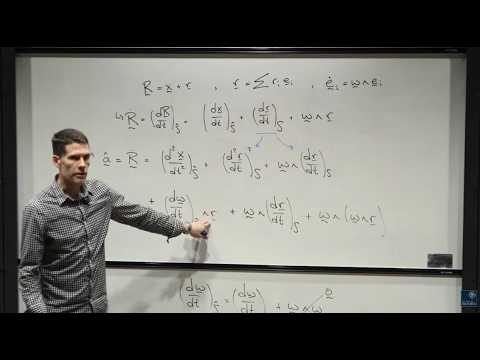
- Fictitious forces (Coriolis, centrifugal, Euler) appear when applying Newton's laws in non-inertial frames, arising from the frame's acceleration and rotation.
- A cylinder rolling down an incline conserves total mechanical energy because the friction force, while necessary for rolling, does no work.
- Choosing an appropriate frame of reference (inertial vs. non-inertial) can simplify problem-solving, trading off complex coordinate transformations for fictitious forces.
Chapters
- Review of notation for center of mass (RG) and position vectors (r, R).
- Derivation of angular momentum (LG) in the form of a matrix times angular velocity (omega).
- Introduction to the inertia tensor (IG) as a matrix representing mass distribution.
- The inertia tensor informs about mass distribution around axes of rotation.
- It relates to how difficult it is to rotate about a given axis.
- Diagonal terms are crucial for understanding rotation about principal axes.
- Comparison of two cylinders with same mass but different dimensions (wider/shorter vs. longer/thinner).
- Focus on diagonal terms of the inertia tensor, particularly the 'C' term.
- The 'C' term (sum of x1^2 + x2^2) is larger for the wider cylinder, indicating more mass spread out in the cross-section.
- Sums over discrete masses (m_i) are converted to integrals over density (rho).
- Total mass (M) becomes the integral of density over volume.
- The inertia tensor calculation shifts from sums to integrals of density and position squared.
- Cylinder rotating only about its axial (E3) axis.
- Angular momentum (LG) is calculated as IG * omega.
- For axial rotation, LG is proportional to the 'C' term of the inertia tensor and omega.
- If angular velocities are equal, the wider cylinder (larger C) has greater angular momentum.
- Alternatively, more torque is needed to spin the wider cylinder to the same angular velocity.
- Analogy to an ice skater tucking arms to spin faster (decreasing C increases omega).
- The inertia tensor connects angular momentum and angular velocity, depending on the axis of rotation.
- The intermediate axis theorem states that rotation about the largest or smallest axis of inertia is stable.
- Rotation about the intermediate axis is unstable, demonstrated with a phone experiment.
- Diagonal terms quantify resistance to rotation about specific axes.
- Off-diagonal terms couple rotations, meaning angular velocity about one axis can induce angular momentum about others.
- These terms arise from asymmetry in mass distribution or non-aligned coordinate systems.
- The inertia tensor is symmetric, allowing it to be diagonalized via a change of basis.
- This means we can always find a set of axes (principal axes) where the inertia tensor is diagonal.
- Off-diagonal terms are often ignored because they can be eliminated by choosing appropriate axes.
- Transitioning from discrete sums to continuous integrals for physical objects.
- The inertia tensor in the continuous limit is an integral over the volume of density times position-squared terms.
- Formula for the inertia tensor: Integral[rho * (r^2 * I - r * r^T) dV].
- Kinetic energy (T) is the sum of kinetic energies of individual particles.
- T = sum(1/2 * m_i * |r_i_dot|^2) in an inertial frame.
- The derivation involves expanding |r_i_dot|^2 and using vector identities.
- Kinetic energy is decomposed into translational (center of mass) and rotational components.
- T = 1/2 * M * |R_G_dot|^2 + 1/2 * L_G . omega.
- The cross-term involving R_G_dot and omega cross r_i integrates to zero due to the center of mass definition.
- The rotational kinetic energy is expressed as 1/2 * L_G . omega.
- Using L_G = I_G * omega, this becomes 1/2 * omega^T * I_G * omega.
- For axial rotation (omega only in E3), T_rot = 1/2 * I_33 * omega_3^2.
- Balance of linear momentum: M * R_G_ddot = F_external.
- Balance of angular momentum: L_G_dot = tau_external.
- These two equations, along with initial conditions, provide a complete description (6 degrees of freedom).
- Setting up coordinate systems: inertial (E1_hat, E2_hat) and body-fixed (E1, E2).
- Relating displacement (x1_hat) to rotation angle (theta) via the no-slip condition: x1_hat = A * theta.
- Inertia tensor for a cylinder is diagonal, with I_33 = M * A^2 / 2.
- Forces: gravity (acting at CM, no torque about CM), normal reaction (no torque about CM).
- Friction force is required to induce rolling and create torque about the CM.
- Friction acts uphill (opposite to motion), creating a torque proportional to F and radius A.
- Linear momentum: M * x1_hat_ddot = M * g * sin(alpha) - F.
- Angular momentum: I_33 * theta_ddot = A * F.
- Eliminating friction (F) and using x1_hat = A * theta yields a single second-order ODE for x1_hat.
- The combined equation of motion simplifies to (M + I_33 / A^2) * x1_hat_ddot = M * g * sin(alpha).
- This results in x1_hat_ddot = (g * sin(alpha)) / (1 + I_33 / (M * A^2)).
- Total energy (kinetic + potential) is conserved, despite the presence of friction, as friction does no work in this rolling scenario.
- Potential energy V = M * g * z_G, where z_G is the vertical position of the center of mass.
- Kinetic energy T = 1/2 * M * x_hat_dot^2 + 1/2 * I_33 * theta_dot^2.
- Substituting I_33 = M*A^2/2 and theta_dot = x_hat_dot/A, T simplifies to 3/4 * M * x_hat_dot^2.
- Total energy TE = 3/4 * M * x_hat_dot^2 - M * g * x_hat * sin(alpha) is conserved.
Summary, takeaways, and chapters were generated by AI from the video's transcript and may contain errors. The video belongs to its creator, Oxford Mathematics.