Dynamics, Lectures 1 & 2: Oxford Mathematics 1st Year Student Lecture
 Watch on YouTube →
Overview
Professor Derek Molton introduces the Oxford Mathematics M4 Dynamics course, aiming to develop a mathematical framework for motion based on Newton's laws, geometry, and vector calculus. The lectures cover fundamental concepts like reference frames, point particles, absolute time, and Newton's three laws of motion, including derivations of velocity, acceleration, and momentum. The course also delves into dimensional analysis and various forces such as gravity, normal reactions, friction, and drag, illustrating their application with examples like projectile motion and terminal velocity.
Key takeaways
- Newton's laws provide a robust mathematical framework for describing everyday motion, forming the foundation for more advanced physics.
- Dimensional analysis is a powerful tool for checking the validity of physical equations and inferring relationships between variables.
- Forces are vector quantities that add up; their net effect determines an object's acceleration according to Newton's second law.
- Gravity near Earth's surface (F=-mgk) is an approximation of the universal law of gravitation (F=-GmM/r²), valid due to large mass and distance differences.
- Drag forces (linear and quadratic) oppose motion and lead to terminal velocity, where the force of gravity is balanced by resistance.
- The distinction between inertial and gravitational mass, though empirically equal, highlights fundamental aspects of how objects interact with forces and fields.
Chapters
- Course objective: develop a mathematical framework for motion.
- Utilizes Newton's laws as ground truth, combined with geometry and vector calculus.
- Addresses situations where Newton's laws are approximations, but foundational for everyday experience.
- Newton's laws are foundational for everyday phenomena, despite being superseded by general relativity and quantum mechanics.
- Applying quantum mechanics to everyday experiments would be overly complex and yield the same results as Newton's laws.
- The course aims for reasonable rigor, using Newton's laws as axioms.
- Dynamics is defined as the motion of objects through space and time.
- Space is considered Euclidean R3, requiring a reference frame (origin and coordinate system) to describe position.
- An object is initially idealized as a point particle with no orientation.
- Time is treated as absolute and the same for all observers.
- Time intervals and distance measurements are agreed upon by all observers.
- This contrasts with Einstein's realization of no absolute space and time, dependent on relative motion.
- Two reference frames, S and S prime, are introduced for measuring the position of a point mass.
- The position vectors R and R prime are related by a translation and/or rotation.
- Orthogonal matrices (R) and translations (X) describe the transformation between frames, with R^T R = I.
- Position vector R(t) has coordinates (x(t), y(t), z(t)).
- Velocity vector V is the time derivative of R (R dot).
- Acceleration is the time derivative of velocity (V dot or R dot dot).
- Particle with constant acceleration Q, initial velocity U, starting at the origin.
- Integrate acceleration twice to find the trajectory R(t).
- R(t) = 1/2 Q t^2 + U t (derived from R dot dot = Q).
- Momentum (P) is defined as mass (m) times velocity (v): P = mv.
- Mass (m) is introduced as inertial mass, a measure of resistance to acceleration.
- A point particle is an idealized object with position and mass.
- In an inertial frame, a particle maintains constant momentum unless acted upon by an external force.
- Constant momentum implies zero acceleration if mass is constant.
- An inertial frame is non-accelerating; a frame where Newton's first law holds.
- Standing still or sliding at constant velocity on ice illustrates Newton's first law (inertial frame).
- A train on a curve or accelerating/decelerating demonstrates non-inertial frames where fictitious forces appear.
- Fictitious forces arise from the acceleration of the reference frame itself.
- In an inertial frame, the rate of change of momentum equals the net external force: F = dP/dt.
- If mass is constant, F = ma, or F = m * R dot dot.
- Mass can change in some scenarios (e.g., shedding a backpack), but is typically assumed constant.
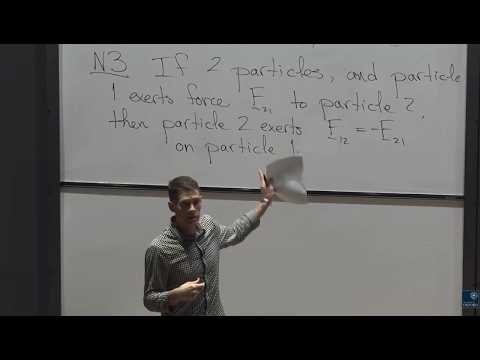
- For every action, there is an equal and opposite reaction.
- If particle 1 exerts force F12 on particle 2, then particle 2 exerts force F21 = -F12 on particle 1.
- Distinguishes between reaction forces (e.g., floor pushing back) and action-reaction pairs (e.g., Earth pulling on person, person pulling on Earth).
- Physical quantities have dimensions (length, time, mass, charge).
- Fundamental dimensions: L (length), T (time), M (mass), Q (charge).
- Quantities can only be combined (added, subtracted) if they have the same dimensions.
- Force dimensions are derived from F = ma: [F] = M * L / T^2.
- SI units: kilograms (M), meters (L), seconds (T).
- A Newton (N) is defined as 1 kg·m/s².
- Arguments of exponentials and trigonometric functions must be dimensionless.
- Example: e^x requires x to be dimensionless, as e^x = 1 + x + x²/2! + ...
- Dimensional analysis can serve as a check for mathematical errors.
- System variables for an object falling from height h under gravity g: t, h, g.
- Assume t = f(h, g), leading to t ~ sqrt(h/g).
- Dimensional analysis predicts the time dependence on h and g, yielding t = α * sqrt(h/g), where α is dimensionless.
- Forces add vectorially: total force F = Σ F_i.
- If acceleration is zero, the net force is zero (Σ F_i = 0).
- Force body diagrams are used to visualize forces acting on an object.
- Force of gravity near Earth's surface: F_g = -mgk.
- g is the acceleration due to gravity (~9.8 m/s²).
- Distinguishes between gravitational mass (interacts with gravity) and inertial mass (resists acceleration); they are empirically equal.
- Force between two masses M and m separated by distance R: F = -G * (Mm/R²) * R_hat.
- G is the universal gravitational constant.
- This is the more general form; the constant g approximation is valid when R is large and the separation distance is small.
- If the only force is gravity (F = -mgk), motion is parabolic or linear.
- Solving R(t) = -1/2 gt²k + vt + R0 for arbitrary initial conditions V and R0.
- Without loss of generality, the coordinate system can be rotated so V lies in the xz-plane, resulting in parabolic trajectory equations.
- Normal reaction force (N) is perpendicular to a surface, pushing back against contact.
- Static friction (f) opposes motion when there is no sliding, up to a maximum of μN.
- μ is the coefficient of friction, determining the maximum static friction force.
- Drag force opposes motion.
- Linear drag: F_drag = -bv (proportional to velocity, e.g., object in syrup).
- Quadratic drag: F_drag = -CD * |v|² * v_hat (proportional to velocity squared, e.g., object in air).
- Terminal velocity occurs when net force is zero (acceleration is zero).
- For linear drag: v_terminal = mg/b.
- For quadratic drag: v_terminal = sqrt(mg/CD).
- In a vacuum, a rock and a leaf dropped from the same height fall at the same rate.
- In air, drag affects objects differently based on mass and surface area.
- Question: What falls faster in air, a rock-shaped leaf or a leaf-shaped rock?
Summary, takeaways, and chapters were generated by AI from the video's transcript and may contain errors. The video belongs to its creator, Oxford Mathematics.