DNA Sequencing, BIO105 Introductory Biology, David Champlin, USM
 Watch on YouTube →
Overview
David Champlin explains how DNA sequencing reads nucleotide letters and connects them to protein sequences, human genetic variation, and evolutionary comparisons. He describes fluorescent chain-terminating dideoxynucleotides in DNA synthesis, gel-based fragment reading, and shotgun sequencing, in which computers assemble overlapping reads—typically about 700 nucleotides each—into much longer sequences.
Key takeaways
- A DNA coding sequence can be translated computationally into a predicted protein’s primary amino acid sequence.
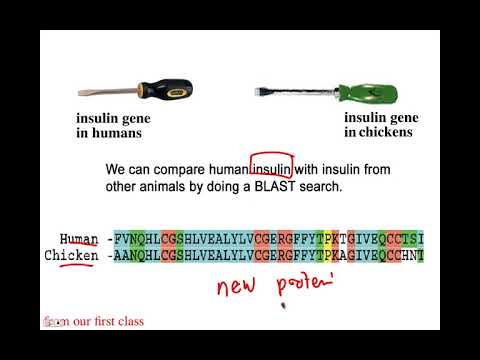
- NCBI BLAST searches let researchers compare DNA sequences across large repositories, including searches for genes and orthologs in other species.
- Fluorescently labeled dideoxynucleotides stop DNA polymerase at different positions, producing labeled fragments that expose the sequence.
- Gel electrophoresis orders fragments by length, while a spectrophotometer reads the fluorescent label that identifies each terminal nucleotide.
- Shotgun sequencing turns short reads of roughly 700 nucleotides into much longer sequences by computationally detecting overlaps among randomly sampled DNA fragments.
Chapters
0:00
DNA Sequences Link Genes, Proteins, and Human Variation
- DNA sequencing reads the nucleotide letters that encode genes; computers can use a coding-region sequence to predict a protein’s primary amino acid sequence.
- Comparing genomes from hundreds or thousands of people helps researchers study alleles across populations and investigate recent human evolution.
- The NCBI BLAST search compares sequences across databases—for example, searching another species’ genome for an insulin gene or an ortholog.
3:53
DNA Polymerase and Fluorescent Chain Terminators Read Bases
- A DNA sequencer runs many DNA-synthesis reactions in tiny test tubes, using DNA polymerase, a template, a primer, and nucleotides.
- Alongside ordinary nucleotides, the reaction contains fluorescently labeled dideoxynucleotides; when one is incorporated, it terminates that DNA strand.
- Millions of reactions produce labeled fragments ending at different positions, creating a set of fragments that reveals the sequence.
8:18
Gel Electrophoresis and Shotgun Assembly Build Long Sequences
- Gel electrophoresis separates DNA fragments by length: shorter fragments travel faster, and a spectrophotometer detects the fluorescent color as each fragment passes.
- Each color identifies the terminating nucleotide, letting researchers infer the DNA sequence from fragments in order of increasing length.
- A sequencing read covers about 700 nucleotides; shotgun sequencing collects many random fragments and computationally joins their overlaps into long contiguous sequences, potentially around 100 million nucleotides.
Summary, takeaways, and chapters were generated by AI from the video's transcript and may contain errors. The video belongs to its creator, The New Evolution for Everyone.