DNA Replication, BIO105 Introductory Biology, David Champlin, USM
 Watch on YouTube →
Overview
David Champlin explains how DNA’s paired bases make strand separation possible and how replication proceeds semi-conservatively: each daughter DNA molecule contains one parental strand and one newly synthesized strand. He traces replication from multiple origins and replication forks through leading- and lagging-strand synthesis, describing DNA polymerase’s requirements, the helper enzymes, and how nucleotide triphosphates supply the energy for DNA assembly.
Key takeaways
- Semi-conservative replication produces daughter DNA molecules that each contain one original strand and one newly made strand.
- Multiple origins of replication let cells copy long chromosomes in parallel; a human chromosome can contain around 100 million nucleotide positions.
- DNA polymerase copies whole chromosomes during replication, while RNA polymerase transcribes selected regions of genes during gene expression.
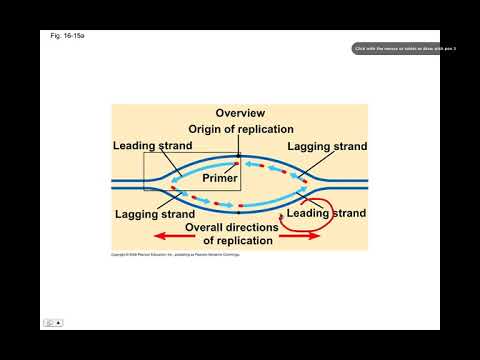
- At each replication fork, antiparallel DNA and polymerase’s directional constraint create a continuously copied leading strand and a repeatedly primed lagging strand.
- DNA polymerase needs a template, a primer, and nucleotide triphosphates; nucleotide phosphate removal supplies energy for DNA strand assembly.
Chapters
0:00
Semi-Conservative Replication Begins at Multiple Origins
- Hydrogen bonds between complementary DNA bases allow the double helix to unzip and expose template strands.
- In semi-conservative replication, each daughter DNA molecule inherits one parental strand and gains one new strand; conservative replication would keep both parental strands together.
- Because a chromosome may contain about 100 million nucleotide positions, replication starts at many sequence-defined origins rather than progressing from one end.
- Origins activate around the G1-to-S transition; DNA polymerase copies chromosomes, unlike RNA polymerase, which transcribes selected gene regions.
4:20
Replication Forks Create Leading and Lagging Strands
- Each replication bubble contains two replication forks, where the parental strands separate and DNA synthesis proceeds.
- DNA’s antiparallel strands and DNA polymerase’s one-way synthesis constrain how each template can be copied.
- The leading strand is copied continuously in the direction the fork opens; the lagging strand is synthesized in sections because its polymerase works opposite the fork’s movement.
- DNA polymerase is processive: it can remain attached to a template and add thousands of nucleotides before dissociating.
7:20
Primers, Enzymes, and Nucleotide Energy Drive DNA Synthesis
- Helicase helps unwind the double helix, while primase makes RNA primers that give DNA polymerase a starting point.
- The leading strand needs a primer relatively rarely, whereas repeated priming starts successive lagging-strand sections; RNA primers are later removed and gaps joined by a final enzyme.
- DNA polymerase requires a DNA template, a primer, and nucleotide triphosphates such as dATP, dGTP, dCTP, and dTTP.
- Removing phosphates from incoming nucleotide triphosphates provides energy for strand synthesis; replication forks continue until they meet neighboring bubbles, and purified components can also reproduce DNA synthesis in a test tube.
Summary, takeaways, and chapters were generated by AI from the video's transcript and may contain errors. The video belongs to its creator, The New Evolution for Everyone.