DNA microarray, BIO105 Introductory Biology, David Champlin, USM
 Watch on YouTube →
Overview
David Champlin explains how DNA microarrays compare gene expression across cell types, despite cells such as brain and pancreas sharing the same DNA. He outlines how differently labeled RNA binds to gene-specific DNA probes on an array, allowing fluorescence measurements to reveal which genes are active in each sample; examples include normal versus cancer cells and treated versus untreated cells.
Key takeaways
- DNA microarrays measure gene expression rather than differences in the cells’ DNA: cells can share a genome while using different subsets of genes.
- Each array spot contains many copies of a DNA probe for one gene, so labeled RNA binding identifies whether that gene is expressed in a sample.
- Using different fluorescent labels for two samples makes it possible to compare their gene expression on the same array.
- A spot that fluoresces in both sample colors indicates expression in both cell types; an unlit spot indicates no detectable expression in either.
- Champlin gives the human genome as containing roughly 25,000–30,000 genes, illustrating why an array can survey thousands of gene-expression targets simultaneously.
Chapters
0:00
Shared DNA, Different Gene Expression
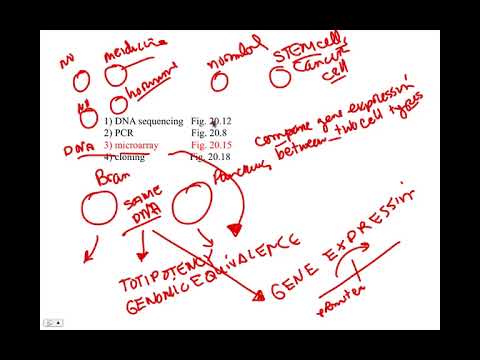
- Brain and pancreas cells contain the same DNA, a concept Champlin connects to genomic equivalence and totipotency.
- Cells differ because they express different subsets of their genes, regulated through gene promoters and transcription.
- Microarrays can compare many conditions, including normal versus cancer cells, normal versus stem cells, or cells exposed to a medicine or hormone.
2:30
Labeling RNA and Hybridizing It to a Gene-Probe Array
- RNA is purified from each sample because it represents genes being expressed; the samples receive different fluorescent labels, such as yellow and red.
- The labeled material is mixed and incubated with an array containing DNA probes for individual genes, such as insulin, hemoglobin, ATP synthase, and the LDL receptor.
- A human array can include probes representing roughly 25,000–30,000 genes, enabling researchers to examine many genes at once.
5:30
Reading Fluorescence to Compare Gene Activity
- Labeled RNA binds to matching DNA probes through complementary base pairing, or annealing; excess material is washed away afterward.
- A spectrophotometer measures fluorescence at each spot: a sample-specific color indicates expression in that sample, while mixed colors indicate expression in both.
- In the normal-versus-cancer example, green and red labels distinguish the samples; dark spots indicate genes not expressed in either cell type.
Summary, takeaways, and chapters were generated by AI from the video's transcript and may contain errors. The video belongs to its creator, The New Evolution for Everyone.