Dihybrid Crosses, BIO105 Introductory Biology, David Champlin, USM
 Watch on YouTube →
Overview
David Champlin explains how allele relationships depend on which alleles are paired, then applies Mendelian segregation and independent assortment to crosses involving two traits. He contrasts unlinked genes, which produce the classic 9:3:3:1 dihybrid phenotype ratio, with linked genes that tend to be inherited together; rare meiotic recombination can create recombinant phenotypes and help map genes on chromosomes.
Key takeaways
- Dominance is not an absolute property of an allele: the same allele can be recessive, dominant, or incompletely dominant depending on its partner allele.
- Genes on separate chromosomes typically assort independently, giving a 9:3:3:1 phenotype ratio in a classic dihybrid cross with complete dominance.
- Linked genes on the same chromosome are usually inherited together, so parental trait combinations are more common than combinations predicted by independent assortment.
- Meiotic crossing over can generate rare recombinant combinations of linked alleles without creating new mutations.
- Recombination frequencies provided geneticists a way to map gene positions along chromosomes.
Chapters
0:00
Allele Pairings, Dominance, and Pleiotropic Effects
- Dominance is a relationship between alleles: an allele recessive to one partner may be dominant or incompletely dominant when paired with a different allele.
- Champlin uses purple and white pigment as an example of dominant and recessive alleles, with the recessive allele potentially hidden in a carrier.
- A gene can have pleiotropic effects; an enzyme involved in pigment production may also be needed for another essential pathway, so some allele combinations can be lethal.
3:25
Mendelian Dihybrid Crosses: Independent Assortment Versus Linkage
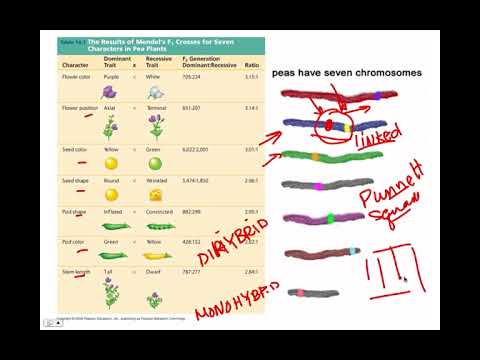
- Gregor Mendel studied seven pea traits located on different chromosomes, allowing them to assort independently during meiosis.
- A dihybrid cross tracks two genes instead of one; for unlinked traits, independent assortment produces the classic 9:3:3:1 phenotypic expectation, compared with 3:1 for a monohybrid cross.
- When two genes occupy the same chromosome, they are linked and tend to travel together, reducing the number of common offspring combinations; Champlin illustrates linked outcomes with a simplified, roughly 3:1 pattern.
6:25
Recombination Creates Rare Phenotypes and Enables Gene Mapping
- Crossing over during meiosis I can exchange chromosome segments and separate linked allele combinations, producing rare recombinant phenotypes.
- Champlin contrasts abundant parental combinations, such as yellow smooth and green wrinkled peas, with uncommon combinations such as yellow wrinkled or green smooth.
- Recombinant outcomes are not necessarily new mutations; their frequency reflects meiotic recombination, which historically helped geneticists infer gene positions along chromosomes.
- The meiosis review emphasizes that homologous chromosomes separate in meiosis I, sister chromatids remain together until meiosis II, and no S phase occurs between the divisions.
Summary, takeaways, and chapters were generated by AI from the video's transcript and may contain errors. The video belongs to its creator, The New Evolution for Everyone.